
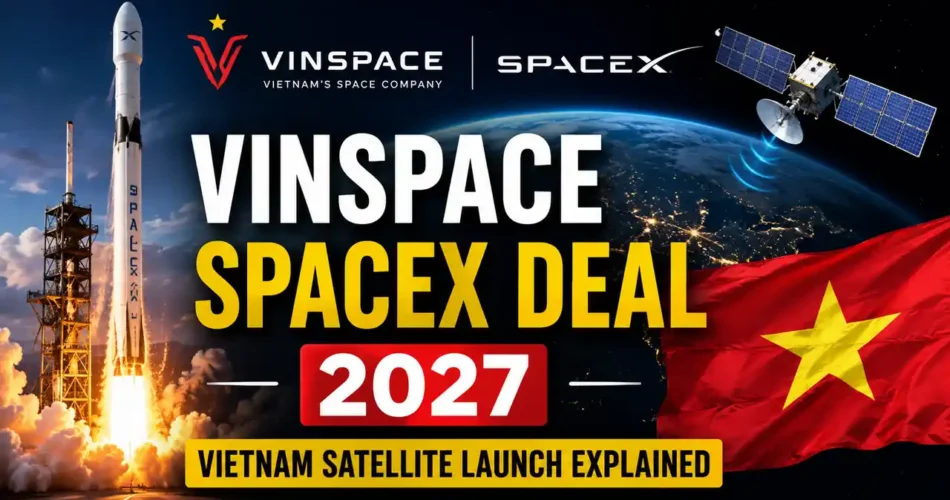
VinSpace Signs Satellite Deal with SpaceX: Vietnam’s Leap into the Commercial Space Age
Vietnam’s private aerospace company VinSpace has signed a landmark contract with SpaceX to launch its first satellites in 2027, marking a significant milestone in the Southeast Asian nation’s ambition to build a domestic space industry. The agreement utilizes SpaceX’s Transporter rideshare program, allowing VinSpace to share launch costs with multiple customers on a single Falcon 9 rocket mission.
Strategic Partnership Details and Launch Timeline
Transporter Rideshare Program Overview
SpaceX’s Transporter rideshare missions represent a cost-effective solution for small satellite operators seeking access to space. The program offers dedicated launches approximately every four months to sun-synchronous orbit (SSO) at 525 km altitude, with pricing starting from $350,000 for 50kg of payload mass. [12] This model has proven successful, having deployed over 1,000 satellites across 22 missions as of mid-2026. [11]
VinSpace will leverage this established infrastructure to deploy its satellites in the second quarter of 2027, joining other commercial and government customers on a shared launch vehicle. The company will handle all aspects of satellite research, development, manufacturing, and in-orbit operations independently.
VinSpace’s Comprehensive Space Value Chain Strategy
The SpaceX contract forms a cornerstone of VinSpace’s broader strategy to become a full-service aerospace company. According to the company’s statement, the agreement supports its long-term plan to develop capabilities across the entire space value chain, including:
- Satellite design and manufacturing
- Assembly, integration, and testing (AIT)
- Launch management and mission operations
- Satellite operations and control
- Space-based data services and applications
VinSpace did not disclose the contract’s financial value or the specific number and technical specifications of the satellites to be launched. However, the company emphasized that these missions will enable technology testing in real orbital conditions, expand international cooperation, and lay the groundwork for future commercial applications.
Vietnam’s Growing Space Industry Ecosystem
Government Support and Regulatory Framework
Vietnam’s space industry development aligns with the government’s strategic vision outlined in the Prime Minister’s 2021 strategy for space science and technology development through 2030. This national strategy aims to:
- Master satellite design, production, and integration technologies
- Develop high-resolution Earth observation capabilities
- Build domestic expertise in satellite control systems and ground stations
- Train approximately 300 experts and 3,000 engineers in space technology by 2030
- Upgrade around 10 specialized research laboratories
The VinSpace-SpaceX partnership represents a practical implementation of these governmental objectives, demonstrating Vietnam’s commitment to reducing dependence on foreign space technology while building indigenous capabilities. [18]
Recent Regulatory Milestones
In April 2026, Vietnam granted SpaceX’s Starlink a license to operate, marking the communist nation’s first trial of large-scale satellite internet connectivity. This regulatory approval preceded the VinSpace announcement and signals Vietnam’s openness to commercial space partnerships while maintaining oversight of critical telecommunications infrastructure.
The dual development—Starlink’s market entry and VinSpace’s satellite launch plans—positions Vietnam to benefit from both immediate satellite internet services and long-term domestic space industry growth. [3]
Technical and Commercial Implications
Small Satellite Market Dynamics
The small satellite rideshare model has transformed access to space for emerging space nations and commercial operators. [16] NASA’s own participation in SpaceX’s rideshare program through its VADR (Venture-class Acquisition of Dedicated and Rideshare) contract demonstrates the model’s credibility and cost-effectiveness for technology demonstration missions. [11][17]
NASA recently expanded its Commercial Satellite Data Acquisition (CSDA) program, awarding contracts to eight new commercial satellite data providers to enhance Earth observation capabilities through public-private partnerships. [13][14] This trend toward commercial data acquisition mirrors VinSpace’s stated goal of developing space-based data services, suggesting potential future market opportunities for the Vietnamese company. [15]
Regional Competitive Landscape
VinSpace’s announcement positions Vietnam among Southeast Asian nations actively developing space capabilities. The company’s unit status within Vingroup, Vietnam’s largest private conglomerate, provides financial backing and industrial expertise that smaller startups lack.
The Transporter rideshare program’s regular cadence—three missions annually to SSO plus two Bandwagon missions to mid-inclination orbits—offers predictable launch opportunities that support systematic capability development. [16] This reliability is crucial for companies like VinSpace that must coordinate satellite manufacturing, testing, and launch preparation across multiple years.
Future Outlook and Commercial Applications
Technology Validation and Commercialization Path
VinSpace’s 2027 missions will serve as critical technology demonstrators, validating the company’s satellite designs and operational capabilities in actual space conditions. Success in these initial missions will enable the company to: [6]
- Refine satellite manufacturing processes
- Develop operational expertise in mission control
- Build credibility with potential commercial customers
- Expand into data services and applications
The company’s statement emphasized that these missions aim to “contribute to the development of a commercial aerospace ecosystem in Vietnam, while connecting Vietnam with the global space value chain.”
Potential Application Areas
While VinSpace has not specified the exact applications for its satellites, Vietnam’s national space strategy identifies several priority areas: [18]
- Earth observation for natural resource management
- Environmental monitoring
- Telecommunications infrastructure
- Positioning and navigation systems
- National security and defense applications
The company’s focus on developing “space-based data services” suggests potential commercial applications in agriculture monitoring, disaster management, maritime surveillance, or telecommunications—sectors where Vietnam has significant needs and where satellite data provides unique value.
Global Context and Industry Trends
Commercial Space Industry Growth
The VinSpace-SpaceX deal reflects broader trends in the global commercial space industry, where private companies increasingly handle satellite manufacturing, launch services, and data provision. [13] NASA’s CSDA program exemplifies this shift, with the agency acquiring data from commercial providers like Planet Labs, Capella Space, ICEYE, and Umbra rather than operating its own Earth observation satellites. [14][15]
SpaceX’s dominance in the launch market—evidenced by recent $1.6 billion U.S. Space Force contracts for 18 Falcon 9 missions through 2027—demonstrates the company’s position as the preferred launch provider for both government and commercial customers. VinSpace’s choice of SpaceX aligns with this industry consensus.
Emerging Space Nations
Vietnam joins a growing list of emerging space nations leveraging commercial launch services to develop indigenous capabilities. The country’s approach—partnering with established providers like SpaceX while building domestic expertise—mirrors strategies employed by other developing space programs. [18]
The success of VinSpace’s 2027 missions will be closely watched by regional competitors and could influence investment decisions across Southeast Asia’s nascent space industry.
External Resources:
- NASA Commercial Satellite Data Acquisition Program
- SpaceX Rideshare Program
- Vietnam’s Space Science and Technology Strategy (VNA)
This article is original content created for informational purposes. All facts are sourced from publicly available news reports and official statements.
Frequently Asked Questions
What is the VinSpace SpaceX deal?
VinSpace, a unit of Vietnamese conglomerate Vingroup, has signed a launch contract with SpaceX to deploy its first satellites in 2027 using the Transporter rideshare program. The agreement covers satellite design, manufacturing, launch management, and in-orbit operations.
When will VinSpace launch its first satellites?
VinSpace satellites are scheduled to launch in the second quarter of 2027 as part of SpaceX’s Transporter rideshare missions, which offer dedicated launches approximately every four months to sun-synchronous orbit at 525 km altitude.
What is SpaceX’s Transporter rideshare program?
SpaceX’s Transporter rideshare program enables multiple customers to share a single Falcon 9 rocket launch, reducing costs significantly. Pricing starts from $350,000 for 50kg of payload mass to sun-synchronous orbit, with over 1,000 satellites deployed across 22 missions as of 2026.
Why is Vietnam developing a space industry?
Vietnam’s 2021 national strategy aims to master satellite technologies, train 300 experts and 3,000 engineers by 2030, and build domestic capabilities in Earth observation, telecommunications, and space-based data services to reduce dependence on foreign technology.
What applications will VinSpace satellites serve?
While specific applications remain undisclosed, Vietnam’s space strategy prioritizes Earth observation for natural resource management, environmental monitoring, telecommunications infrastructure, positioning systems, and national security applications.
Is VinSpace part of Vingroup?
Yes, VinSpace Joint Stock is a unit of Vingroup, Vietnam’s largest private conglomerate. This provides financial backing and industrial expertise for developing a comprehensive space value chain from satellite manufacturing to data services.

