
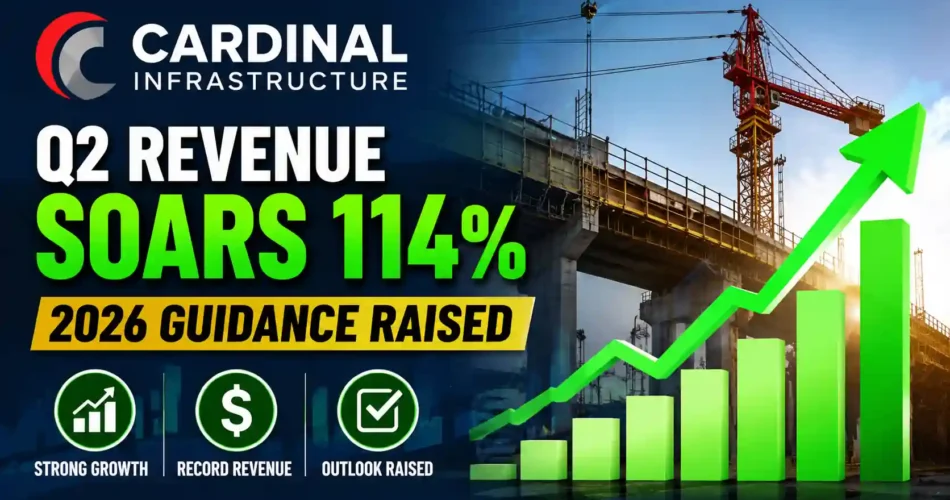
Cardinal Infrastructure Q2 Revenue Jumps 114% on Organic and Acquisition Growth, Raises 2026 Sales Guidance
Cardinal Infrastructure Group Inc. (NASDAQ: CDNL) reported a standout second quarter, with revenue surging 114% year over year as both organic expansion and recent acquisitions powered top‑line growth. Backed by a record backlog and stronger demand across its core markets, the company also raised its full‑year 2026 revenue guidance, signaling confidence in sustained momentum through the rest of the year.
Q2 Performance Highlights
Revenue and Growth Drivers
- Q2 revenue: Up 114% year over year, reflecting a combination of robust organic growth and contributions from completed acquisitions.
- Organic vs. acquisition mix: Growth was driven by higher project volumes and pricing in core civil infrastructure segments, alongside meaningful revenue from recently integrated businesses.
- Demand backdrop: The company continues to benefit from elevated public and private infrastructure spending, particularly in transportation, utilities, and site development projects across its Southeast and Sun Belt footprint.
This pattern aligns with Cardinal’s earlier results, where full‑year 2025 revenue grew 45% (33% organic), setting a strong base for 2026 acceleration.
Profitability and Cash Flow
- Earnings trajectory: Net income and adjusted EBITDA have expanded alongside revenue, supported by scale efficiencies and disciplined cost management.
- Margin profile: Management has reiterated a target of 20%+ adjusted EBITDA margin for 2026, underscoring confidence in operating leverage as the backlog converts to revenue.
- Cash position: Cash declined from prior periods due to acquisition outlays and working capital needs tied to growth, a typical pattern for fast‑scaling infrastructure contractors executing large projects.
Backlog and Visibility
- Record backlog: The company reported a backlog of $854 million, up roughly 60% year over year, providing strong revenue visibility into 2026 and beyond.
- Bid activity: Elevated bid pipelines and award rates in key regions have supported backlog growth, with particular strength in data center‑related site work and transportation infrastructure.
A deep backlog is a key quality indicator for construction and infrastructure firms, as it reduces revenue volatility and supports planning for labor, equipment, and materials.
Raised 2026 Sales Guidance
New Guidance Range and Rationale
Following the strong Q2 print and robust backlog, Cardinal raised its full‑year 2026 revenue guidance to a range of $675 million to $685 million, up from the prior $665 million to $678 million range.
Key reasons cited for the increase include:
- Better‑than‑expected Q2 execution and margin performance
- Continued strength in bid activity and project awards
- Synergies and revenue contributions from recent acquisitions, including the A.L. Grading Contractors (ALGC) deal
- A favorable macro environment for U.S. infrastructure investment
Management continues to expect adjusted EBITDA margins of 20% or higher for 2026, reflecting confidence in operating discipline even as the company scales.
What This Means for Investors
For investors, the raised guidance suggests:
- Sustainable growth: The company is not just growing via acquisitions but also via organic volume and pricing power.
- Execution quality: Strong backlog conversion and margin targets indicate effective project management and cost control.
- Sector tailwinds: Ongoing public infrastructure programs and private industrial/data center construction support multi‑year demand.
As always, investors should monitor execution risk, input cost inflation, and interest rate impacts on project financing when evaluating forward estimates.
Strategic Context and Market Position
Business Model and Segments
Cardinal Infrastructure operates as a civil infrastructure and site development contractor, focusing on:
- Transportation and roadway projects
- Utilities and underground infrastructure
- Site development for industrial, logistics, and data center campuses
- Grading, earthwork, and related civil construction services
This mix positions the company to capture spending from both government programs and private industrial expansion, particularly in high‑growth regions of the Southeast and Sun Belt.
M&A as a Growth Lever
Acquisitions have been a core part of Cardinal’s strategy:
- The ALGC acquisition expanded capabilities and geographic reach, notably around Atlanta, Georgia.
- Integration of acquired teams has contributed to both revenue scale and backlog depth.
When executed well, M&A allows infrastructure contractors to quickly add skilled crews, equipment, and local relationships—critical advantages in winning and delivering large projects.
Macro Tailwinds from U.S. Infrastructure Spending
Cardinal’s growth is unfolding against a supportive policy backdrop for U.S. infrastructure investment.
- The Bipartisan Infrastructure Law (Infrastructure Investment and Jobs Act) authorizes hundreds of billions in federal funding for roads, bridges, transit, broadband, and other critical infrastructure over multiple years. See:
White House – Bipartisan Infrastructure Law fact sheet. - Federal agencies such as the U.S. Department of Transportation and the Federal Highway Administration oversee major grant and formula programs that flow to state and local projects, many of which rely on civil contractors like Cardinal:
These programs help sustain multi‑year demand for site development, earthwork, and related civil construction services, especially in regions experiencing population and industrial growth.
Risks and Considerations
While the Q2 results and raised guidance are positive, several risks remain:
- Input cost inflation: Prices for fuel, materials, and equipment can pressure margins if not fully passed through to customers.
- Labor availability: Skilled labor shortages in construction can constrain growth or delay projects.
- Interest rates and financing: Higher borrowing costs can slow some private projects or affect developers’ timelines.
- Execution and integration: Rapid growth via M&A requires effective integration of teams, systems, and safety cultures.
Investors typically watch backlog quality, margin trends, and cash conversion as key indicators of how well these risks are being managed.
FAQ
What was Cardinal Infrastructure’s Q2 revenue growth?
Cardinal Infrastructure reported Q2 revenue growth of 114% year over year, driven by a mix of strong organic expansion and contributions from recent acquisitions.
Why did Cardinal raise its 2026 revenue guidance?
The company raised its 2026 revenue guidance to $675–$685 million due to better‑than‑expected Q2 performance, a record backlog of $854 million, robust bid activity, and incremental revenue from acquisitions such as ALGC.
What is Cardinal Infrastructure’s backlog?
Cardinal’s backlog stood at $854 million, up around 60% year over year, providing strong visibility for future revenue and supporting the raised 2026 outlook.
What margin target has Cardinal set for 2026?
Management targets an adjusted EBITDA margin of 20% or higher for full‑year 2026, reflecting confidence in operating leverage as the company scales.
How does U.S. infrastructure policy affect Cardinal’s business?
Federal programs under the Bipartisan Infrastructure Law and related DOT/FHWA initiatives support sustained public infrastructure spending, which benefits civil contractors like Cardinal through more roads, utilities, and site development projects.

