
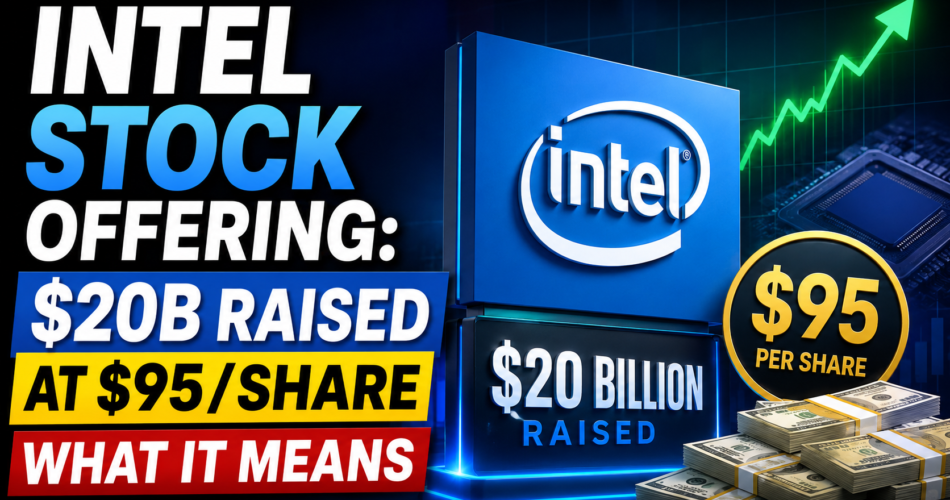
Intel Prices $20 Billion Stock Offering at $95 Per Share
Intel Corporation has officially priced its upsized public stock offering at $95 per share, raising approximately $20 billion in one of the largest equity raises in the semiconductor industry’s recent history. [1][2] The Santa Clara-based chipmaker sold 210.5 million shares in the underwritten offering, which was increased from an initially announced $15 billion to $20 billion due to strong investor demand.
Offering Details and Structure
Share Count and Pricing
The offering consists of 210,526,315 shares of Intel’s common stock priced at $95 per share. This price represents approximately a 2.6% discount to Intel’s previous closing price of $97.52, which is a standard practice in large underwritten equity offerings to ensure successful execution and attract institutional investors.
Underwriters’ Option
Intel has granted the underwriters a 30-day option to purchase up to an additional 31,578,947 shares at the public offering price, less underwriting discounts and commissions. If this option is fully exercised, the total offering could reach approximately $23 billion, representing additional dilution of roughly 0.7% beyond the base offering.
Expected Proceeds
After deducting underwriting discounts, commissions, and estimated offering expenses payable by Intel, the company expects to receive net proceeds of approximately $19.7 billion from the offering. The transaction is expected to close on August 12, 2026, subject to customary closing conditions.
Strategic Rationale Behind the Capital Raise
Funding Chip Foundry Expansion
The primary driver behind Intel’s decision to raise $20 billion is to fund the capital-intensive build-out of its chip contract manufacturing business, also known as Intel Foundry. This strategic initiative positions Intel to compete with Taiwan Semiconductor Manufacturing Company (TSMC) and Samsung in the lucrative foundry services market, where companies design chips but outsource manufacturing.
According to Intel’s announcement, the company is responding to “unprecedented investment in AI compute” and strong customer demand driven by artificial intelligence infrastructure needs. The semiconductor industry is experiencing a historic boom as data centers, cloud providers, and AI companies require ever-more powerful chips for machine learning, large language models, and other AI applications.
Capital Expenditure Requirements
Building advanced semiconductor fabrication facilities (fabs) requires enormous capital investment. A single state-of-the-art chip manufacturing plant can cost $10 billion to $20 billion to construct and equip. [9] Intel’s foundry expansion plans include multiple new facilities across the United States and internationally as part of its IDM 2.0 strategy, which combines internal manufacturing with external foundry partnerships.
The U.S. government’s CHIPS and Science Act, which provides subsidies and tax incentives for domestic semiconductor manufacturing, has made this capital raise particularly timely. Intel can leverage both the equity raise and government support to accelerate its manufacturing expansion while maintaining financial flexibility.
Market Reaction and Investor Sentiment
Stock Price Movement
Following the announcement of the $15 billion offering on Monday, Intel’s stock initially rallied before the upsized $20 billion pricing was revealed on Tuesday. The stock experienced some premarket pressure on Tuesday as investors digested the dilution implications of the larger offering size.
Despite the short-term pressure, the offering was reported to be multiple times oversubscribed, indicating strong institutional demand for Intel shares at the $95 price point. This suggests that investors view Intel’s turnaround strategy and foundry ambitions favorably, even with the near-term dilution.
Dilution Impact
At $95 per share, Intel issued approximately 210.5 million new shares, representing roughly 4.9% dilution to existing shareholders based on approximately 4.3 billion shares outstanding. If the underwriters’ 30-day option is fully exercised, dilution could increase to approximately 5.6%.
While dilution is generally viewed negatively by existing shareholders, the market appears to be weighing this against Intel’s improved growth prospects in the AI-driven semiconductor market. The company’s stock had rallied significantly in the weeks leading up to the offering, allowing Intel to raise more capital at a higher price than initially anticipated.
Use of Proceeds and Corporate Strategy
General Corporate Purposes
Intel stated that the net proceeds from the offering will be used for “general corporate purposes,” which may include capital expenditures and working capital. While this language is standard in equity offering documents, market analysts widely interpret this as funding for Intel’s foundry expansion and AI-related infrastructure investments.
AI and Data Center Focus
The timing of this capital raise coincides with Intel’s renewed focus on artificial intelligence and data center markets. The company has been working to regain competitiveness in AI accelerators and GPUs, areas where it has faced intense competition from NVIDIA and AMD.
Intel’s Gaudi AI accelerator lineup and upcoming Falcon Shores architecture represent the company’s efforts to capture a larger share of the AI chip market, which is projected to grow substantially over the next decade. The $20 billion raised will help fund both the manufacturing capacity and R&D needed to support these initiatives.
Regulatory and Compliance Considerations
SEC Filing Requirements
As a publicly traded company, Intel’s stock offering is subject to Securities and Exchange Commission (SEC) regulations and disclosure requirements. The company filed a prospectus supplement with the SEC detailing the offering terms, use of proceeds, and risk factors.
Investors can review Intel’s SEC filings, including the S-3 registration statement and prospectus supplement, through the SEC’s EDGAR database at https://www.sec.gov/edgar. [16] These documents provide comprehensive information about the offering structure, underwriting arrangements, and Intel’s financial condition.
Tax Implications
For U.S. investors, the stock offering itself does not create immediate tax consequences. However, the dilution effect may impact the cost basis calculations for existing shareholders over time. Investors should consult with tax professionals regarding their specific situations.
The Internal Revenue Service (IRS) provides guidance on stock transactions and capital gains at https://www.irs.gov/taxtopics/tc409. [17] International investors should consult their local tax authorities regarding cross-border investment implications.
Industry Context and Competitive Landscape
Semiconductor Capital Markets
Intel’s $20 billion equity raise is among the largest in the semiconductor industry’s history, reflecting both the capital intensity of chip manufacturing and the unprecedented demand for AI-related infrastructure.
For context, TSMC, the world’s largest contract chip manufacturer, has announced capital expenditure plans exceeding $30 billion annually to meet surging demand for advanced node production. Samsung Foundry has similarly committed to aggressive expansion plans. Intel’s capital raise positions it to compete more effectively in this capital-intensive arena.
Government Support for Domestic Manufacturing
The U.S. government has made semiconductor manufacturing a national priority, with the CHIPS and Science Act providing $52 billion in subsidies and tax incentives for domestic chip production. Intel is expected to be a major beneficiary of these programs, which aim to reduce reliance on foreign chip manufacturing and strengthen U.S. technological leadership.
The Department of Commerce oversees CHIPS Act implementation, with information available at https://www.chips.gov. [18] This government support complements Intel’s equity raise, effectively multiplying the capital available for domestic manufacturing expansion.
Frequently Asked Questions (FAQ)
What is Intel’s stock offering price?
Intel priced its public stock offering at $95 per share, representing approximately 210.5 million shares for a total offering size of $20 billion.
Why is Intel raising $20 billion?
Intel is raising capital primarily to fund the expansion of its chip foundry business and capitalize on strong demand for AI-related semiconductor manufacturing. The company cited “unprecedented investment in AI compute” as a key driver.
How does this affect existing shareholders?
The offering represents approximately 4.9% dilution to existing shareholders, with potential for up to 5.6% if the underwriters’ 30-day option is fully exercised. While dilution reduces existing shareholders’ ownership percentage, the capital raised is intended to fund growth initiatives that could increase long-term shareholder value.
When will the offering close?
The offering is expected to close on August 12, 2026, subject to customary closing conditions.
Can I purchase shares in this offering?
Public offerings of this size are typically available primarily to institutional investors through the underwriting syndicate. Individual investors can purchase Intel shares (ticker: INTC) on the NASDAQ exchange after the offering closes.
What are the risks of this investment?
Key risks include execution risk on Intel’s foundry expansion, competitive pressures from TSMC and Samsung, potential delays in CHIPS Act funding, and the inherent cyclicality of the semiconductor industry. Investors should review Intel’s SEC filings for comprehensive risk disclosures.
Where can I find more information about Intel’s financials?
Intel’s investor relations website at https://www.intc.com/investor-relations provides comprehensive financial information, SEC filings, and earnings reports. [19] The SEC’s EDGAR database at https://www.sec.gov/edgar offers access to all public filings. [16]
This article is for informational purposes only and does not constitute investment advice. Investors should conduct their own research and consult with financial professionals before making investment decisions.

