
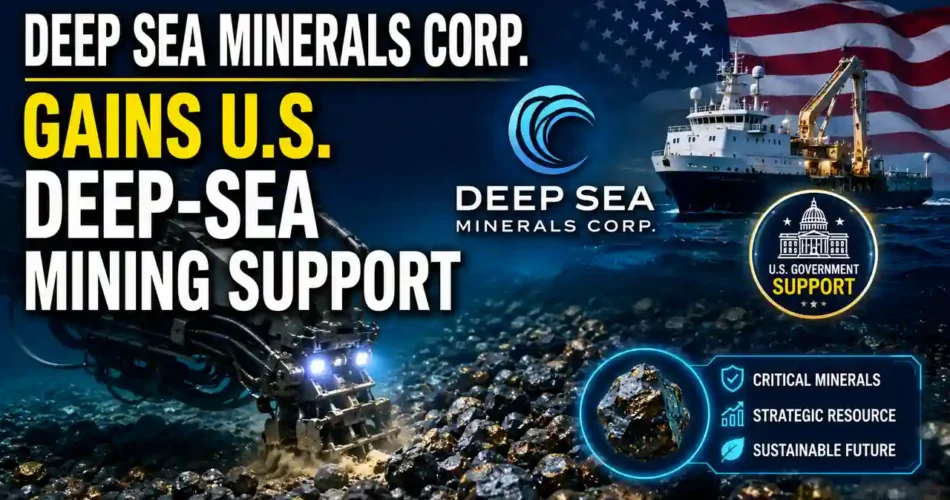
Deep Sea Minerals Corp. Highlights Growing U.S. Focus on Deep-Sea Mining
Deep Sea Minerals Corp. has welcomed the increasing attention being given to critical minerals and deep-sea mining in the United States. The company issued its statement after the American Mining Roundtable, held on August 7, 2026, at the U.S. Department of State. The event placed offshore mineral resources within a broader discussion about national security, industrial capacity, energy systems, and supply-chain independence.
According to the company, the U.S. government announced approximately US$3 billion in financing commitments for critical-mineral and battery projects, along with more than US$180 million for mining education and workforce development. Source
U.S. Policy Draws Attention to Critical Minerals
Critical minerals are increasingly important to industries such as electric vehicles, renewable energy, electronics, aerospace, telecommunications, and defense. These materials are used in batteries, electrical infrastructure, advanced manufacturing, and several emerging technologies.
Many countries rely on international suppliers for the minerals and processed materials required by modern industries. Supply disruptions, geopolitical tensions, trade restrictions, and limited domestic processing capacity have encouraged governments to search for alternative sources.
Why Critical Minerals Are Important
Critical minerals are generally considered essential to economic or national-security interests while facing potential supply risks. Copper, nickel, cobalt, manganese, and other metals can support energy storage, power transmission, industrial production, and defense-related applications.
The growing policy interest in these resources has increased attention on several potential supply solutions, including domestic mining, recycling, mineral processing, technological substitutes, and offshore exploration.
Deep-Sea Mining Enters the National Conversation
Deep-sea mining involves the exploration of mineral deposits located on or beneath the ocean floor. Some seabed formations, including polymetallic nodules, may contain metals such as manganese, nickel, copper, and cobalt.
Deep Sea Minerals Corp. believes offshore mineral resources could eventually become one component of a more diversified U.S. critical-minerals strategy. The company has also emphasized that these resources should be assessed through a transparent, science-led, and responsible regulatory process.
Company Comments on the American Mining Roundtable
James Deckelman, chief executive officer of Deep Sea Minerals Corp., said that deep-sea minerals have become part of the wider discussion surrounding economic security, defense readiness, and American industrial strength.
He added that the attention given to deep-sea mining at the event underlines the importance of evaluating offshore resources through appropriate scientific and regulatory procedures.
The company’s comments reflect growing interest in the potential role of seabed minerals, but they do not indicate that commercial mining has already begun. Exploration and development projects must still satisfy regulatory, environmental, technical, and financial requirements.
Deep Sea Minerals Corp. and Its Exploration Strategy
Deep Sea Minerals Corp. is a seabed mineral exploration and development company focused on advancing critical-mineral opportunities from the deep ocean. The company trades on the Canadian Securities Exchange under the symbol SEAS, on the OTCQB Venture Market under DSEAF, and on the Frankfurt Stock Exchange under X450.
The company is pursuing opportunities through regulatory channels in the United States. Its strategy involves assessing deep-sea mineral rights, conducting exploration-related work, and examining how offshore resources could contribute to future critical-mineral supply chains.
Exploration Is Different From Commercial Mining
An exploration application does not automatically authorize commercial mineral recovery. Exploration generally involves activities such as seabed mapping, geological surveys, sampling, environmental studies, and technical analysis.
Commercial mining would require additional approvals, project-development plans, operational equipment, financing, environmental safeguards, and evidence that the proposed activity can be conducted responsibly and economically.
NOAA Application and Regulatory Review
Earlier in 2026, Deep Sea Minerals Corp. announced that its U.S. subsidiary, American Ocean Minerals Corp., had submitted an exploration-license application to the National Oceanic and Atmospheric Administration, or NOAA. The application was submitted under the Deep Seabed Hard Mineral Resources Act of 1980.
The company’s proposed exploration area is located in a portion of the Clarion-Clipperton Zone in the Pacific Ocean. NOAA has determined that the application is in substantial compliance with applicable regulatory requirements, but this determination does not represent final approval of an exploration license. Read more about the regulatory update.
What the NOAA Process Could Involve
The regulatory process may require further review of the proposed work program, environmental information, technical capabilities, monitoring systems, and operating procedures.
The final timing and outcome may depend on the completeness of the company’s supporting information and the requirements established by relevant authorities. Until the process is completed, the project should be viewed as an exploration-stage opportunity rather than an operating mine.
The Clarion-Clipperton Zone
The Clarion-Clipperton Zone is a large area of the Pacific Ocean located between Hawaii and Mexico. It has attracted scientific and commercial interest because of the presence of polymetallic nodules on the ocean floor.
These nodules are naturally occurring mineral formations that may contain several metals in one deposit. Their composition and concentration can vary by location, making detailed exploration and testing necessary.
Metals Found in Polymetallic Nodules
Polymetallic nodules may contain manganese, nickel, copper, cobalt, and other elements. These metals have a wide range of industrial uses.
- Copper: Used extensively in electrical wiring, power infrastructure, electronics, and renewable-energy systems.
- Nickel: Used in stainless steel, industrial applications, and certain battery technologies.
- Cobalt: Used in some battery chemistries and specialized industrial products.
- Manganese: Important in steel manufacturing and selected energy-storage applications.
The existence of these metals on the seabed does not guarantee that they can be recovered profitably or safely. Project economics will depend on resource quality, technology, commodity prices, financing, transportation, processing, and regulatory approvals.
Environmental Considerations
Deep-sea mining remains a subject of significant scientific and environmental debate. The deep ocean contains diverse ecosystems, and many marine species and habitats are not yet fully understood.
Potential environmental concerns include seabed disturbance, sediment plumes, underwater noise, effects on marine organisms, and changes to habitats. Researchers and regulators may therefore require extensive baseline studies before allowing large-scale activity.
Importance of Responsible Development
A responsible deep-sea exploration program would require detailed environmental monitoring, transparent reporting, operational controls, emergency procedures, and independent oversight where appropriate.
Baseline data can help scientists and regulators understand existing ocean conditions before exploration begins. Continued monitoring may then help identify changes associated with project activities.
Deep Sea Minerals Corp. has stated that it supports a transparent and science-based process for evaluating deep-sea mineral opportunities. This approach will be important as the company continues to engage with regulators and other stakeholders.
Potential Opportunities and Risks
The renewed U.S. focus on critical minerals could create greater visibility for companies involved in offshore exploration, marine engineering, mineral processing, and related technologies.
However, deep-sea mining is still an emerging industry. Exploration companies may face long development timelines, substantial capital requirements, technical uncertainty, regulatory delays, environmental challenges, and commodity-price volatility.
Key Factors to Monitor
- Progress of the company’s NOAA exploration-license application.
- Additional technical and environmental studies.
- Changes in U.S. policies affecting seabed mineral exploration.
- Potential partnerships with scientific, engineering, or mining organizations.
- Availability of financing for future exploration and development.
- Market prices for copper, nickel, cobalt, and manganese.
- Any future decision regarding commercial recovery.
Investors should remember that political attention or a regulatory milestone does not guarantee commercial success. Anyone considering an investment should review official company disclosures, understand the risks of early-stage exploration, and seek independent professional advice when appropriate.
What Could Happen Next?
Deep Sea Minerals Corp. is expected to remain focused on regulatory engagement, exploration planning, technical preparation, and environmental evaluation. The outcome of the NOAA process could become an important milestone for the company’s U.S. strategy.
The wider policy environment will also influence the future of the sector. Continued government support for critical-mineral projects could encourage new investment, but companies will still need to demonstrate technical feasibility, financial strength, legal compliance, and environmental responsibility.
Frequently Asked Questions
What did Deep Sea Minerals Corp. announce?
Deep Sea Minerals Corp. welcomed the growing U.S. focus on critical minerals and deep-sea mining following the American Mining Roundtable held at the U.S. Department of State.
Has the company received a final exploration license?
No. The company’s application remains subject to regulatory review, and substantial compliance does not represent final license approval.
Where is the company seeking to explore?
The proposed exploration area is located in a portion of the Clarion-Clipperton Zone in the Pacific Ocean.
What are polymetallic nodules?
Polymetallic nodules are mineral-rich formations found on the seabed. They may contain metals such as manganese, nickel, copper, and cobalt.
Does exploration approval mean commercial mining can begin?
No. Exploration and commercial recovery are separate stages. Commercial mining would require additional technical, environmental, financial, and regulatory approvals.
Why is deep-sea mining controversial?
Environmental concerns relate to potential seabed disturbance, sediment plumes, underwater noise, and possible effects on marine ecosystems that are still being studied.
Is Deep Sea Minerals Corp. currently a producing mining company?
The company is focused on seabed mineral exploration and development. Its future production prospects depend on regulatory approvals, exploration results, financing, technology, and commercial feasibility.
Is this article investment advice?
No. This article is provided for informational purposes only. Deep-sea mineral exploration involves significant risks, and readers should conduct their own research or consult a qualified financial adviser before making investment decisions.
Conclusion
Deep Sea Minerals Corp.’s statement highlights the rising importance of deep-sea minerals in the U.S. discussion about critical-mineral security, industrial capacity, and supply-chain diversification.
The company’s proposed exploration activities remain subject to regulatory review and should not be confused with commercial mining approval. Future progress will depend on scientific research, environmental safeguards, technical performance, financing, and compliance with applicable laws.
Disclaimer: This article is for informational purposes only and does not constitute financial, investment, legal, or environmental advice. Information may change as regulatory reviews and company developments continue. Always verify details through official filings and reliable sources before making decisions.
