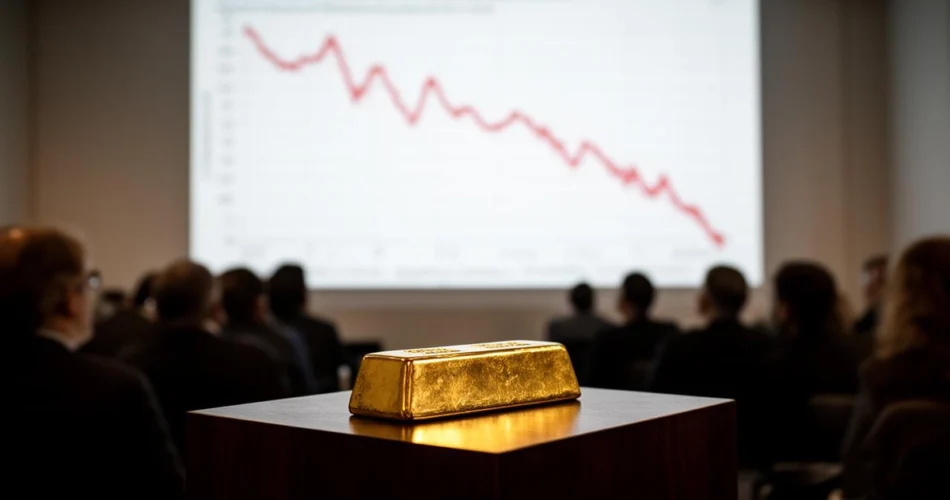
Federal Reserve Chair Kevin Warsh’s first speech at the Jackson Hole Economic Symposium became the pivotal catalyst that flipped gold market sentiment. In his address, he made clear that inflation has not slowed meaningfully and that policymakers still have work to do—remarks widely interpreted as hawkish—which drove the US Dollar Index higher and sent spot gold tumbling as much as 1.2%, breaching the $4,560-per-ounce level.
Warsh reiterated in his speech that the Federal Reserve will bring inflation back down to 2%, calling it “an unwavering objective.” He noted that short-term interest rates are the primary tool for achieving the Fed’s dual mandate, and stressed that “unconventional policies aimed at stimulating economic activity may be appropriate in genuine crises, but beyond that, even if used, they should be employed with great caution.” The message to markets was unambiguous: do not expect the Fed to pivot toward accommodation anytime soon.
His hawkish stance directly pressured precious metals. Spot gold ultimately fell 1% to settle at $4,555.39 per ounce, while silver declined 0.47% to $68.92 per ounce. Platinum and palladium, by contrast, bucked the trend to post gains. The Bloomberg Dollar Spot Index, which measures the greenback against a basket of major currencies, advanced in tandem, further eroding the appeal of dollar-denominated gold for holders of other currencies.
The speech drew outsized attention because it marked Warsh’s first major policy address at the Jackson Hole symposium since assuming the Fed chairmanship. Investors had hoped for clear signals on the inflation trajectory, the role of the bond market, and the interest-rate outlook—and the answers he delivered were more hawkish than the market had anticipated.
Looking back at gold’s trajectory this week, the metal had climbed to its highest level since mid-May earlier in the week, briefly approaching $4,700 per ounce. The rally was fueled by the U.S. Treasury Department’s announcement that it would expand buybacks of older long-dated bonds, stoking concerns about dilution of the dollar’s value and driving capital into gold as a haven. However, profit-taking pressure emerged even before Warsh’s speech, with spot gold sliding 1.4% on Wednesday—its biggest one-day drop in a week.
Bob Haberkorn, senior market strategist at StoneX, said ahead of the speech: “I’m bullish on gold, purely because demand right now is extremely strong. Not only are we seeing significant demand on the ETF side, but central banks continue to buy gold as an alternative asset to the dollar.” He added, however, that traders were staying cautious ahead of the symposium, waiting for policy signals to crystallize.
Based on interest-rate futures pricing, traders’ expectations for a Fed rate hike in September held steady at around 34%, while the probability of a hike by December remained as high as 74%. Since gold itself yields no interest, a rising-rate environment increases the opportunity cost of holding the metal, making it less attractive relative to income-generating assets such as bonds.
Inflation data also lent support to the hawkish stance. The Fed’s preferred inflation gauge—the Personal Consumption Expenditures (PCE) price index—rose 3.7% over the 12 months through July, unchanged from June and still well above the 2% target. That gave Warsh ample justification to emphasize in his speech that “there is still work to do.”
Among other precious metals, silver had risen 1.8% on Thursday ahead of the speech to $69.35 per ounce, but gave back those gains following Warsh’s remarks. Platinum rose 1% on Thursday to $1,848.08 per ounce, while palladium gained 1.3% to $1,344.72 per ounce.
Notably, despite the near-term pressure on gold, the metal has still gained more than 13% since the start of August, and the broader bullish structure remains intact. Market participants believe that structural demand from central banks continuing to accumulate gold as an alternative to the dollar, along with safe-haven buying driven by geopolitical risks, will continue to provide downside support for prices.
Following Warsh’s speech, market focus now shifts to the Fed’s September policy meeting. The August employment report and inflation data due before then will be critical in determining whether the Fed moves to raise rates before year-end.
Source link
Author

- Ytv Market News
- Share-market news writer and analyst with deep experience covering equities, commodities, forex, and cryptocurrencies for readers in the USA, UK, Canada, and Australia. Ytv Market News delivers timely market updates, practical trading insights, and clear explanations of macro and company-level catalysts that move prices. Combines on-the-ground financial reporting with technical analysis, using concise charts and actionable ideas to help investors and traders make smarter decisions.
Latest entries
 Forex NewsAugust 28, 2026Canadian Dollar awaits fresh catalyst with Warsh, GDP data in focus
 IndiaAugust 28, 2026Broker’s call: Varun Beverages (Buy)
 Company Press ReleasesAugust 28, 2026Net Asset Value(s)
Thu, Aug 27, 2026 15:23 CET
Janus Valuation ISIN Code Shares in Currency Share NET Asset NAV ExHenderson Date Issue Redeemed Value per DividendHaitong since Share DateAsia ex Previous-Japan ValuationHighYieldCorpUSD BondScreenedCoreUCITSETF 27.08.26 IE000LZC9NM0 5,545,546.00 USD 0 46,594,485.49 8.4021
Company Press ReleasesAugust 28, 2026Net Asset Value(s)
Thu, Aug 27, 2026 15:23 CET
Janus Valuation ISIN Code Shares in Currency Share NET Asset NAV ExHenderson Date Issue Redeemed Value per DividendHaitong since Share DateAsia ex Previous-Japan ValuationHighYieldCorpUSD BondScreenedCoreUCITSETF 27.08.26 IE000LZC9NM0 5,545,546.00 USD 0 46,594,485.49 8.4021 Company NewsAugust 28, 2026Die BT-Group-Aktie bleibt nach starken Zahlen stabil