

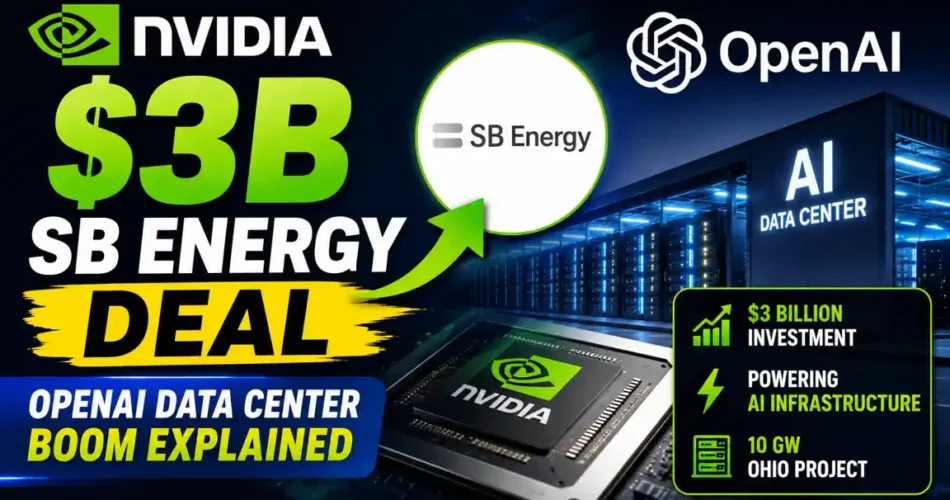
Nvidia Reportedly in Talks to Invest $3 Billion in SB Energy as OpenAI Data Center Plans Advance
Nvidia is reportedly considering a multibillion-dollar investment in SB Energy as the chip giant becomes increasingly involved in the infrastructure needed to support OpenAI’s rapidly expanding artificial intelligence ambitions. According to reports from The Information, Nvidia could invest as much as $3 billion in SB Energy as part of a broader arrangement connected to a proposed OpenAI data center project.
The reported discussions highlight a major shift taking place across the AI industry. Companies that once focused primarily on developing chips and software are now becoming increasingly involved in power generation, data centers, financing and other parts of the infrastructure chain required to operate advanced AI systems.
The potential investment also comes as OpenAI explores a massive data center campus in Ohio that could ultimately reach 10 gigawatts of capacity. The project is being developed by SB Energy, a SoftBank-backed company, and could become one of the largest AI infrastructure developments in the United States.
Nvidia’s Potential $3 Billion SB Energy Investment
The reported Nvidia investment would represent another step in the company’s strategy of supporting the infrastructure ecosystem surrounding its AI processors.
Details of the potential transaction have not been finalized, and the reported discussions could change. However, the possible $3 billion commitment is significant because it would give Nvidia a more direct financial connection to the company developing major data center facilities for OpenAI.
SB Energy already has a close relationship with OpenAI and SoftBank. In January 2026, OpenAI and SoftBank announced that each would invest $500 million in SB Energy, creating a combined $1 billion investment to help the company expand its data center development capabilities. OpenAI also selected SB Energy to build and operate a 1.2-gigawatt data center site in Milam County, Texas.
Why SB Energy Matters to OpenAI
SB Energy sits at the intersection of two increasingly important parts of the AI economy: computing infrastructure and energy.
Modern AI models require enormous amounts of computing power. Training and operating those models can require thousands or even millions of advanced processors, while the data centers housing those systems consume vast quantities of electricity.
That means access to suitable land, electricity, cooling systems, grid connections and construction capacity can become just as important as access to AI chips.
SB Energy’s role is therefore strategically important. The company is developing large-scale campuses designed to combine data center capacity with supporting energy infrastructure, potentially allowing AI companies to expand computing capacity more quickly.
The Massive Ohio Data Center Project
The reported Nvidia investment is linked to a much larger infrastructure story involving OpenAI and SB Energy in Ohio.
OpenAI has been negotiating to lease a proposed 10-gigawatt data center campus in southern Ohio. The Information previously reported that the campus could cost at least $500 billion when chips, servers, construction, power and other expenses are considered. The first phase is expected to begin operating later in the decade, with an initial portion of the site targeted for completion in 2028.
The scale of the proposed campus is extraordinary. A 10-gigawatt facility would require enormous amounts of electricity and supporting infrastructure. The project is being developed on Department of Energy land and private property, with SB Energy responsible for major elements of the development.
Reuters previously reported that Nvidia could provide financial support connected with the Ohio project and supply hardware for the facility.
From AI Chips to AI Infrastructure
Nvidia’s involvement illustrates how the economics of artificial intelligence are changing.
For years, Nvidia’s central role in AI was relatively straightforward: develop and sell high-performance processors, networking equipment and related software.
But the next phase of AI growth requires customers to build enormous computing facilities. If customers cannot secure enough power or financing, demand for Nvidia hardware can eventually be constrained.
By supporting infrastructure developers, Nvidia could potentially help remove some of those bottlenecks.
This strategy could also strengthen Nvidia’s position within the AI ecosystem because data centers built around its technology may create long-term demand for successive generations of GPUs and networking equipment.
OpenAI’s Growing Need for Computing Capacity
OpenAI is under pressure to secure additional computing resources as its AI models become more capable and its user base expands.
The company has already entered large agreements with major cloud providers, including Microsoft, Oracle and Amazon, while also exploring additional infrastructure arrangements.
Building or leasing dedicated facilities could give OpenAI greater control over its computing capacity. It could also potentially reduce its dependence on third-party cloud infrastructure over the long term.
The Ohio proposal is particularly important because OpenAI would reportedly control the equipment inside the facility through a long-term lease arrangement. That could provide the company with dedicated capacity designed specifically around its AI workloads.
Why Nvidia Could Benefit From the Deal
At first glance, investing billions of dollars in a data center developer may appear to be a departure from Nvidia’s traditional business model. However, the move could have several strategic advantages.
Securing Future Chip Demand
The most obvious benefit is demand visibility.
Large AI data centers require enormous quantities of GPUs, networking equipment and related components. If Nvidia helps enable the construction of these facilities, it could indirectly support future orders for its products.
The company has already announced a broader strategic partnership with OpenAI involving plans to deploy at least 10 gigawatts of Nvidia systems. Nvidia previously said it intended to invest up to $100 billion in OpenAI progressively as those systems are deployed.
Reducing Infrastructure Bottlenecks
AI chip demand is only one part of the equation. Even if customers have enough money to purchase processors, they still need facilities with sufficient electrical capacity and cooling.
Investing in infrastructure developers could help Nvidia participate in solving these bottlenecks.
Strengthening the Nvidia Ecosystem
The more AI infrastructure that is designed around Nvidia technology, the more deeply Nvidia becomes embedded in the computing ecosystem.
This could create advantages beyond individual hardware sales, particularly when data center operators build systems around Nvidia’s GPUs, networking products and software stack.
The Role of SoftBank
SoftBank is another important player in the proposed arrangement.
SB Energy is majority-owned by SoftBank, while OpenAI is also closely connected to SoftBank through its broader infrastructure ambitions. OpenAI and SoftBank each invested $500 million in SB Energy earlier this year, demonstrating the strategic relationship among the companies.
SoftBank has been pursuing large investments in AI infrastructure, making SB Energy an important component of its strategy to participate in the physical infrastructure supporting the AI economy.
Energy Is Becoming AI’s Biggest Constraint
The rapid expansion of AI is creating a new problem: electricity.
Traditional data centers consumed substantial power, but AI facilities can require dramatically greater energy because of the computing intensity of modern accelerator-based workloads.
This is why developers are increasingly looking for locations with access to large power supplies, transmission infrastructure and favorable permitting conditions.
The Ohio project reflects this trend. The site has attracted attention partly because of its connection to government-owned land and planned energy infrastructure.
According to reporting on the project, a large natural gas power development is also planned for the Ohio site with Japanese funding, while SB Energy is expected to operate the facility.
Potential Risks for Nvidia
Despite the strategic logic, a multibillion-dollar investment would not be without risks.
Data center projects of this scale can face construction delays, permitting challenges, power constraints and rapidly changing technology requirements.
There is also the question of capital allocation. Nvidia has generated enormous cash flows from its semiconductor business, but investors may scrutinize large infrastructure investments to determine whether they generate attractive returns compared with returning capital to shareholders or investing directly in technology.
Another risk is the possibility that AI infrastructure demand grows more slowly than expected. If model development or enterprise AI adoption disappoints, some planned facilities could face lower utilization than projected.
What the Deal Could Mean for AI Infrastructure
If Nvidia ultimately invests $3 billion in SB Energy, the transaction could signal that AI infrastructure is becoming a strategic asset class in its own right.
The AI race is no longer simply about which company develops the best model. Companies increasingly need access to chips, electricity, land, cooling, financing and data center construction expertise.
That creates opportunities for semiconductor companies, utilities, construction firms, energy developers and financial institutions.
Nvidia’s reported interest in SB Energy demonstrates how these industries are becoming interconnected.
What Investors Should Watch Next
Investors will likely focus on several developments if the reported transaction progresses.
- Whether Nvidia formally confirms an investment in SB Energy.
- The final size and structure of any investment.
- Whether Nvidia provides financial guarantees for OpenAI-related infrastructure.
- The timeline for construction of the Ohio data center campus.
- The amount of Nvidia hardware expected to be deployed.
- How OpenAI finances the long-term cost of its computing expansion.
These factors could help determine whether the project becomes a major source of future Nvidia demand or remains primarily a strategic infrastructure investment.
Conclusion
Nvidia’s reported talks to invest up to $3 billion in SB Energy underline the increasingly complex economics of the artificial intelligence boom.
As AI models become more computationally demanding, access to processors alone is no longer sufficient. Companies need enormous data centers, reliable power supplies and financing structures capable of supporting projects that can cost hundreds of billions of dollars.
For Nvidia, helping build that infrastructure could protect the long-term demand for its AI technology while expanding its role beyond the semiconductor market. For OpenAI, partnerships with Nvidia, SoftBank and SB Energy could provide a path toward securing the dedicated computing capacity required for future AI systems.
However, the reported investment remains subject to negotiations, and the final structure could differ from the proposals currently under discussion. The scale of the Ohio project means execution, financing and energy availability will remain critical factors.
FAQ
Is Nvidia investing $3 billion in SB Energy?
Nvidia is reportedly in talks to invest as much as $3 billion in SB Energy, according to reporting from The Information. The discussions have not necessarily resulted in a finalized transaction, so the final investment amount and structure could change.
What is SB Energy?
SB Energy is a SoftBank-backed energy and data center infrastructure developer. The company is working on large-scale projects intended to provide the power and facilities required by AI workloads.
Why is Nvidia interested in data centers?
Nvidia’s AI chips are used inside data centers, so expanding data center capacity can directly support future demand for its processors, networking products and software ecosystem.
What is the Ohio OpenAI data center project?
It is a proposed data center campus in southern Ohio that OpenAI is reportedly considering leasing from SB Energy. The campus could eventually reach 10 gigawatts of capacity and could cost hundreds of billions of dollars when fully equipped.
How much has OpenAI already invested in SB Energy?
OpenAI and SoftBank each committed $500 million to SB Energy in January 2026, creating a combined $1 billion investment. OpenAI also selected SB Energy to develop and operate a 1.2-gigawatt data center site in Texas.
Could the deal increase demand for Nvidia GPUs?
Potentially. A large-scale OpenAI data center buildout would require substantial computing hardware, and Nvidia is expected to be a major hardware supplier for the proposed infrastructure. The actual volume of equipment would depend on the final project design and agreements.
What is the biggest challenge facing AI data centers?
Power availability is increasingly one of the biggest constraints. AI facilities require huge amounts of electricity as well as suitable land, transmission capacity, cooling systems, financing and construction resources.
External References
U.S. Department of Energy – Partnership to Power America’s AI Future
U.S. Department of Energy – Powering America’s AI Future: Data Center Resource Hub
U.S. Department of Energy – Report on U.S. Data Center Energy Use
U.S. Energy Information Administration – Data Center Power Demand and U.S. Electricity Growth
U.S. Energy Information Administration – Electricity Demand Growth Fueled by Data Centers

