

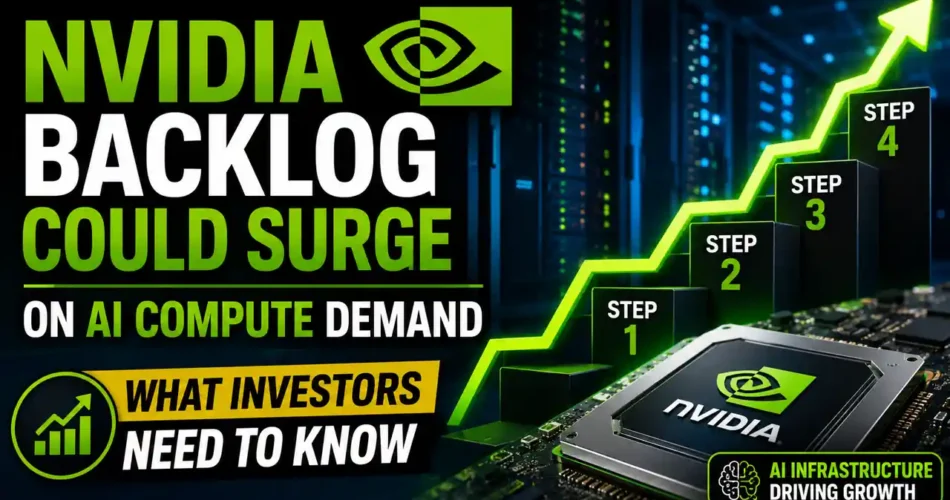
Nvidia May Report “Stair-Step” in Backlog From Compute Demand — Market Talk
Nvidia could be heading toward another important phase of growth as demand for artificial intelligence computing continues to outpace the ability of many customers to secure the latest-generation hardware. A recent market view suggests the chipmaker may report a “stair-step” pattern in its backlog, reflecting the way large AI infrastructure projects are being built and delivered over time.
The idea is important for investors because Nvidia’s growth story is increasingly tied not only to how much revenue the company generates in a single quarter, but also to the visibility it has into future demand. As cloud providers, technology companies and other organizations expand AI infrastructure, orders can accumulate before the associated systems are delivered and recognized as revenue.
A stair-step backlog would suggest that demand is arriving in waves rather than following a smooth, linear trajectory. Each new wave of computing investment could add another layer of committed demand, potentially giving Nvidia greater visibility into future sales.
What Does a “Stair-Step” Backlog Mean?
A stair-step backlog describes a situation in which customer orders build in distinct stages. Instead of backlog rising steadily every month, it can remain relatively stable for a period and then jump sharply when a major customer places a new order or expands an existing deployment.
For Nvidia, this pattern can be particularly relevant because AI data-center projects are often extremely large and complex. Customers may first secure computing capacity, followed by additional GPU systems, networking equipment, software and supporting infrastructure.
As these projects expand, additional orders can create another “step” in the backlog. That can make Nvidia’s future revenue opportunity look stronger even when individual quarterly results fluctuate.
AI Compute Demand Remains the Central Growth Driver
The fundamental driver behind the discussion is the rapid expansion of AI computing. Training and running advanced AI models require significant amounts of computing power, and demand has encouraged major technology companies to invest heavily in data centers.
Nvidia occupies a particularly important position in this ecosystem because its accelerated computing platforms are used for both AI model training and inference. The company also supplies networking technology and software that can help customers build large-scale AI clusters.
This broader platform approach means a new AI infrastructure project can create demand for more than individual graphics processors. Customers may require complete computing architectures capable of connecting thousands of processors and moving data efficiently between them.
Why Large Orders Matter
Large customers can materially influence Nvidia’s demand profile. Cloud service providers and major technology companies are building AI infrastructure at enormous scale, and their purchasing decisions can generate substantial order volumes.
When several customers expand their AI capacity around the same period, Nvidia could see a sudden increase in committed orders. If another group of customers follows later, the company may experience another jump, producing the stair-step effect described by market analysts.
Backlog Provides a Window Into Future Revenue
Investors frequently watch backlog because it can provide an indication of future business activity. A growing backlog does not automatically guarantee that every dollar will become revenue immediately, but it can improve visibility when orders are supported by firm customer commitments and delivery schedules.
For Nvidia, backlog trends may become increasingly important as its revenue base becomes larger. At a smaller scale, a major order can significantly change quarterly results. At Nvidia’s current scale, investors need to understand how much future demand is already embedded in the company’s pipeline.
A stair-step pattern could therefore indicate that customers are continuing to commit capital to AI infrastructure despite the enormous costs involved.
The Importance of Nvidia’s New Computing Platforms
Nvidia’s product roadmap is another key element of the demand equation. The company has been moving rapidly through generations of accelerated computing technology, with customers seeking improved performance and greater efficiency for increasingly demanding AI workloads.
New platforms can encourage customers to refresh existing systems while also adding entirely new computing capacity. This creates the possibility of overlapping demand: customers may continue operating existing systems while ordering newer technology for the next stage of their AI infrastructure.
From GPUs to Complete AI Infrastructure
The investment opportunity surrounding Nvidia has expanded beyond standalone GPUs. Modern AI data centers require processors, networking, memory, storage, power infrastructure and sophisticated software.
Nvidia’s integrated approach allows the company to participate in several parts of this infrastructure stack. Its networking products, interconnect technology and software ecosystem can increase the value of each large-scale deployment.
This matters for backlog because a customer ordering an AI system may ultimately purchase a broad range of Nvidia products rather than a single category of chips.
Why Investors Are Watching Backlog Closely
Nvidia has become one of the most closely followed companies in the global technology sector. Expectations surrounding its AI business are exceptionally high, meaning investors increasingly look beyond headline revenue and earnings figures.
Backlog can help answer a critical question: how sustainable is demand after the current quarter?
If Nvidia demonstrates that customer commitments continue to accumulate, investors may interpret that as evidence that AI infrastructure spending remains strong. Conversely, slower order growth could raise concerns about whether customers are approaching a period of digestion after aggressive capital expenditure.
Revenue Timing Can Still Be Uneven
It is important to distinguish backlog from recognized revenue. A customer order does not necessarily translate into immediate quarterly revenue. Production schedules, supply availability, installation timelines and customer deployment plans can all affect when sales are recognized.
That means a stair-step backlog could produce uneven quarterly results even when underlying demand remains healthy. One quarter might benefit from accelerated deliveries, while another could reflect the timing of large installations.
Potential Risks Behind the AI Growth Story
Although AI demand remains a major opportunity, Nvidia investors should not assume that every increase in orders will continue indefinitely. The market is becoming increasingly competitive, and major customers are investing in their own AI accelerators and alternative computing solutions.
Cloud providers and large technology companies are also under pressure to generate returns from their massive AI capital expenditures. If those investments fail to produce sufficient economic benefits, future spending could eventually moderate.
Supply-chain constraints, export restrictions, changing regulations and shifts in data-center construction schedules can also affect the timing and size of Nvidia’s sales.
What a Strong Backlog Could Signal
If Nvidia reports evidence of a rising backlog associated with compute demand, investors could view it as a sign that AI infrastructure spending remains in an expansion phase.
A strong backlog could potentially support revenue visibility, reinforce confidence in future product demand and demonstrate that customers are continuing to allocate substantial capital toward accelerated computing.
However, the quality of that backlog matters. Investors will likely pay attention to customer concentration, delivery schedules, product mix and the extent to which orders represent firm commitments.
What Investors Should Watch Next
Investors following Nvidia should focus on several indicators alongside the backlog discussion. Data-center revenue remains central, while commentary about customer demand can provide important clues about future growth.
Product transitions will also matter. Investors will want to know how quickly customers are adopting new computing platforms and whether demand is broad-based across hyperscalers, enterprises and other AI developers.
Margins are another important consideration. Nvidia’s ability to maintain strong profitability while investing in new products and supporting an expanding ecosystem will influence how much of its AI demand converts into earnings and cash flow.
Bottom Line
The possibility of a “stair-step” backlog highlights an important feature of Nvidia’s AI business: demand may arrive in large waves as customers expand computing infrastructure.
If those waves continue, Nvidia could maintain strong visibility into future AI-related sales. Large-scale data-center projects, new computing platforms and growing AI workloads provide several potential sources of additional demand.
At the same time, investors should avoid treating backlog growth as a guaranteed forecast of future earnings. Delivery schedules, customer spending decisions, competition, regulation and the economics of AI investment can all influence the eventual outcome.
For now, the key takeaway is that the backlog conversation offers another way to evaluate Nvidia’s AI opportunity. Rather than focusing exclusively on the next quarter, investors may increasingly look at how much future computing demand is already being built into the company’s order pipeline.
Frequently Asked Questions
What does a stair-step backlog mean for Nvidia?
A stair-step backlog means customer commitments could increase in distinct waves rather than at a steady pace. For Nvidia, this may reflect large AI infrastructure projects being ordered and expanded in stages.
Why is compute demand important to Nvidia?
AI models require significant computing power for training and inference. Nvidia supplies accelerated computing platforms and related networking and software technologies used in many AI data centers.
Does a larger backlog guarantee higher Nvidia revenue?
No. Backlog can improve revenue visibility, but orders still depend on production, delivery, installation and customer deployment schedules. Backlog should therefore be viewed as an indicator of potential future business rather than a guarantee.
What should Nvidia investors watch besides backlog?
Investors should monitor data-center revenue, customer spending, product adoption, gross margins, free cash flow, competition, supply conditions and management commentary about future AI infrastructure demand.
Could AI spending eventually slow?
Yes. AI investment could moderate if customers become more cautious about capital expenditures, if AI projects generate weaker-than-expected returns or if alternative computing technologies gain market share. The pace of future spending remains an important risk factor.
Why does Nvidia remain important to the AI infrastructure market?
Nvidia provides more than computing processors. Its broader platform includes accelerated computing, networking and software technologies, allowing customers to build large-scale AI infrastructure around an integrated ecosystem.
External References
- U.S. Securities and Exchange Commission (SEC) — Corporate filings and investor information for NVIDIA Corporation.
- U.S. Department of Commerce — Statement on UAE and Saudi Chip Exports — Information on advanced semiconductor exports, including Nvidia Blackwell chips. 0
- National Institute of Standards and Technology (NIST) — AI Risk Management Framework — U.S. government guidance on artificial intelligence systems and risk management. 1
- NIST — Artificial Intelligence Risk Management Framework 1.0 — Official U.S. government publication covering AI development, deployment and risk management. 2
- U.S. Department of Energy — Government resources on data centers, computing infrastructure and energy requirements.
“`3

