

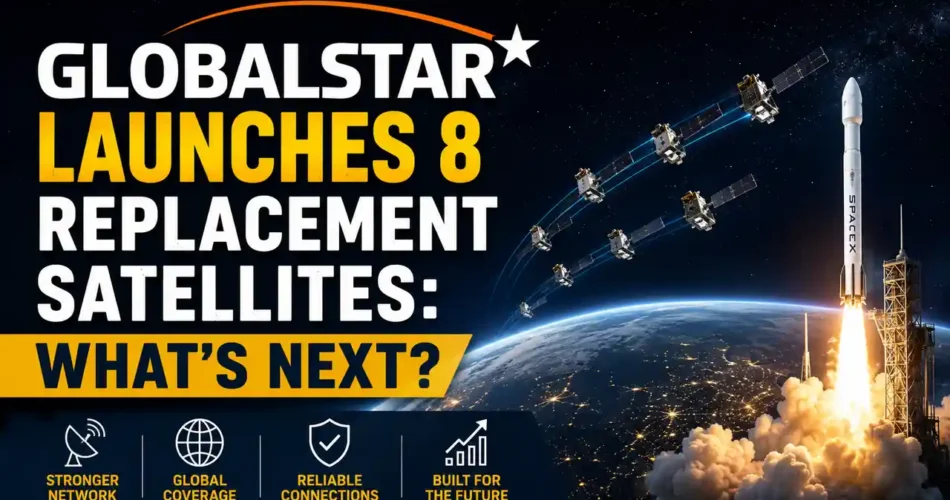
Globalstar Confirms Successful Launch of All 8 HIBLEO-4 Replacement Satellites
Globalstar is advancing the renewal of its low Earth orbit satellite network with the successful deployment of eight replacement satellites designed to replenish its HIBLEO-4 system. The milestone represents an important step in the company’s long-term effort to maintain reliable mobile satellite services while preparing its network for future growth.
The replacement program has been under development for several years. Globalstar entered into an agreement with MDA Space to acquire replacement satellites for its HIBLEO-4 U.S.-licensed system, while SpaceX was selected to provide launch services. The broader program calls for at least 17 replacement satellites, with additional spacecraft potentially available under the company’s regulatory authorization.
The first group consists of eight satellites. Their deployment is intended to complement Globalstar’s existing second-generation constellation and strengthen continuity of service as older spacecraft are eventually retired or phased out.
Eight Replacement Satellites Mark a Major Network Milestone
The HIBLEO-4 replacement project is more than a routine satellite launch. It is part of Globalstar’s strategy to preserve the infrastructure behind its mobile satellite services for years to come.
Globalstar operates a low Earth orbit constellation designed to provide coverage across large portions of the globe. Its satellites communicate with a network of ground gateways, allowing customers to access voice, messaging, data and other satellite-enabled services in areas where traditional terrestrial networks may be unavailable or unreliable.
Adding eight replacement spacecraft gives the company additional capacity and redundancy within the network. It also supports a gradual transition away from aging first-generation infrastructure.
Why HIBLEO-4 Still Matters
HIBLEO-4 is the name associated with Globalstar’s U.S.-licensed first-generation satellite system. Although Globalstar has operated second-generation HIBLEO-X spacecraft for years, the company has continued investing in the HIBLEO-4 authorization and its replacement infrastructure.
In August 2024, the Federal Communications Commission approved Globalstar’s request to replenish its HIBLEO-4 U.S.-licensed system with up to 26 replacement satellites and granted a renewed 15-year authorization. The FCC said the modification would support continued satellite voice and data communications, including safety-related services.
That regulatory decision provides the foundation for the replacement program and gives Globalstar a longer operating horizon for its satellite communications business.
SpaceX Launch Supports Globalstar’s Satellite Refresh
Globalstar selected SpaceX to launch the replacement satellites. The companies have agreements covering two launches associated with the replacement program. The first launch was planned for eight satellites, while a second batch is expected to bring the overall replacement effort to at least 17 spacecraft.
The launch campaign was not completely straightforward. Globalstar announced in May 2026 that the planned launch needed to be postponed to allow additional preparation work on the satellites. The company subsequently planned a revised launch opportunity.
The successful deployment of the eight-spacecraft first batch therefore represents an important execution milestone after the earlier scheduling delay.
MDA Space Plays a Central Role
MDA Space is responsible for manufacturing the replacement satellites under Globalstar’s procurement agreement. The agreement was originally signed in 2022 and covers at least 17 satellites, with Globalstar holding provisions that can support a larger replacement program.
According to Globalstar’s regulatory filings, the amended contract price for 17 replacement satellites is approximately $329.3 million, while additional equipment and a satellite operations control center are also included in the broader arrangement.
The project demonstrates how satellite operators increasingly rely on specialized aerospace suppliers rather than developing every part of a spacecraft program internally.
What the New Satellites Mean for Globalstar Customers
For customers, the most important benefit of the new satellites is expected to be network continuity. Satellite systems must maintain sufficient spacecraft availability and coverage to deliver dependable services. Replenishment satellites help operators manage aging hardware, replace spacecraft when necessary and maintain network resilience.
Globalstar says its LEO constellation is designed so that at least one satellite has a high probability of being visible from locations between approximately 70 degrees north and 70 degrees south latitude. The network works together with terrestrial gateways that connect satellite traffic to the broader communications infrastructure.
The replacement spacecraft are designed to work alongside the company’s existing satellites rather than immediately creating an entirely separate network. This approach allows Globalstar to gradually refresh its orbital infrastructure while maintaining existing services.
Reliability Is a Key Objective
Satellite operators face unique challenges because spacecraft cannot simply be repaired like conventional terrestrial equipment. Once a satellite is in orbit, operators generally depend on onboard redundancy and network-level backup capacity.
Replacing older spacecraft before they become a major operational problem can therefore improve resilience. For Globalstar, the eight new satellites are an important component of that strategy.
Globalstar’s Broader Satellite Strategy
The HIBLEO-4 replacement program is only one part of Globalstar’s broader satellite investment strategy. The company is also developing an Extended MSS Network based on a new generation of satellites.
In February 2025, Globalstar entered into another agreement with MDA Space for more than 50 third-generation satellites associated with the Extended MSS Network. The company has described that network as a major component of its longer-term infrastructure plans.
This means Globalstar is simultaneously addressing two different priorities: replacing existing satellite infrastructure and developing new-generation capabilities for future services.
From Replacement to Long-Term Expansion
The eight HIBLEO-4 replacement satellites should be viewed as part of a transition rather than the final destination of Globalstar’s satellite strategy.
The company has said that replacement satellites will complement its second-generation constellation and help ensure continuous service delivery. Over time, Globalstar expects to replenish additional HIBLEO-4 spacecraft and gradually phase out older satellites.
The ultimate goal is a more sustainable orbital architecture capable of supporting Globalstar’s satellite communications business throughout the renewed regulatory period.
Financial and Operational Significance
Satellite replacement programs require significant upfront investment. Globalstar has reported substantial expenditures associated with both satellite construction and launch preparation.
As of March 31, 2026, the company had incurred approximately $299.4 million in capital expenditures related to milestones under its MDA Space replacement-satellite agreement and another $91.8 million related to SpaceX launch milestones. The replacement satellites are expected to be placed into service after launch and begin depreciation once operational.
These figures highlight the scale of the infrastructure investment behind the eight-satellite deployment.
Why Investors May Watch the Program Closely
For investors, successful satellite deployment can reduce one source of execution risk. Manufacturing delays, launch scheduling issues and spacecraft commissioning all have the potential to affect the timing of a satellite operator’s infrastructure plans.
A completed launch removes the launch phase for the first batch from that risk equation. Attention can then shift toward satellite commissioning, operational performance and the next phase of the replacement program.
The market may also focus on how effectively Globalstar converts its satellite infrastructure investment into long-term service reliability and revenue opportunities.
What Comes Next for Globalstar
The successful deployment of the first eight replacement satellites does not complete Globalstar’s HIBLEO-4 modernization program. The company has planned a second group of replacement satellites, bringing the initial procurement program to at least 17 spacecraft.
Globalstar’s filings indicate that the second batch was expected later in 2026. The company is also continuing work on its much larger Extended MSS Network, which is intended to provide a foundation for future satellite communications capabilities.
As the new spacecraft enter service, Globalstar will need to complete commissioning and integrate them into its operational network. The performance of those satellites will be an important indicator of the effectiveness of the replacement strategy.
Conclusion
The successful launch of all eight HIBLEO-4 replacement satellites represents a significant step in Globalstar’s effort to modernize and strengthen its satellite infrastructure. The spacecraft are designed to replenish the company’s existing LEO network, improve long-term resilience and support continuity of mobile satellite services.
The project also illustrates the scale of investment required to maintain a global satellite communications network. With MDA Space handling satellite production and SpaceX providing launch services, Globalstar has built a multi-stage program aimed at replacing aging infrastructure while preparing for a broader next-generation network.
For Globalstar, the eight-satellite deployment is therefore both an operational achievement and a building block for its longer-term strategy. The next major milestones will include bringing the spacecraft fully into service, launching additional replacement satellites and progressing the company’s Extended MSS Network.
FAQ
What are the HIBLEO-4 replacement satellites?
They are new spacecraft being deployed by Globalstar to replenish its U.S.-licensed HIBLEO-4 satellite system. The replacement program is intended to support continued mobile satellite services and improve long-term network continuity.
How many HIBLEO-4 replacement satellites is Globalstar planning?
Globalstar’s procurement agreement covers at least 17 replacement satellites, while its FCC authorization permits the company to operate up to 26 replacement satellites under the renewed HIBLEO-4 authorization.
Who is building the replacement satellites?
MDA Space is responsible for producing the replacement satellites under Globalstar’s satellite procurement agreement. The company is also providing associated satellite operations infrastructure.
Who is launching Globalstar’s replacement satellites?
SpaceX is providing launch services for Globalstar’s replacement-satellite program. The companies have agreements covering two launches associated with the replacement spacecraft.
Why are the replacement satellites important?
The new spacecraft are intended to replenish aging orbital infrastructure, support network resilience and help Globalstar maintain reliable satellite communications services over the long term.
What is Globalstar’s Extended MSS Network?
It is a broader next-generation satellite communications initiative. Globalstar has contracted with MDA Space for more than 50 third-generation satellites associated with the Extended MSS Network, making it a major part of the company’s future infrastructure strategy.
5 Government and U.S. Regulatory Sources for Reference
- Federal Communications Commission (FCC) – Globalstar HIBLEO-4 Replacement Authorization
- U.S. Securities and Exchange Commission – Globalstar 2026 Quarterly Filing
- U.S. Securities and Exchange Commission – Globalstar Annual Filing
- U.S. Securities and Exchange Commission – Globalstar Satellite Procurement and Launch Agreements
- U.S. Securities and Exchange Commission – Globalstar HIBLEO-4 Replacement Program

