

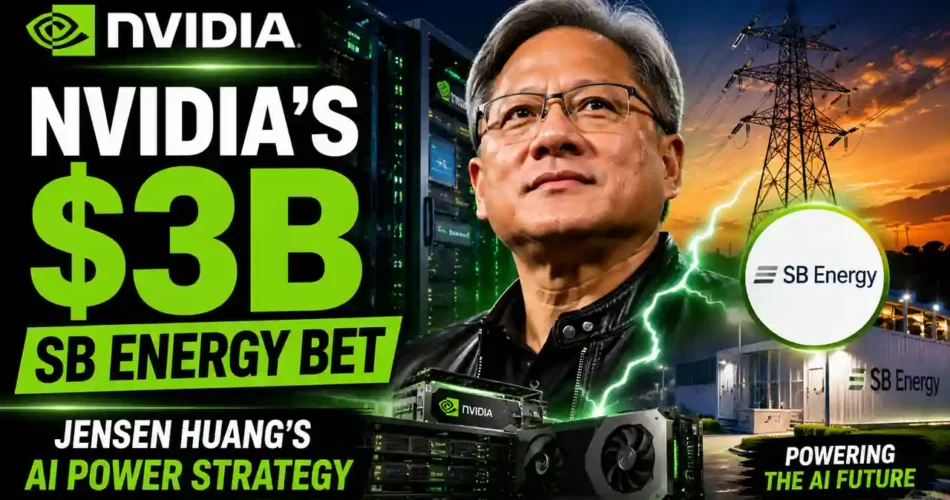
Nvidia’s $3 Billion SB Energy Investment Signals a New Era for AI Compute
Nvidia’s reported $3 billion investment in SB Energy highlights a growing reality in the artificial intelligence industry: advanced AI is no longer dependent only on better chips. It also requires enormous amounts of electricity, data-center capacity and infrastructure capable of delivering computing power at scale.
The investment puts Nvidia at the center of a broader effort to connect artificial intelligence with the energy infrastructure needed to support it. CEO Jensen Huang has repeatedly emphasized that the next stage of AI development will require massive expansion of computing capacity. Nvidia’s involvement with SB Energy underscores how closely the future of AI is becoming linked to power generation and data-center infrastructure.
Nvidia’s Growing Focus on AI Infrastructure
Nvidia became one of the defining companies of the generative AI boom through its graphics processing units, or GPUs. These processors have become essential for training and operating many of the world’s most sophisticated AI models.
However, powerful processors are only one part of the equation. AI systems require data centers containing thousands of accelerators, high-speed networking equipment, cooling systems and reliable electricity supplies.
As companies build increasingly large AI models, electricity consumption has become a major consideration. Nvidia’s interest in energy infrastructure therefore represents a logical extension of its position in the AI computing market.
Why Energy Matters to AI
AI data centers can consume substantially more electricity than conventional computing facilities because of the density of specialized processors operating continuously.
Training a major AI model can require huge computing resources, while serving millions of users also creates a persistent demand for processing power. As AI adoption expands into search, software development, robotics, healthcare, finance and other industries, the need for computing capacity is expected to rise.
That creates a potential bottleneck. Even when companies have access to advanced Nvidia hardware, they still need sufficient electrical capacity to operate it.
What the $3 Billion Investment Could Mean
The reported $3 billion commitment to SB Energy illustrates the strategic importance of controlling or supporting the infrastructure surrounding AI computing.
SB Energy is involved in large-scale energy projects, making its business closely connected to the challenge facing the AI industry. Nvidia’s investment can therefore be viewed as part of a larger infrastructure strategy rather than simply a conventional financial investment.
The broader objective is straightforward: build an ecosystem in which advanced computing hardware can be deployed alongside dependable power infrastructure.
From Chips to Complete Computing Ecosystems
Nvidia’s traditional business model has centered on selling GPUs and related technology. The rapid expansion of AI, however, has changed the competitive landscape.
Customers increasingly want complete computing platforms. These can include processors, networking systems, software, cooling technology and data-center infrastructure.
Energy is becoming another critical component. Without sufficient electricity, even the world’s most powerful AI processors cannot operate at full scale.
This makes investments connected to power generation potentially valuable to Nvidia’s long-term strategy.
Jensen Huang’s Vision for AI Compute
Jensen Huang has consistently argued that AI development will require a dramatic expansion in computing infrastructure. His comments about the future of AI have increasingly focused not only on semiconductor technology but also on the physical infrastructure required to support increasingly capable systems.
The concept of AI factories is particularly important in this discussion. Instead of thinking about data centers simply as facilities that store information and run software, Nvidia increasingly describes them as industrial-scale systems that transform electricity and computing resources into AI-generated output.
That framing helps explain why energy can become strategically important to a semiconductor company.
AI Demand Is Creating an Energy Challenge
The rapid growth of generative AI has already triggered a wave of investment in new data centers. Technology companies and cloud providers are committing billions of dollars to facilities designed specifically for AI workloads.
These facilities require reliable electricity around the clock. In some regions, power availability is becoming a factor in determining where new data centers can be constructed.
Grid connections can take years to develop, while transmission infrastructure may require substantial investment. As a result, companies are exploring alternative approaches, including direct relationships with power producers and investments in new generation capacity.
Why Renewable Energy Is Part of the Conversation
Large technology companies are also under pressure to manage the environmental impact of expanding data-center operations. Renewable energy can help companies address emissions concerns while providing additional electricity for growing workloads.
Solar and other renewable projects can therefore become part of the infrastructure strategy surrounding AI, although questions remain about intermittency, storage and grid reliability.
The challenge is not simply producing more electricity. AI operators need power that is available when computing demand requires it.
What This Means for Nvidia Investors
For Nvidia investors, the SB Energy investment could signal that management sees infrastructure as an increasingly important part of the AI opportunity.
Nvidia has benefited enormously from demand for AI accelerators. But the company also faces the risk that customers may eventually encounter physical limitations that slow deployments.
If power availability becomes a major constraint, helping expand energy infrastructure could indirectly support continued demand for Nvidia’s processors.
The strategy also demonstrates how the AI economy is spreading beyond traditional technology companies. Semiconductor manufacturers, utilities, energy developers, construction companies and data-center operators are becoming increasingly interconnected.
Potential Benefits and Risks
Potential Benefits
A stronger connection between energy infrastructure and AI computing could accelerate data-center construction and reduce some of the bottlenecks affecting AI deployment.
It could also create opportunities for more efficient energy management, particularly if computing facilities can be coordinated with new power-generation projects.
For Nvidia, the strategy may help reinforce its position as AI infrastructure becomes a larger and more complex industry.
Key Risks
The investment also carries risks. Energy projects can face regulatory delays, construction challenges, financing pressures and changing electricity-market conditions.
There is also uncertainty surrounding the pace of future AI demand. If AI infrastructure spending grows more slowly than expected, some new power projects could face weaker economics.
Another issue is the enormous capital requirement associated with expanding both data-center and energy infrastructure. The AI boom has created unprecedented investment expectations, and companies will need to demonstrate that the resulting capacity can generate sustainable returns.
The Bigger Picture for the AI Industry
Nvidia’s reported investment reflects a much larger transformation taking place across the technology sector.
In the early stages of the AI boom, attention was focused primarily on model development and semiconductor performance. Today, the conversation increasingly includes electricity, cooling, networking, land, construction and grid capacity.
That shift suggests the next phase of AI competition could depend partly on who can build the largest and most efficient physical infrastructure.
Companies that secure access to electricity and data-center capacity may have an important advantage as AI workloads continue to expand.
What Comes Next for AI Compute
The future of AI computing is likely to involve closer integration between technology and energy companies. Data-center developers may increasingly seek dedicated power arrangements, while energy companies could become strategic partners for technology firms.
Nvidia’s relationship with SB Energy could therefore be an early example of a broader trend.
The most important question is whether investments in energy infrastructure can keep pace with the explosive growth in AI computing demand. If they can, the industry may be able to continue expanding rapidly. If they cannot, power availability could become one of the biggest constraints on AI development.
Frequently Asked Questions
What is Nvidia’s reported investment in SB Energy?
The investment has been reported at approximately $3 billion and is connected to the growing need for energy infrastructure supporting AI computing.
Why would Nvidia invest in an energy company?
AI data centers require enormous amounts of electricity. Supporting energy infrastructure can help address one of the physical constraints on expanding AI computing capacity.
Who is Jensen Huang?
Jensen Huang is Nvidia’s co-founder and chief executive officer. He has been a prominent voice on the rapid expansion of AI computing and the infrastructure required to support it.
Why does AI require so much electricity?
AI workloads use large numbers of specialized processors operating at high utilization. Training advanced models and serving AI applications at scale can therefore require substantial amounts of electricity.
Could energy become a bottleneck for AI growth?
Yes. Limited grid capacity, lengthy connection timelines and the need for reliable power could constrain the construction and operation of large AI data centers in some locations.
Does Nvidia’s investment mean it is becoming an energy company?
Not necessarily. The investment is better understood as part of a broader strategy around AI infrastructure. Nvidia remains primarily a semiconductor and computing technology company.
What does this mean for the future of AI?
The development of AI is increasingly becoming an infrastructure challenge as well as a software and semiconductor challenge. Access to computing power, electricity and data-center capacity will likely remain critical to the next generation of AI systems.
Conclusion
Nvidia’s reported $3 billion investment in SB Energy highlights an important evolution in the artificial intelligence industry. The future of AI will depend not only on increasingly powerful chips but also on the energy and physical infrastructure required to operate them.
Jensen Huang’s emphasis on expanding AI compute capacity fits directly into this trend. As AI adoption accelerates, electricity could become just as strategically important as processors, networking and software.
The Nvidia-SB Energy connection therefore represents more than an individual investment. It points toward an emerging AI economy in which semiconductor technology and energy infrastructure increasingly develop together. For the technology industry, investors and policymakers, the message is clear: building the future of AI will require building the power systems capable of running it.
External References
U.S. Department of Energy – Artificial Intelligence
U.S. Department of Energy – Powering America’s AI Future: Data Center Resource Hub
U.S. Department of Energy – Partnership to Power America’s AI Future
U.S. Department of Energy – Data Center Electricity Demand Report
National Institute of Standards and Technology (NIST) – Artificial Intelligence

