

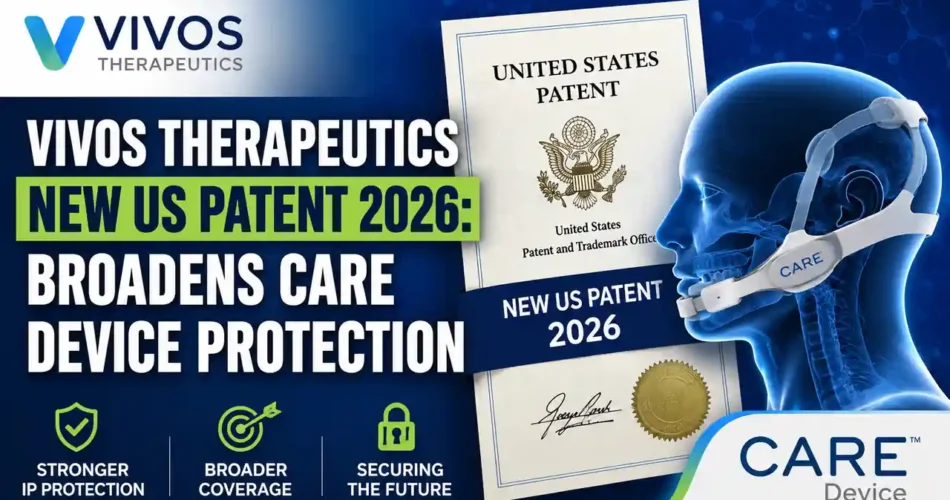
Vivos Therapeutics Issues New US Patent Broadening Protection for Vivos CARE Devices
Vivos Therapeutics, Inc. (NASDAQ: VVOS) has secured a new United States patent that significantly expands intellectual property protection for its flagship Vivos CARE oral medical device platform used to treat obstructive sleep apnea (OSA). The August 2026 patent issuance strengthens the company’s competitive moat around its FDA-cleared technology, which remains the only oral appliance system cleared for severe OSA in adults and moderate-to-severe OSA in children.
New US Patent No. 12,697,190 Expands Vivos CARE Technology Protection
Continuation Patent Builds on 2024 Foundational IP
The United States Patent and Trademark Office issued US Patent No. 12,697,190, titled “Vibrational Oral Appliance with Mandibular Advancements,” on August 5, 2026. This new ‘190 Patent is a continuation of Vivos’ previously issued US Patent No. 12,048,608 (the ‘608 Patent), which was granted on July 30, 2024.
Together, these two patents create layered, complementary coverage over Vivos’ proprietary oral medical device technology. The earlier ‘608 Patent contains more detailed, structure-specific claims that provide focused protection for a particular design embodiment of the Vivos CARE platform. The newly issued ‘190 Patent broadens the scope beyond specific structural designs, establishing design-independent claims that cover the underlying vibrational oral appliance technology with mandibular advancement features.
This dual-patent strategy gives Vivos both broad, difficult-to-design-around protection and detailed, embodiment-specific protection over its core OSA treatment technology. Company leadership stated that broader patent claims make it harder for competitors to circumvent Vivos’ innovations while reflecting continued investment in protecting the science behind improved patient outcomes.
FDA-Cleared Vivos CARE Devices Target Severe Sleep Apnea
Vivos CARE devices have received two separate and unprecedented FDA 510(k) clearances in 2023 and 2024. These clearances authorize the devices to treat severe obstructive sleep apnea in adults and moderate-to-severe OSA in children ages 6 to 17. To date, no other oral appliances have received such FDA clearances for these specific patient populations and severity levels.
Clinical studies cited by Vivos indicate that approximately 80% of patients treated with Vivos CARE devices achieve significant reductions or complete resolution of OSA symptoms, as measured by industry-standard Apnea-Hypopnea Index (AHI) scores. The devices work by targeting underlying physiological and anatomical deficiencies often associated with OSA, rather than simply managing symptoms mechanistically like traditional CPAP machines.
Market Context and Clinical Significance
Growing Demand for CPAP Alternatives
The commercial and clinical market for safe, effective alternatives to CPAP therapy has expanded considerably since 2021. Over 5 million CPAP units have been subject to FDA-mandated recalls due to safety concerns, while research has documented increased mortality and health risks associated with long-term CPAP use in certain patient populations.
More than one billion people globally—and up to 90 million Americans—suffer from sleep apnea, with approximately 80% remaining undiagnosed and unaware of their condition. OSA is a serious chronic illness that increases the risk of comorbidities including high blood pressure, heart failure, stroke, diabetes, dementia, chronic pain, and fibromyalgia.
The Vivos Method: Non-Surgical, Non-Invasive Treatment
Vivos refers to its treatment approach as The Vivos Method, which offers a proprietary, clinically effective solution that is non-surgical, non-invasive, and non-pharmaceutical. The company’s Complete Airway Repositioning and Expansion (CARE) devices target the root causes of breathing and sleep disorders arising from certain dentofacial abnormalities.
Vivos Therapeutics positions itself as a medical technology and healthcare services company focused on developing innovative diagnostic and treatment methods for patients suffering from breathing and sleep issues. Through its technology, provider education, and strategic acquisitions or collaborations with sleep healthcare providers, Vivos aims to empower clinicians to address the complex needs of OSA patients more thoroughly than legacy treatments.
Strategic IP Positioning and Competitive Advantages
Layered Patent Protection Creates Stronger Barriers
The combination of the ‘190 Patent and ‘608 Patent establishes what Vivos describes as “broad, difficult-to-design-around protection” alongside “detailed, embodiment-specific protection.” This layered approach is designed to prevent competitors from creating workarounds while maintaining enforceable claims over specific product implementations.
Kirk Huntsman, Vivos Chairman and CEO, commented that the new patent meaningfully strengthens the company’s intellectual property position around the technology underlying its most important and advanced product lines. He noted that broader, more resilient patent claims reflect Vivos’ continued investment in protecting the science behind better outcomes for OSA patients.
Supporting Commercial Growth and Market Leadership
The strengthened patent portfolio supports Vivos’ FDA-cleared Vivos CARE devices, which the company states remain the only oral appliances to receive specific FDA clearances for severe OSA in adults and moderate-to-severe OSA in children. This unique regulatory positioning, combined with expanded IP protection, reinforces Vivos’ competitive position in the obstructive sleep apnea treatment market.
With OSA and insomnia affecting over one billion adults aged 30-69 worldwide—yet 80% or more remaining undiagnosed—Vivos sees significant opportunity for growth as awareness and diagnosis rates improve. The company’s strategy includes expanding access to its technology through healthcare provider partnerships and sleep center acquisitions.
Forward-Looking Considerations and Risk Factors
Patent Enforceability and Market Dynamics
Vivos includes standard forward-looking statement disclaimers in its announcement, noting that actual results may differ from expectations due to various risks. These include the possibility that the newly issued continuation patent may have limited practical value, that either patent could be challenged or invalidated, or that new competing technology could limit the economic value of the patents.
The company also faces risks related to regulatory scrutiny of the sleep apnea treatment sector, its ability to secure additional financing, and broader market conditions that could impact business operations. Investors and stakeholders are directed to review Vivos’ SEC filings for comprehensive risk factor disclosures.
Long-Term Vision for Sleep Health Innovation
Vivos Therapeutics continues to position itself at the forefront of sleep health innovation, emphasizing that breathing and sleep disorders remain areas not fully understood by the medical community. While legacy OSA treatments like CPAP are often mechanistic and fail to address root causes, Vivos CARE oral medical devices target underlying physiology and anatomical deficiencies.
The company’s mission—summarized by its tagline “Breathe New Life”—reflects its commitment to providing hope to patients suffering from OSA through non-invasive, physiologically-targeted treatment modalities.
FAQ
Q1: What is the new Vivos patent number and when was it issued?
US Patent No. 12,697,190 was issued on August 5, 2026, by the United States Patent and Trademark Office.
Q2: How does this patent differ from Vivos’ 2024 patent?
The 2024 ‘608 Patent contains structure-specific claims for a particular design embodiment, while the new ‘190 Patent establishes broader, design-independent claims covering the underlying vibrational oral appliance technology with mandibular advancement features.
Q3: What are Vivos CARE devices cleared to treat by the FDA?
Vivos CARE devices have FDA 510(k) clearance to treat severe obstructive sleep apnea in adults and moderate-to-severe OSA in children ages 6 to 17.
Q4: Are other oral appliances FDA-cleared for severe OSA?
According to Vivos, no other oral appliances have received FDA clearance for treating severe OSA in adults or moderate-to-severe OSA in children ages 6-17.
Q5: What clinical outcomes have been reported for Vivos CARE devices?
Studies cited by Vivos indicate approximately 80% of patients achieve significant reductions or complete resolution of OSA symptoms as measured by AHI scores.
Q6: How does The Vivos Method differ from CPAP therapy?
The Vivos Method uses non-surgical, non-invasive oral devices that target underlying physiological and anatomical causes of OSA, rather than mechanically forcing airways open like CPAP machines.
Q7: How many people globally suffer from sleep apnea?
More than one billion people worldwide and up to 90 million Americans suffer from sleep apnea, with approximately 80% remaining undiagnosed.

