

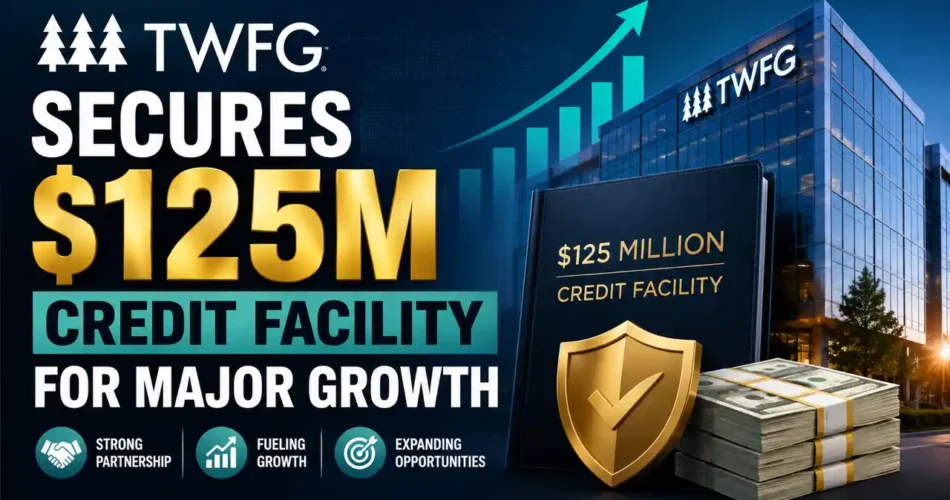
TWFG Expands Credit Facility to $125 Million, Enhancing Capacity for Continued Growth and Strategic Investments
TWFG Holdings has expanded its revolving credit facility to $125 million, giving the insurance distribution company greater financial flexibility to support future growth, acquisitions, technology investments, and other strategic initiatives.
The amended and restated credit agreement also extends the facility’s maturity to August 12, 2031. In addition, the agreement includes an uncommitted accordion feature that could allow TWFG to seek up to $75 million in additional lender commitments, potentially increasing total borrowing capacity to $200 million.
TWFG Increases Revolving Credit Capacity
TWFG entered into an amended and restated credit agreement that provides a $125 million revolving credit facility. PNC Bank, National Association, serves as the administrative agent for the facility.
The expanded credit arrangement is designed to strengthen TWFG’s liquidity position and provide additional funding flexibility as the company continues to grow its insurance distribution platform. The company can use the facility for permitted acquisitions, working capital requirements, technology investments, and general corporate purposes.
Increasing the facility gives TWFG access to a larger pool of committed capital without requiring the company to immediately draw the full amount. This allows management to deploy funds when suitable opportunities become available while maintaining flexibility across different market conditions.
Potential Borrowing Capacity Could Reach $200 Million
One of the notable features of the new agreement is the uncommitted accordion provision. Under this arrangement, TWFG may seek up to an additional $75 million in lender commitments, subject to lender approval and other applicable conditions.
If the additional commitments are secured, the company’s potential total borrowing capacity could increase to $200 million. The accordion feature gives TWFG an opportunity to expand its financing resources without having to renegotiate the entire credit agreement.
However, the additional $75 million is not automatically available. It represents potential capacity that would depend on lender participation, company performance, financial conditions, and the terms agreed upon at the time of any future expansion.
Credit Facility Supports Acquisition Strategy
TWFG operates in the insurance distribution industry, a market that includes a large number of independent agencies and specialized insurance businesses. This fragmented market can create opportunities for companies with sufficient capital, operating expertise, and integration capabilities.
The expanded facility could help TWFG pursue acquisitions more efficiently. Access to committed financing may allow the company to respond more quickly when attractive acquisition opportunities arise.
Faster Execution on Opportunities
In competitive acquisition processes, transaction certainty can be an important advantage. A larger revolving facility may give TWFG greater confidence when evaluating potential transactions and negotiating with agency owners.
With financing resources available, the company may be able to reduce its dependence on transaction-specific financing arrangements. This could help simplify the acquisition process and support faster execution, although every transaction will still depend on valuation, due diligence, financing terms, and regulatory considerations.
Supporting Integration and Expansion
Acquisitions often require investment after closing. TWFG may use part of its available capacity to support the integration of acquired agencies, upgrade systems, retain employees, and expand service capabilities.
Successful integration can help an insurance distribution company improve operational efficiency, strengthen customer relationships, and create opportunities for cross-selling. The expanded facility may therefore support not only the purchase of businesses but also the resources required to develop them after acquisition.
Investment in Technology, Data, and Artificial Intelligence
TWFG has indicated that the expanded financing capacity may also support investments in technology, data, and artificial intelligence-enabled capabilities. These areas are becoming increasingly important across the insurance industry.
Technology can help insurance distributors improve customer service, streamline administrative processes, enhance reporting, and provide agents with better tools. Data analytics may also help management identify trends, measure performance, and make more informed decisions.
Improving Operational Efficiency
Modern systems can reduce manual processes and improve communication between agencies, employees, carriers, and customers. Investments in digital infrastructure may also help TWFG standardize operations as its platform expands.
Greater efficiency can be particularly valuable for a company pursuing growth through acquisitions. Integrating new businesses into a common technology and reporting environment may help management monitor performance and identify potential improvements.
Developing AI-Enabled Capabilities
Artificial intelligence may provide opportunities in areas such as workflow automation, customer support, data analysis, and internal decision-making. The effectiveness of these investments will depend on implementation quality, data security, regulatory compliance, and employee adoption.
Technology investments also carry risks, including higher costs, cybersecurity concerns, system integration challenges, and uncertain returns. TWFG will need to maintain disciplined capital allocation as it evaluates these initiatives.
Extended Maturity Improves Financial Flexibility
The credit facility’s maturity has been extended to August 12, 2031. A longer maturity period can give TWFG more time to execute its growth strategy and reduce the need to refinance the facility in the near term.
Longer-dated financing may also improve planning visibility. Management can evaluate acquisitions and capital investments with a clearer understanding of the availability period for the facility.
Nevertheless, the facility remains subject to its contractual terms, including interest costs, financial covenants, borrowing limits, and other conditions. The amount ultimately drawn by the company will determine the impact on debt levels and interest expenses.
What the Expansion Means for TWFG
The expanded credit facility does not necessarily mean that TWFG has immediately increased its outstanding debt. A revolving credit facility provides access to capital, but debt generally increases only when the company draws funds.
This distinction is important for investors. The $125 million facility represents available borrowing capacity rather than a direct increase in debt equal to the full facility amount.
TWFG’s future financial position will depend on how much of the facility it uses, how effectively it invests the funds, and whether acquisitions or other initiatives generate sufficient returns to offset borrowing costs.
Potential Benefits for Investors
Investors may view the expanded facility as a sign that TWFG is preparing for additional growth opportunities. The financing could support revenue expansion, strategic acquisitions, technology upgrades, and broader platform development.
If the company deploys the capital prudently, the facility may help TWFG increase its scale and strengthen its competitive position in the insurance distribution market.
However, investors should also consider the risks associated with debt-funded growth. Higher borrowing can increase interest expenses and financial obligations. Acquisitions may not always perform as expected, and integration challenges could affect profitability.
Key Risks to Monitor
Although the expanded facility provides useful flexibility, it does not eliminate the risks associated with growth and capital allocation.
- Leverage risk: Significant borrowing could increase TWFG’s debt burden and reduce financial flexibility.
- Interest-rate risk: Higher interest rates could increase the cost of borrowing under the facility.
- Acquisition risk: Purchased agencies may not deliver expected revenue, earnings, or operational synergies.
- Integration risk: Combining systems, teams, and processes may take longer or cost more than anticipated.
- Technology risk: Investments in data and artificial intelligence may produce uncertain returns or create cybersecurity challenges.
- Market risk: Changes in insurance demand, commission structures, regulations, or competition could affect performance.
TWFG’s ability to manage these risks will be important as it decides how quickly and extensively to use the expanded credit capacity.
Strategic Outlook
The $125 million revolving credit facility gives TWFG a stronger foundation for pursuing its long-term business objectives. The additional liquidity may help the company respond to acquisition opportunities, invest in its operating platform, and develop new technology-driven capabilities.
The potential to seek another $75 million in lender commitments adds a further layer of financial flexibility. However, the value of the facility will ultimately depend on disciplined execution, careful due diligence, and the company’s ability to generate sustainable returns from its investments.
For TWFG, the expanded credit facility represents an important financial resource rather than a guarantee of future growth. Management’s capital allocation decisions, operating performance, and ability to integrate new businesses will determine how effectively the company converts this borrowing capacity into long-term value.
Frequently Asked Questions
What is TWFG’s new credit facility?
TWFG’s amended credit agreement provides a $125 million revolving credit facility. The facility is intended to support acquisitions, organic growth, technology investments, working capital, and general corporate needs.
When does the credit facility mature?
The maturity of the credit facility has been extended to August 12, 2031.
Can TWFG increase the facility beyond $125 million?
Yes. The agreement includes an uncommitted accordion feature that may allow TWFG to seek up to $75 million in additional lender commitments. If approved, potential total borrowing capacity could reach $200 million.
Does the expanded facility mean TWFG has borrowed $125 million?
No. The $125 million represents the facility’s borrowing capacity. TWFG’s outstanding debt would increase only when the company draws funds under the agreement.
How could TWFG use the additional financing?
TWFG may use the financing to pursue acquisitions, fund working capital, expand organically, and invest in technology, data, and artificial intelligence-related capabilities.
Why are credit facilities important for insurance companies?
Credit facilities can provide insurance companies and distributors with flexible access to capital. They may help fund acquisitions, manage cash flow, support expansion, and respond quickly to strategic opportunities.
What are the main risks associated with the facility?
The main risks include higher leverage, increased interest expenses, acquisition-related challenges, integration difficulties, technology costs, and changes in market conditions.
What should investors watch next?
Investors should monitor TWFG’s borrowing levels, acquisition activity, integration results, technology spending, revenue growth, profitability, and ability to generate returns from its strategic investments.

