

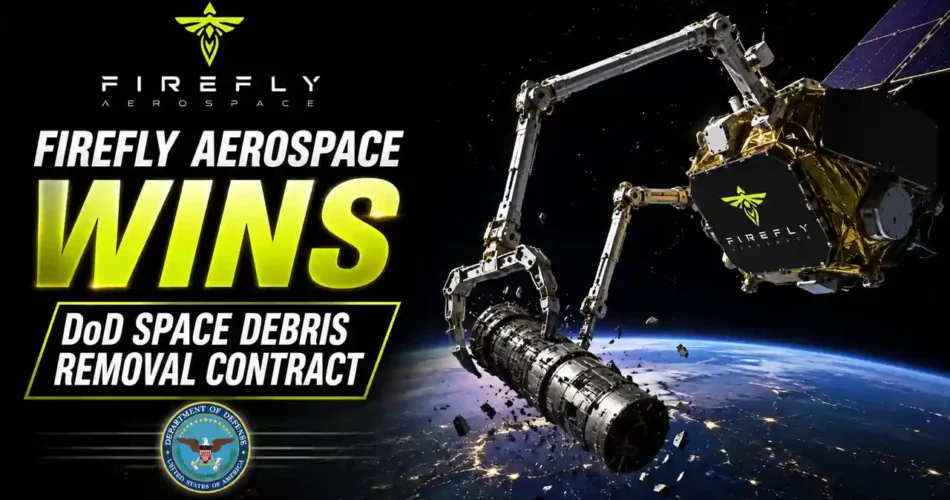
Firefly Aerospace Wins Department of Defense Contract to Support Space Debris Removal
Space debris — defunct satellites, spent rocket stages, and fragments from past collisions — is an increasingly urgent risk for both military and commercial space operations. In response, the U.S. Department of Defense has awarded a contract to Firefly Aerospace to develop and support debris-removal capabilities. The award marks a significant step in the government’s effort to protect valuable orbital assets and ensure safe access to space for national security and civilian missions.
Why space debris matters now
Low Earth orbit (LEO) hosts thousands of operational satellites that provide communications, navigation, reconnaissance, and scientific services. Over the past two decades the number of objects in orbit has grown rapidly, driven by increasing launch cadence, large satellite constellations, and legacy hardware left in orbit. Even small pieces of debris—millimeter-sized paint flecks—can damage spacecraft because of the extreme relative speeds involved.
For the military, space situational awareness and resilient satellite networks are critical. A collision or cascading debris event (a “Kessler Syndrome” scenario) could degrade national security capabilities and commercial services alike. The DoD’s contract with Firefly signals a proactive posture: remove or mitigate debris before it poses imminent risks to high-value systems.
What Firefly Aerospace will deliver
The contract covers development work and operational support tailored to debris removal and related on-orbit servicing tasks. While program specifics and budgetary figures remain limited in public announcements, the scope typically includes:
- Designing or adapting spacecraft capable of rendezvous, capture, and deorbit of debris items.
- Integrating sensors and guidance systems for precise approach and proximity operations.
- Developing mission planning, ground-control infrastructure, and software tools to support operations.
- Testing and demonstration flights to validate techniques such as nets, robotic arms, harpoons, or propulsion-tug approaches.
- Ensuring compliance with safety and international norms for on-orbit operations.
Firefly brings recent experience in small- to medium-class launch vehicles, spacecraft development, and rapid mission cadence—strengths the DoD likely evaluated when selecting contractors. The company’s expertise in manufacturing and integrated systems can shorten development timelines, which is important because the debris problem is time-sensitive.
Technologies and approaches under consideration
There are several technical approaches to removing debris; a few examples the Firefly program may explore or integrate:
- Active capture using robotic manipulators or grappling mechanisms for large, trackable objects.
- Net or harpoon systems to secure and deorbit smaller intact payloads or upper stages.
- Tethered drag augmentation or deployable sails to accelerate atmospheric reentry for objects that retain some mass.
- Propulsive “tug” vehicles that attach to debris and move it to a graveyard orbit or toward reentry.
- Autonomous guidance, navigation, and control (GNC) coupled with machine-vision sensors for safe proximity operations.
Each approach has trade-offs in cost, risk, and applicability to different types and sizes of debris. The DoD’s contract likely funds evaluations and prototype demonstrations to determine the most reliable methods for prioritized debris classes.
Strategic and policy implications
The DoD’s involvement underscores that debris mitigation is not purely a civil or commercial matter. Key strategic considerations include:
- Protecting national security assets: Ensuring satellites delivering critical services remain available and survivable.
- Deterrence and norms: Demonstrating responsible behavior in orbit—such as removing derelict objects—supports norms that reduce escalation or misinterpretation of intent.
- Partnerships: Contracts with commercial firms like Firefly can accelerate capability deployment by leveraging private-sector innovation and manufacturing scale.
- Regulatory and legal aspects: On-orbit removal raises questions about ownership, liability, and approval processes. The U.S. government must navigate international law and coordination with other spacefaring nations.
The contract could also spur industry collaboration. If Firefly’s systems prove effective, similar services could be offered commercially, creating a new sector for on-orbit servicing and space sustainability solutions.
Operational challenges and risk management
Removing debris is technically and operationally complex. Some of the main challenges are:
- Identification and tracking: Accurately tracking small or irregular objects, especially in congested orbital regimes.
- Safe rendezvous: Approaching tumbling or unpredictable objects without creating new fragments.
- Legal authorization: Securing permission to remove objects that may be owned by other countries or private entities.
- Cost-effectiveness: Building systems that provide measurable risk reduction at acceptable program costs.
- Reliability and redundancy: Designing capture systems that operate correctly in the harsh environment of space.
To mitigate these risks, the DoD and contractors typically employ phased development: concept studies, ground testing, subsystems demonstrations, followed by limited on-orbit demonstrations before scaling operations. This staged approach reduces program risk while validating key technologies in progressively realistic environments.
Why industry involvement matters
Private companies like Firefly accelerate innovation through iterative development, flexible manufacturing, and commercial funding models. Their participation enables:
- Faster prototyping and shorter development cycles compared with traditional, purely government-led programs.
- Economies of scale and potential for commercial service offerings that share costs across customers.
- Cross-pollination of technologies between launch, satellite manufacturing, and on-orbit servicing sectors.
For Firefly, winning the DoD contract provides a chance to expand capabilities beyond launch services into a broader space-systems portfolio. For the DoD, partnering with industry taps into cutting-edge solutions that can be deployed more rapidly than purely internal programs.
Broader impact on the space ecosystem
An operational debris-removal capability could produce wide-ranging benefits:
- Reduced collision risk for satellites in crowded orbits, preserving valuable orbital real estate.
- Greater confidence for commercial operators and constellations, potentially lowering insurance and operational costs.
- Incentives for better end-of-life practices, such as passivation and controlled reentry, if removal services are available for high-risk objects.
- Advancement of international cooperation by demonstrating practical solutions countries can adopt or support collectively.
While a single contract does not solve the debris problem, it represents momentum toward practical interventions and establishes operational experience that can scale over time.
Frequently Asked Questions
Q: What exactly is space debris?
A: Space debris includes defunct satellites, spent rocket stages, fragments from explosions or collisions, and small objects like paint flakes or bolts orbiting Earth. Even small pieces can damage an operational satellite due to high relative velocities.
Q: Why is the DoD interested in debris removal?
A: The DoD relies on satellites for communications, navigation, intelligence, and early warning. Debris threatens those systems and could impair national security capabilities, so the DoD invests in mitigation and removal to protect assets.
Q: Does Firefly plan to remove debris itself or build technologies for others?
A: Public details are limited, but contracts of this type typically fund both technology development and demonstration missions. Firefly may build and operate removal systems or supply technology and services to DoD programs.
Q: How does debris removal affect international law and ownership?
A: Removing an object often requires consent from its owner because space law (including the Outer Space Treaty) ties objects to their launching state. Programs coordinate with owners and international partners to address legal and diplomatic issues.
Q: When will we see an operational debris-removal vehicle?
A: Timelines vary by program, but staged development means demonstrations could occur within a few years, with scalable operational capabilities following successful tests and policy approvals.
Q: Could debris-removal technology be used for hostile purposes?
A: Dual-use concerns exist; systems capable of approaching and manipulating satellites could conceivably be repurposed. Transparent oversight, rules of engagement, and international norms are important to minimize misuse.

