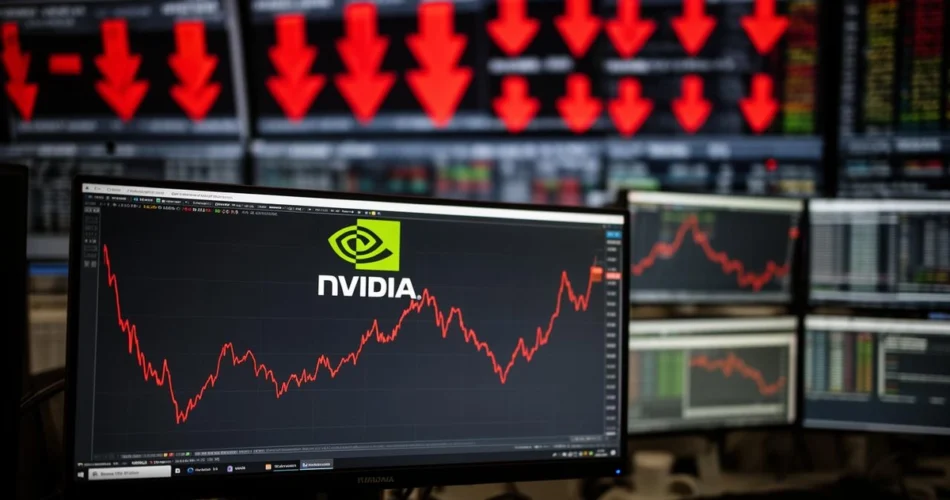
Technology shares dragged the S&P 500 and Nasdaq Composite lower on Monday, while the Dow Jones Industrial Average managed a modest gain, as investors braced for a week headlined by Nvidia’s quarterly results, a key inflation report and a high-stakes speech from Federal Reserve Chair Kevin Warsh.
The Dow rose 140.15 points, or 0.26%, to 53,417.16. The S&P 500 fell 21.51 points, or 0.28%, to 7,652.86, and the Nasdaq Composite lost 200.26 points, or 0.76%, to 25,980.19.
Semiconductor stocks bore the brunt of the selling. Nvidia (NVDA) dropped 2.9%, extending its losing streak to seven consecutive sessions, the longest since September 2022. Micron Technology fell 5.8%, Broadcom slid 2.6% and the Philadelphia Semiconductor Index closed down 2.7%. The S&P 500 Information Technology sector led sectoral losses, falling 1.11%.
Reports that Nvidia plans to raise prices on AI servers by more than 15% due to higher memory chip costs added to the cautious tone. The price increases are expected to affect systems delivered early next year, including models built around the Vera Rubin and Grace Blackwell platforms.
“Chips have become a frothy space. I just don’t know what good news hasn’t already been priced in,” said Marta Norton, chief investment strategist at Empower. “It doesn’t necessarily mean that the fundamentals are challenged. You can have a great company, but that doesn’t necessarily make it a great investment at a given point in time.”
Beyond semiconductors, sentiment around the broader AI complex took another hit after Texas Governor Greg Abbott issued one of the starkest warnings yet from a Republican to the data center industry. Abbott said data center companies “dug their own grave” and deserved the backlash they are facing after failing to win community support, Axios reported. He has already ordered a pause on approvals of new data center projects through the state’s grid interconnection process, citing reliability concerns as electricity demand surges.
“The bigger worry we have is the hawkish rhetoric we’re starting to hear from politicians on AI and data centers,” said Ohsung Kwon, chief equity strategist at Wells Fargo. “We’ve been highlighting that as a big risk heading into the midterms.”
Financials offered a counterweight. JPMorgan Chase rose 1.4% and Visa gained 3%, helping keep the blue-chip Dow in positive territory.
Iran Sanctions and Treasury Market Turbulence
The Trump administration announced on Monday a possible expansion of sanctions on countries doing business with Iran as part of what it billed as an “economic D-Day,” but stopped short of actually imposing penalties. Treasury Secretary Scott Bessent described the effort as “the greatest financial offensive ever” and warned that any country, financial institution or company continuing to do business with Iran could face secondary sanctions.
Iran’s parliamentary speaker dismissed the threats, saying Tehran’s trading partners “don’t take these comments seriously” and that the United States lacks the economic power to further restrict other countries’ relationships.
The geopolitical tension has kept energy markets on edge, though crude prices actually fell on Monday. West Texas Intermediate crude for October delivery declined $2.05 to settle at $85.01 a barrel, while Brent crude dropped $2.22 to $92.17 a barrel.
Longer-term Treasury yields pulled back from last week’s spike, with the 10-year yield falling 3.4 basis points to 4.703% and the 30-year yield down 4.6 basis points to 5.230%. The 30-year had touched a 19-year high before the Treasury announced support measures last week.
CNBC reported Monday that Bessent could tap the Treasury’s near $1 trillion General Account to help fund bond buybacks rather than issuing short-term bills. The account currently holds roughly $950 billion, well above the Biden administration’s target range of $550 billion to $600 billion.
The turbulence has sharpened focus on Warsh’s speech at the Jackson Hole symposium on Friday, where investors will look for clues on how policymakers view the Treasury’s rescue efforts.
“Nvidia needs to impress in order to keep one leg of the stock market stable, and Warsh needs to provide clarity on interest rates in order to keep the other leg stable,” said Richard Reyle, chief investment officer at Questar Capital Partners.
Morgan Stanley economists said Warsh’s first Jackson Hole speech is unlikely to resolve investor confusion over the Treasury’s bond market intervention, noting that last week’s expansion of bond buybacks signals the department is already uncomfortable with the rise in long-term rates.
Auto Tariffs Add Another Layer of Uncertainty
President Donald Trump warned that tariffs on cars, trucks and automotive parts from Canada would be increased to 50% starting January 1 after trade talks collapsed over the weekend.
Ford fell 3.3% and General Motors declined 1.1%, while trucking company J.B. Hunt Transport dropped about 5.7%. The news also pushed the Canadian dollar lower. By contrast, shares of U.S. steel producers Nucor and Steel Dynamics jumped to record highs on expectations of windfall gains from higher barriers for foreign competitors.
What’s Ahead This Week
Investors face a packed calendar. The Personal Consumption Expenditures report, the Fed’s preferred inflation gauge, is due Wednesday. It follows a benign consumer inflation report earlier this month that reduced the chances of an immediate rate increase. Traders expect one 25-basis-point hike by the end of 2026, according to LSEG data.
Nvidia’s quarterly results, due Wednesday after the market close, are expected to be another key catalyst. Analysts are looking for revenue to nearly double to around $92 billion, leaving the company facing unusually high expectations after the AI-driven rally.
“It’s a pivotal week,” said one market strategist. “Between Nvidia, PCE and Jackson Hole, there are three events that could each independently move the market.”
Declining issues outnumbered advancers by a 1.08-to-1 ratio on the NYSE. On the Nasdaq, 1,955 stocks rose while 2,934 fell. Volume on U.S. exchanges was 14.36 billion shares, compared with the 16.5 billion average over the last 20 trading days.
Source link
Author

- Ytv Market News
- Share-market news writer and analyst with deep experience covering equities, commodities, forex, and cryptocurrencies for readers in the USA, UK, Canada, and Australia. Ytv Market News delivers timely market updates, practical trading insights, and clear explanations of macro and company-level catalysts that move prices. Combines on-the-ground financial reporting with technical analysis, using concise charts and actionable ideas to help investors and traders make smarter decisions.
Latest entries
 AustraliaAugust 25, 2026Integral Diagnostics Lifts FY26 Earnings as Capitol Synergies Beat Expectations
 UsaAugust 25, 2026Here’s How Much the Average 401(k) Match Could Be Worth by Retirement
 AustraliaAugust 25, 2026SkinKandy: FY26 earnings lift 41% as store growth outpaces forecast
 Crypto NewsAugust 25, 2026Stablecoin ID rules should exclude P2P transfers: BA