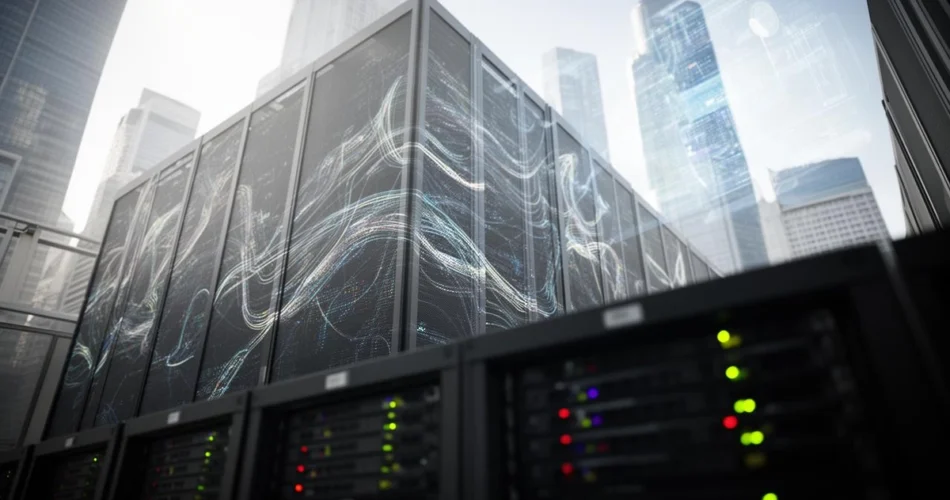
HTX Research, the research arm of cryptocurrency exchange HTX, has released a new report examining where U.S. artificial intelligence stocks currently sit in their market cycle. The report’s core thesis is that the AI industry and AI stocks are not synchronized in their cycles—technology diffusion remains in its early stages, but capital expenditure, valuation levels, and investor sentiment have already surged far ahead, creating a misalignment where “the industry is not in a bubble, but the financial architecture already shows speculation.”
The report, titled “The Industrialization of Intelligence and Bubble Cycles: Token Economics, Capex, and the Repricing of Risk-Reward in U.S. AI Stocks,” was published on August 23, 2026. It argues that the market’s pricing logic for AI stocks is undergoing a fundamental transformation.
Pricing Variables Shift from Scarcity to Cash Flow
The report notes that the market initially priced in the scarcity of GPUs, high-bandwidth memory, servers, and data center capacity, and subsequently reflected the capability gains delivered by frontier models and coding agents. Entering 2026, however, the variables driving stock returns are shifting away from model parameter counts and capex scale toward token production costs, task completion reliability, usage intensity, enterprise workflow penetration, and whether massive AI investments can generate sustainable free cash flow.
Behind this shift is a dramatic expansion in capital expenditure. J.P. Morgan Asset Management estimates that five U.S. hyperscalers will spend approximately $697 billion (roughly NT$22.2 trillion) on capex in 2026, with capex as a share of operating cash flow climbing from approximately 33% in 2023 to a projected 93%. The report stresses that once capex consumes the vast majority of operating cash flow, market attention inevitably pivots from revenue growth to capital returns.
The Bubble Exists in Financial Architecture, Not the Industry Itself
The report draws a clear distinction between industry fundamentals and financial markets. Cloud revenue, coding agent adoption rates, semiconductor sales, and enterprise demand are all growing in real terms, indicating that AI technology itself is not a false narrative. However, capital expenditure, external financing, data center projects, private model valuations, and several high-multiple second-tier stocks increasingly exhibit speculative characteristics.
The report further argues that surface-level P/E ratios fail to reflect true valuation levels. Alphabet (GOOGL), for example, has its P/E ratio distorted by investment income; Amazon (AMZN) also does not reflect normalized valuation in its current accounting profits. What truly holds value are companies that achieve the tightest alignment among normalized valuation, competitive moats, cash flow, and AI optionality.
Based on current prices and cycle positioning, the report identifies Alphabet as offering the most attractive overall risk-reward asymmetry. The research team applied the same framework to Microsoft (MSFT), Meta (META), TSMC (TSM), NVIDIA (NVDA), Amazon, Oracle (ORCL), Micron (MU), AMD (AMD), Arista (ANET), and Vertiv (VRT), with the goal of distinguishing companies with high fundamental win rates from those whose valuations already demand near-perfect execution.
Shifts in Crypto Investor Allocation Behavior
The report also explores how AI themes are influencing asset allocation behavior among cryptocurrency investors. As companies such as NVIDIA, Micron, TSMC, Broadcom (AVGO), Meta, and Alphabet enter the everyday portfolios of crypto users—alongside gold, crude oil, ETFs, and pre-IPO assets—a growing number of users are treating crypto assets and U.S. stocks as different allocation directions within a single global risk-asset system.
HTX describes itself as one of the earliest cryptocurrency exchanges to systematically advance in this direction. According to data disclosed in August 2026, the platform’s TradFi perpetual contracts segment has surpassed $2.5 billion (approximately NT$80 billion) in cumulative trading volume, supporting more than 170 TradFi-related assets spanning U.S. stocks, ETFs, gold, silver, crude oil, AI semiconductors, memory, aerospace, and pre-IPO themes such as OpenAI and Anthropic.
The model’s operational foundation rests on the platform’s existing crypto user base. Users holding stablecoins such as USDT can directly trade TradFi assets within the same account, without needing to open a brokerage account or transfer funds into a separate financial system. When risk appetite declines, users can allocate to gold, ETFs, or large-cap tech stocks; when risk appetite recovers, they can increase exposure to crypto assets and high-beta AI assets.
The report concludes that the competitive frontier among trading platforms is shifting—from spot markets, derivatives, liquidity, and listing speed toward a broader competition encompassing multi-asset access, wealth management, and AI investment tools. For platforms with durable competitive advantages, the core capability will evolve from pure trade execution to global asset allocation.
Source link
Author

- Ytv Market News
- Share-market news writer and analyst with deep experience covering equities, commodities, forex, and cryptocurrencies for readers in the USA, UK, Canada, and Australia. Ytv Market News delivers timely market updates, practical trading insights, and clear explanations of macro and company-level catalysts that move prices. Combines on-the-ground financial reporting with technical analysis, using concise charts and actionable ideas to help investors and traders make smarter decisions.
Latest entries
 Investing InsightsAugust 24, 2026S&P 500 CAPE Hits 42.2 — Highest in 26 Years, Why It’s Different From the Dot-Com Bubble — BigGo Finance
 Crypto NewsAugust 24, 2026Bitcoin Breakout Meets Skepticism Across Prediction Markets
 Crypto NewsAugust 24, 2026Cardano Price Forecast: ADA rally pauses as profit taking kicks in
 CanadaAugust 24, 2026Canadian Investment Regulatory Organization Trading Halt