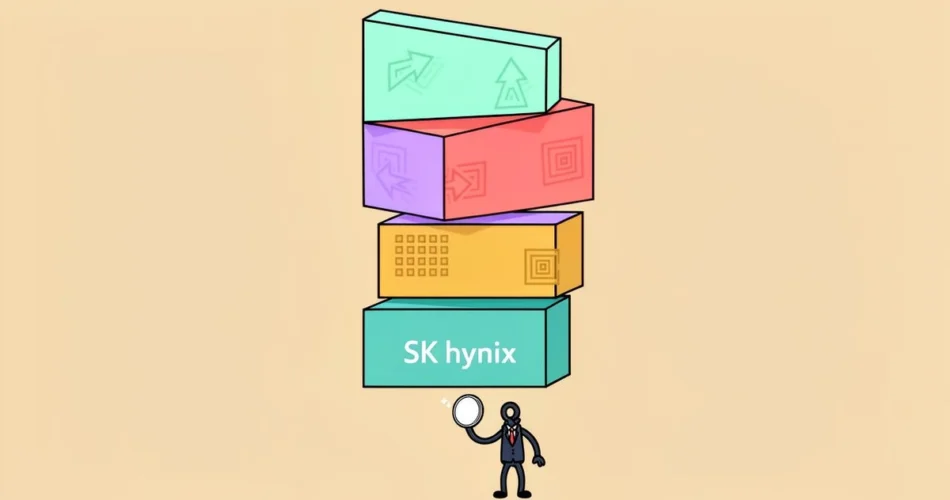
SK Hynix captured market attention with a surprise announcement of a 40 trillion won (approximately $28.9 billion) share buyback and cancellation plan. The company will purchase 24.07 million shares by November 19 and cancel them in full. JPMorgan assessed the announcement as coming “much sooner than expected,” noting that the market had anticipated a related announcement around late September, making this more than a month ahead of schedule.
However, immediately following the large-scale shareholder return announcement, SK Hynix found itself embroiled once again in controversy over potential shareholder value destruction surrounding the Nasdaq listing of its U.S. NAND subsidiary, Solidigm. On August 24, the day after the buyback announcement, the Korea Corporate Governance Forum issued a statement pointing to “ineffective shareholder return measures and an unprecedented ‘five-tier overlapping listing’ scheme,” urging governance improvements.
The controversy traces back to January. SK Hynix announced a restructuring plan to convert the existing Solidigm—established to acquire Intel’s NAND business—into an “AI company,” with a newly created Solidigm placed beneath it. The NAND business was subsequently transferred to the new Solidigm entity. Recent reports of U.S. disclosure personnel hiring have lent weight to speculation about a Nasdaq listing.
Shareholder discontent centers on the potential for value destruction through overlapping listings. If Solidigm goes public, it would create a five-tier overlapping listing structure: SK Inc. → SK Square → SK Hynix → U.S. AI company → Solidigm. The Corporate Governance Forum raised its voice, stating, “Now is not the time to pursue a five-tier overlapping listing, but rather the time to resolve the existing three-tier overlapping listing of SK Inc.-SK Square-SK Hynix.”
The Forum also expressed skepticism about the share cancellation plan itself. Pointing out that SK Hynix issued 40 trillion won in ADRs (American Depositary Receipts) in early July, followed immediately by the 40 trillion won buyback and cancellation announcement, it dismissed the move: “Considering the ADR issuance scale, even if cancellation proceeds, shareholder returns are effectively nonexistent.” The Forum also noted that the company’s plan to “return more than 50% of cumulative free cash flow (FCF) generated from 2025 to 2027” would be difficult to reconcile with the Solidigm listing issue.
The statement emphasized that SK Hynix’s board cannot be absolved of responsibility simply because Solidigm and its parent are U.S. entities. Under the revised South Korean Commercial Act, directors are obligated to protect the interests of the company and all shareholders and to treat shareholders equitably.
In particular, the Forum demanded specific clarification regarding suspicions surrounding Noh Jong-won, Solidigm’s CEO. Following reports that Noh—who until a few weeks prior had been an SK Hynix president—established a California-based PE fund called TechBridge Investment after his departure to pursue a stake acquisition, the Forum urged full disclosure of the founding shareholders and limited partners (LPs). The opacity surrounding who decides and where the massive funds would flow if the formerly loss-making subsidiary, now rapidly growing, were to have its stake sold, was identified as a root cause of SK Hynix’s price-to-earnings ratio (PER) remaining at just 3x.
The Forum recommended that both SK Hynix and Samsung Electronics shift their shareholder return frameworks from free cash flow-based metrics to a “target capital structure policy.” The advice: the board should determine an appropriate level of surplus cash, disclose it transparently, and focus on share buybacks and cancellations during periods of extreme undervaluation. The statement concluded by noting that just as it took Apple more than five years to achieve a valuation re-rating, management and the board must exercise patience and devote full effort to protecting shareholder rights.
This controversy demonstrates that SK Hynix’s shareholder return policy is directly tied to governance transparency, extending far beyond the mere scale of share buybacks. While JPMorgan expressed surprise at the “sooner than expected” cancellation announcement, market attention is now shifting from whether the November cancellation will be completed to the trajectory of Solidigm’s listing plans and the governance restructuring roadmap.
Source link
Author

- Ytv Market News
- Share-market news writer and analyst with deep experience covering equities, commodities, forex, and cryptocurrencies for readers in the USA, UK, Canada, and Australia. Ytv Market News delivers timely market updates, practical trading insights, and clear explanations of macro and company-level catalysts that move prices. Combines on-the-ground financial reporting with technical analysis, using concise charts and actionable ideas to help investors and traders make smarter decisions.
Latest entries
 IndiaAugust 25, 2026Vedanta deploys portable rigs for gold, critical mineral exploration in Chhattisgarh
 Company Press ReleasesAugust 25, 2026Gjensidige hosts its Analyst Day 2026 today
 Company NewsAugust 25, 2026Die United-Rentals-Aktie zeigt Stabilität vor Dividendenausschüttung
 Stock Market VideosAugust 25, 2026Costly US Bond Sales,‘SaaSpocalypse’, Rare Earth Investments |Bloomberg Businessweek Daily 8/13/2026