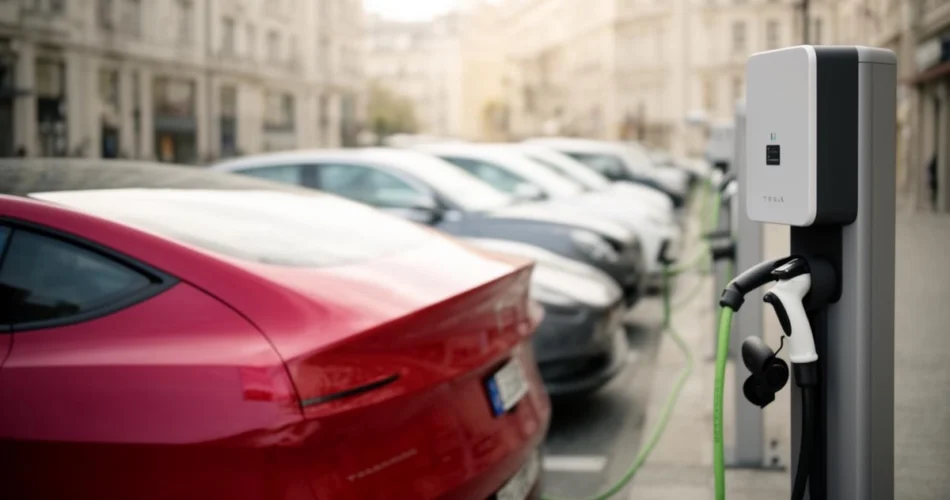
Electric vehicle registrations accelerated across Europe in July, pushing EVs to more than a quarter of new-car sales in the region’s largest markets as high fuel costs, government incentives and a wave of cheaper models reshape consumer behavior.
Data from industry group E-Mobility Europe and research firm New Automotive show pure-electric registrations climbed 13% year over year in July across 16 markets that together account for more than 90% of car sales in the European Union and the European Free Trade Association. EVs made up 25.7% of all new cars sold in those markets that month.
The momentum has been building since February, when the conflict involving Iran, the United States and Israel sent oil prices higher and made filling a combustion-engine tank considerably more expensive. The shift has left automakers and analysts debating whether demand can hold up if pump prices eventually retreat.
“People are looking for ways to protect themselves from volatility in fuel prices and EVs are a great way to do that,” Adam Wood, managing director of Renault UK, said at the French automaker’s dealership in Letchworth, about 64 kilometers north of London. “We’re at a tipping point where EVs are part of the mainstream.”
Two years ago, electric models accounted for just 10% of Renault’s UK sales. By July of this year, that figure had climbed above 50% of orders. The Renault 5, a revived version of the company’s best-selling model originally launched in 1972, was Britain’s top-selling electric car last month. The model now offers a curvier design and up to 250 miles of range.
Renault plans to add the electric Twingo later this year with a starting price below £20,000 (US$26,984), before any potential UK government subsidy for which the company hopes to qualify.
For some buyers, the economics are already compelling. Charlotte Merrell, 32, recently purchased an electric Renault Megane as her first EV. Charging at home costs her a little more than £1, compared with £60 for her previous combustion-engine model. She described the switch as “the best decision I ever made” and said there is “no chance” of returning to a gasoline car.
In the first half of the year, EU electric vehicle sales rose 40.5% from the same period in 2025 to more than 1.2 million cars, or 20.7% of all sales, according to industry data.
The surge in interest is visible beyond traditional dealerships. Amsterdam-based online marketplace OLX reported that customer inquiries for EVs jumped sharply across its platforms in France (84%), Romania (59%), Portugal (30%) and Poland (19%) since the conflict began. Chinese brands known for affordable models account for a growing portion of EV listings, the company said.
“People are getting far more confident around this new technology,” said OLX chief executive officer Christian Gisy.
A late July survey of 1,000 users by German online marketplace Carwow found that 62% of respondents consider switching to an EV the best long-term response to persistently high fuel costs.
France has emerged as a standout market. In the year through July, EVs represented 29% of new-car sales. In July alone, the figure hit a record 35%, up from 17% a year earlier, as the country’s “social leasing” subsidy program for lower-income buyers took effect. Marie-Laure Nivot, head of automotive market analysis at AAA Data, said the program “creates an environment that accelerates the transition” to electric vehicles.
The picture is markedly different in the United States, where the Trump administration eliminated a federal EV tax break last year. Second-quarter EV sales rose 15% from the first quarter but fell more than 20% year over year. Cox Automotive projects US EV sales will decline 23% in 2026 versus 2025, leaving the segment with a market share of just 6.2%.
Even in Europe, obstacles remain. A lack of public charging infrastructure is a persistent concern, particularly for the millions of residents who live in apartments without dedicated parking or home chargers.
Ian Henry of consultancy AutoAnalysis cautioned that the market may be approaching a near-term ceiling. “We could be near a saturation point because there are people who might want to go electric, but can’t,” he said, referring to consumers whose housing situations make charging impractical.
The coming months will test whether the current momentum reflects a durable structural shift or a temporary response to elevated fuel prices. Automakers are betting on the former, expanding their affordable EV lineups while governments continue to roll out targeted incentives.
Source link
Author

- Ytv Market News
- Share-market news writer and analyst with deep experience covering equities, commodities, forex, and cryptocurrencies for readers in the USA, UK, Canada, and Australia. Ytv Market News delivers timely market updates, practical trading insights, and clear explanations of macro and company-level catalysts that move prices. Combines on-the-ground financial reporting with technical analysis, using concise charts and actionable ideas to help investors and traders make smarter decisions.
Latest entries
![QQE Trend Confluence [MarkitTick] — Indicator by MarkitTick — TradingView](https://ytvmarketnews.com/wp-content/uploads/2026/08/Yg0CNk0R_big-1200x675.png) Trading IndicatorsAugust 25, 2026QQE Trend Confluence [MarkitTick] — Indicator by MarkitTick — TradingView
Trading IndicatorsAugust 25, 2026QQE Trend Confluence [MarkitTick] — Indicator by MarkitTick — TradingView UkAugust 25, 2026Wall Street Futures Rise as Oil Sell-Off Eases Inflation Concerns: Dow Jones, S&P, Nasdaq
 UsaAugust 25, 2026RingCentral Chief Accounting Officer Sells 5,623 Shares
 AustraliaAugust 25, 20268 ASX mining shares hitting 52-week highs today