

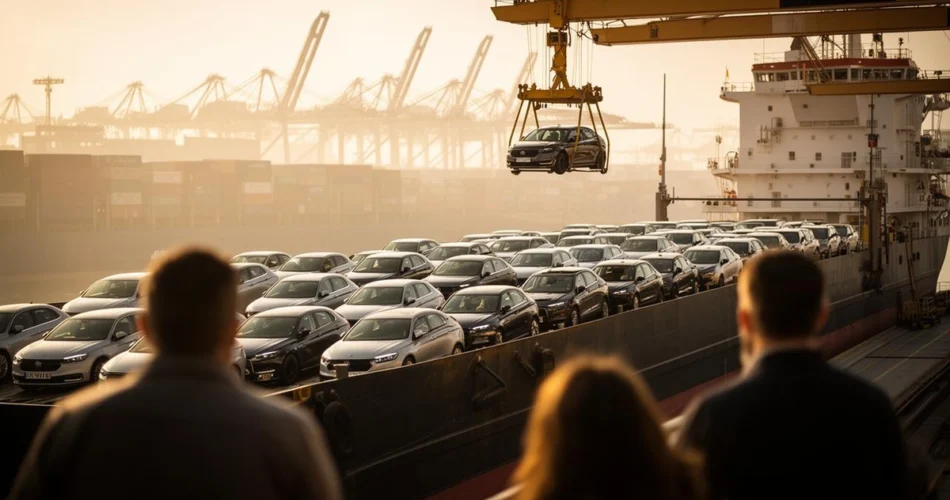
All seven major Chinese automakers have now reported results for the January–June 2026 period, with every company posting a decline in bottom-line profit or falling into the red. The primary cause is a roughly 20% contraction in China’s domestic new-car market following the rollback of purchase incentives centered on electric vehicles (EVs). To offset the domestic slump, each company is accelerating overseas expansion, and the main battleground for competition among Chinese manufacturers is shifting to Europe and other markets outside China.
An aggregation of the seven major automakers with sales exceeding 500,000 units shows that while five managed to grow revenue, all seven saw bottom-line profit decline or turn to losses. The pattern of growing revenue while failing to secure profits underscores how intensifying price competition and rising sales incentive burdens are squeezing earnings.
BYD falls to first profit decline in five periods
BYD, China’s largest EV maker, announced on the 28th that net profit for January–June 2026 fell 21% year-on-year to CNY 12.3 billion (approximately $1.8 billion). This marks the company’s first interim profit decline in five periods. New-vehicle sales during the period are believed to have reached roughly 1.8 million units, but the company was unable to convert sales volume growth into profit.
While struggling to reduce inventory that has piled up to record levels, BYD’s strategy is to stimulate demand through the launch of new models supporting fast charging. With the domestic market stagnation expected to be prolonged, the company is increasingly convinced that expanding sales in overseas markets holds the key to growth.
Other automakers also struggle; major listed carmakers release earnings guidance
Beyond BYD, other major listed automakers have also released similarly tough results and earnings guidance. Great Wall Motors and Changan Automobile both remained profitable, but each saw profits fall by roughly 60% year-on-year. Great Wall Motors Chairman Wei Jianjun explained on social media that delays in receiving overseas tax incentive payments alone reduced profit by approximately CNY 2.3 billion (approximately $342.2 million). Changan Automobile also disclosed in public materials that foreign exchange losses and high raw material costs weighed on performance.
More severe are the situations at GAC Group and Seres. Despite GAC Group’s first-half sales rising 2.35% year-on-year to 773,100 units and exports surging 132%, the company fell into a final loss exceeding CNY 4 billion (approximately $595.2 million), trapped in a pattern where “the more it sells, the deeper the losses.” Seres is also expected to swing from a CNY 2.94 billion (approximately $437.5 million) profit in the same period last year to a loss, with the company explaining that memory chip unit prices soared from CNY 20 to nearly CNY 100, adding CNY 15,000–20,000 (approximately $2,200–$3,000) in costs per vehicle.
| Company | H1 2026 Forecast Profit/Loss | Year-on-Year Change |
|---|---|---|
| Great Wall Motors | Profit of CNY 2.35–2.6 billion (approx. $349.7–$386.9 million) | Down 59–63% |
| Changan Automobile | Profit of CNY 740 million–970 million (approx. $110.1–$144.3 million) | Down 58–68% |
| GAC Group | Loss of CNY 4.06–4.57 billion (approx. $604.1–$680.0 million) | Loss widening 60–80% |
| Seres | Loss of CNY 1.5–1.8 billion (approx. $223.2–$267.8 million) | Swing from profit (CNY 2.94 billion) to loss |
| BAIC BluePark | Loss of CNY 1.77–1.97 billion (approx. $263.4–$293.1 million) | Loss narrowing by CNY 340–540 million |
| JAC Motors | Loss of approx. CNY 740 million (approx. $110.1 million) | Loss narrowing by approx. 4% |
Source: CarNewsChina compilation of each company’s 2026 interim earnings guidance (as of July 17, 2026). Yen conversions use an approximate rate based on BYD’s announced figures (CNY 1 ≈ JPY 23.6).
Shrinking domestic demand takes direct toll; incentive rollback fallout materializes
The Chinese government has been gradually scaling back purchase subsidies and tax breaks for EVs and plug-in hybrid vehicles (PHVs). As a result, the backlash from rush demand has fully materialized in 2026, with the domestic new-car market contracting by roughly 20% from the previous year.
China’s auto market boasts the world’s largest scale, but it is reaching a turning point in a growth model dependent on subsidies. Each company is also facing excess production capacity, and domestic discount wars have become the norm. A structure is taking hold in which profit margins per vehicle decline even when sales volumes are maintained.
Note: Chen Shihua, deputy secretary-general of the China Association of Automobile Manufacturers (CAAM), revealed on July 28, 2026, that the average net profit margin in the vehicle manufacturing sector fell to 1.5% in the first half—the lowest level in a decade. At an average selling price of CNY 202,000 (approximately $30,000), attributable net profit per vehicle amounts to only about CNY 3,000 (approximately $450).
The structure behind profit declines
The flow of factors compressing profits—the domestic demand slump triggered by subsidy rollbacks combined with structural supply-side problems—can be summarized as follows:
The front line of competition shifts overseas
Facing a shrinking domestic market, Chinese manufacturers are rushing to build sales networks in Southeast Asia, Europe, and Latin America. In Europe in particular, despite the impact of tariff measures, there is active movement to penetrate the market through local production and partnerships.
Behind this lies severe overcapacity. According to industry data, Chinese auto plants have annual production capacity of 55.5 million units, while domestic demand stands at only about 23 million units, with capacity utilization reportedly falling to around 50%. Exports have served as the primary outlet for this excess capacity, with new energy vehicle (NEV) exports reaching 424,000 units in May 2026, up 112.6% year-on-year, accounting for a record 54% of total passenger vehicle exports. However, this export “outlet” is also gradually narrowing due to the European Union’s anti-China tariffs, Brazil’s import restrictions, and strengthening trade barriers in Southeast Asian countries. The Chinese government has called for correction of excessive price competition among manufacturers at least five times since 2025, but in reality, discounting continues in transformed forms such as zero-interest loans and enhanced trade-in values.
As Chinese companies accelerate overseas expansion, challenges are also emerging in the form of price competition with local incumbent manufacturers, regulatory compliance, and brand recognition. Whether each company can leverage the price competitiveness and EV technology cultivated in China’s domestic market to expand overseas market share will determine the pace of their earnings recovery.
China’s auto industry has grown rapidly on the tailwind of an expanding domestic market, but it now faces structural changes in the form of subsidy rollbacks and market saturation. Whether each company can establish a profitable foundation overseas will be tested in the second half of 2026.
Source link
Author

- Ytv Market News
- Share-market news writer and analyst with deep experience covering equities, commodities, forex, and cryptocurrencies for readers in the USA, UK, Canada, and Australia. Ytv Market News delivers timely market updates, practical trading insights, and clear explanations of macro and company-level catalysts that move prices. Combines on-the-ground financial reporting with technical analysis, using concise charts and actionable ideas to help investors and traders make smarter decisions.
Latest entries
 Crypto NewsAugust 29, 2026Bitcoin price tests $82K resistance as Brandt stays long
 Politics News TodayAugust 29, 2026Trump says massive Venezuela oil deal will slash US gas prices
 Market Movers TodayAugust 29, 20263 Unpopular Stocks We Steer Clear Of
 Crypto NewsAugust 29, 2026XRP Price Drops Sharply After Fed Chair’s Comments

