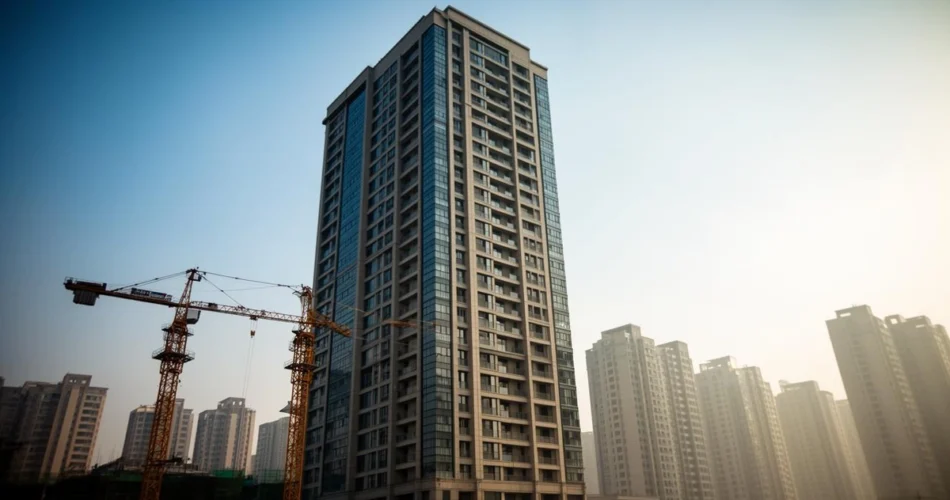
Poly Developments and Holdings (600048.SS) disclosed its 2026 interim report on August 26. The financial statements show that first-half revenue came to approximately 102.86 billion yuan (approximately $15.3 billion), down 11.98% year-on-year. Net profit attributable to shareholders of the listed company was approximately 1.96 billion yuan (approximately $291.4 million), down 40.84%. Net profit after deducting non-recurring items was approximately 1.87 billion yuan (approximately $277.8 million), down 41.26%. Basic earnings per share were 0.17 yuan.
Although profitability metrics declined markedly, the company’s cash flow position showed improvement. During the reporting period, net cash flow from operating activities was approximately 24.55 billion yuan (approximately $3.7 billion), up 53.28% year-on-year and positive for a ninth consecutive year. Total assets at period-end were approximately 1.17 trillion yuan (approximately $173.4 billion), down 1.99% year-on-year.
Sales outperform the industry, with strong collection capability
On the sales front, Poly Developments achieved contracted sales of 135.11 billion yuan (approximately $20.1 billion) in the first half, with contracted gross floor area of 6.3194 million square meters. Sales value declined 6.93% year-on-year, but the company said this performance was better than the industry average, with sales value remaining No. 1 in the industry and an equity sales ratio of 84%. During the reporting period, the company cumulatively collected 111 billion yuan (approximately $16.5 billion) in cash.
The company continued to pursue a strategy of deep cultivation in core cities, with core-city sales contributing 95% of the total, maintaining a high level of around 90% for a fourth consecutive year. By city tier, first-tier and second-tier cities accounted for 42% and 44% of sales value, respectively. By project performance, five projects each achieved sales exceeding 3 billion yuan (approximately $446.4 million) in the first half, totaling 21 billion yuan (approximately $3.1 billion).
Debt structure continues to improve; financing costs hit record low
As of June 30, Poly Developments’ debt-to-asset ratio fell 0.45 percentage points from the beginning of the year to 71.79%, a sixth consecutive annual decline. Cash and cash equivalents stood at 133.8 billion yuan (approximately $19.9 billion), up 10.9 billion yuan (approximately $1.6 billion) from the end of last year, representing 11.48% of total assets.
Interest-bearing debt at period-end was 332.5 billion yuan (approximately $49.5 billion), down 8.6 billion yuan (approximately $1.3 billion) from the beginning of the year. The debt maturity structure continued to improve, with new interest-bearing debt of more than three years accounting for 67% of first-half additions, and the proportion of interest-bearing debt with maturities beyond three years steadily rising as a share of total debt.
On financing costs, the company completed issuance of 8.1 billion yuan (approximately $1.2 billion) in corporate bonds in the first half, including a three-year tranche at a record-low coupon of 1.85% and a five-year tranche at 2.20%, marking the lowest bond financing rates in company history. The average cost of newly added interest-bearing debt during the year fell 27 basis points year-on-year to 2.44%, while the blended financing cost at period-end declined 28 basis points year-on-year to 2.61%. In addition, the company’s newly applied registration for 5 billion yuan (approximately $744.1 million) in private convertible bonds received approval from the China Securities Regulatory Commission in May.
Focused expansion in core cities; strategic entry into Shenzhen
On land acquisition, Poly Developments expanded into 21 new projects in the first half, with total planned gross floor area of 1.66 million square meters and total investment of 38.4 billion yuan (approximately $5.7 billion). The equity ratio of investment reached as high as 98%. By region, land costs in first- and second-tier cities accounted for more than 94% of total investment, with core-city investment reaching 100%.
Notably, the company made a strategic entry into Shenzhen in the first half, thereby completing full coverage of China’s four first-tier cities. Data shows that the four first-tier cities accounted for 66% of total investment, while the top five cities (Beijing, Shanghai, Guangzhou, Shenzhen, and Hangzhou) accounted for 82%.
In revitalizing existing resources, the company advanced asset monetization through multiple approaches, including finished-product sales, exchanges and adjustments, and conversion to operating assets. Among these, comprehensive measures such as showroom refreshes, product optimization, and rent-to-sell promotions drove contracted sales of finished products of 45.5 billion yuan (approximately $6.8 billion). Land assets of approximately 7.6 billion yuan (approximately $1.1 billion) were revitalized through exchanges, adjustments, and asset transfers. Approximately 8.9 billion yuan (approximately $1.3 billion) was recovered through conversion to operating assets and other means.
In the real estate operations segment, as of the end of the reporting period, the company’s four major asset categories—commercial, hotel, rental housing, and office—had cumulative operating area of 6.68 million square meters, with 460,000 square meters newly opened. Rental housing added 330,000 square meters and 5,729 units, bringing the cumulative operating portfolio to 41,000 units. Net leasable office area increased by 130,000 square meters, with occupancy up 2 percentage points. Average hotel occupancy rose 1 percentage point year-on-year.
Poly Developments noted in its financial report that in the first half of 2026, the company seized market windows and recovery opportunities in certain core cities, made timely strategic decisions, and maintained its leading position in sales scale during the industry adjustment period. At the same time, it continued to strengthen its financial safety margin and operational resilience through measures such as optimizing the debt structure, lowering financing costs, and revitalizing existing assets.
Source link
Author

- Ytv Market News
- Share-market news writer and analyst with deep experience covering equities, commodities, forex, and cryptocurrencies for readers in the USA, UK, Canada, and Australia. Ytv Market News delivers timely market updates, practical trading insights, and clear explanations of macro and company-level catalysts that move prices. Combines on-the-ground financial reporting with technical analysis, using concise charts and actionable ideas to help investors and traders make smarter decisions.
Latest entries
 Market Movers TodayAugust 27, 2026A Q2 Deep Dive: Product Momentum, China Recovery, and Operating Leverage Drive Results
 Forex NewsAugust 27, 2026Australian Dollar remains firm on firm RBA interest rate hike prospects
 IndiaAugust 27, 2026Lumino Industries IPO opens to mixed response on Day 1; retail oversubscribed, QIB lags
 Company Press ReleasesAugust 27, 2026Interim Report Q2 2026: Net sales increased by 19%