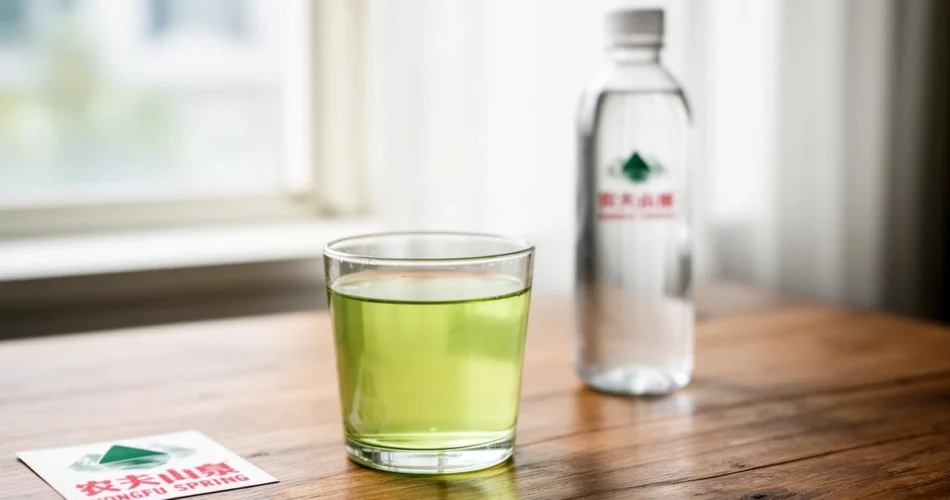
Nongfu Spring (9633.HK), marking its 30th anniversary, delivered interim results that exceeded market expectations. According to its 2026 interim results disclosed on August 25, the company posted first-half revenue of 29.72 billion yuan (approximately $4.4 billion), up 16% year-on-year, and net profit of 8.89 billion yuan (approximately $1.3 billion), up 16.6% — surpassing market consensus estimates of 29.3 billion yuan and 8.63 billion yuan respectively. Gross profit rose 17.1% to 18.1 billion yuan (approximately $2.7 billion), and basic earnings per share increased 16.7% to 0.79 yuan.
The most noteworthy structural change in these results is that tea beverages overtook packaged drinking water for the first time to become the company’s largest revenue source. In the first half, tea beverage revenue reached 13.12 billion yuan (approximately $2.0 billion), up 30.1% year-on-year, with its share of total revenue climbing to 44.2%. Packaged drinking water revenue came in at 9.64 billion yuan (approximately $1.4 billion), up 2.1%, with its share falling to 32.4%. The role reversal between “a bottle of water” and “a bottle of tea” marks the completion of Nongfu Spring’s growth engine transition.
Tea Beverages: From Niche Category to Core Engine
Tea beverages were the standout segment in this earnings cycle. The 30.1% growth rate significantly outpaced the group’s overall performance, driving a qualitative shift in the revenue structure. Among these, the unsweetened tea brand “Oriental Leaf” remained the core growth driver.
When Oriental Leaf launched in 2011, unsweetened tea was still a niche category in China. Fifteen years later, this segment has become a critical battleground in the beverage industry, with new products emerging constantly and competition intensifying. Oriental Leaf, with its positioning of no added sugar, no added flavoring, and no added preservatives, has continued to gain market recognition as consumers grow increasingly sensitive to sugar content and ingredient lists.
During the reporting period, the company further expanded the Oriental Leaf product matrix: adding 335ml and 900ml white tea formats, launching the “Longjing New Tea” for the fifth consecutive year, and introducing its first cold-chain tea product “Cold-Brewed Longjing” in April, sold through full cold-chain distribution to tap into the premium ready-to-drink tea consumption scenario. Meanwhile, “Tea π” advanced its sugar-reduction upgrade, cutting sugar content by more than 25% across its entire product line in line with health-conscious and low-sugar consumption trends.
Upstream, tea beverage growth has also deepened Nongfu Spring’s ties with agricultural production regions. In Yunnan, the company built preliminary tea processing facilities directly in growing areas, enabling freshly picked leaves to enter processing more quickly, and established long-term partnerships with local growers and cooperatives around pesticide residue control, fresh leaf standards, and processing techniques. In Hengzhou, Guangxi, the company partnered with approximately 1,000 jasmine farmers in 2026, offering price incentives through a quality-based pricing mechanism for jasmine flowers meeting higher pesticide residue and quality standards.
Packaged Water Stabilizes as Water Source Network Expands
Compared with the high growth of tea beverages, packaged drinking water delivered relatively steady performance. First-half revenue for the segment was 9.64 billion yuan (approximately $1.4 billion), up 2.1% year-on-year — notably below the group’s overall growth rate — with its share of total revenue declining from 36.9% in the same period last year to 32.4%, relinquishing its position as the group’s largest business for the first time.
This growth occurred against a backdrop of industry-wide pressure. Nielsen data shows that packaged drinking water market sales growth has been trending downward this year, with sales volume falling 4.9% year-on-year and sales value declining 7.3% from January to June. Amid slowing industry growth and intensifying price competition, Nongfu Spring’s packaged water business still managed to return to growth, further stabilizing its core foundation.
Underpinning this foundation is the company’s water source resources accumulated over many years. Nongfu Spring adheres to its “build plants at water sources, bottle at water sources” model. From sourcing and surveying to plant construction and building production and logistics capabilities, bringing a natural water source into the national supply system requires sustained investment. During the reporting period, the company added two new water sources — Yunnan Jiaozishan Snow Mountain and the Hainan Leiqiong Haikou Volcanic Cluster — bringing its nationwide total to 17 sites and further extending its production network across China.
Beyond tea beverages and packaged water, functional beverages and juice businesses also maintained double-digit growth. First-half functional beverage revenue reached 3.35 billion yuan (approximately $499.1 million), up 15.5%, with the company launching new electrolyte beverage products in lemon and grapefruit flavors with 550ml and 950ml formats, leveraging sports marketing scenarios such as the 2026 World Cup to reach younger consumers. Juice beverage revenue was 2.92 billion yuan (approximately $435.6 million), up 14.0%, with “17.5°” and “NFC” continuing to expand at-home consumption scenarios through family-size packaging, “Shuirong C100” reinforcing its vitamin C supplementation positioning, and “Nongfu Orchard” launching an upgraded 100% tomato mixed fruit and vegetable juice.
Profitability and Financial Structure
The company’s overall profitability remained stable. First-half gross margin was 60.9%, up 0.6 percentage points year-on-year, primarily benefiting from the higher proportion of high-margin tea beverages and lower procurement costs for raw materials such as juice and sugar. Administrative expenses as a percentage of revenue declined from 4.2% to 3.8%, reflecting further operational efficiency improvements.
| Business Segment | H1 Revenue (100M yuan) | YoY Growth | Share of Total Revenue |
|---|---|---|---|
| Tea Beverages | 131.22 | 30.1% | 44.2% |
| Packaged Drinking Water | 96.41 | 2.1% | 32.4% |
| Functional Beverages | 33.48 | 15.5% | 11.3% |
| Juice Beverages | 29.22 | 14.0% | 9.8% |
Note: Data sourced from the company’s 2026 interim results announcement.
On the financial structure front, Nongfu Spring maintained ample liquidity. As of June 30, the company’s long-term bank time deposits, cash, and bank balances totaled 26.53 billion yuan (approximately $4.0 billion), up 19.0% from the end of 2025. Current assets of 40.75 billion yuan (approximately $6.1 billion) exceeded current liabilities of 38.53 billion yuan (approximately $5.7 billion).
Other payables and accrued expenses increased from 11.96 billion yuan (approximately $1.8 billion) at the beginning of the year to 25.67 billion yuan (approximately $3.8 billion), primarily related to the accrual of the 2025 final dividend of 11.13 billion yuan (approximately $1.7 billion). The company completed the dividend payout in August at 0.99 yuan per share, up from 0.76 yuan in the prior year.
On capital expenditure, the company remains in an expansion phase. As of period-end, capital commitments totaled approximately 3.97 billion yuan (approximately $591.8 million), mainly for production facility construction and equipment procurement. Property, plant, and equipment book value increased by approximately 2.5 billion yuan (approximately $372.1 million) from the beginning of the year to 27.21 billion yuan (approximately $4.1 billion).
Worth noting is that the company recorded a foreign exchange loss of approximately 180 million yuan (approximately $26.8 million) during the reporting period, with other expenses rising 74.8% year-on-year. Given ongoing RMB exchange rate volatility, FX gains and losses may continue to create fluctuations in future profit performance.
Three Decades of Accumulation and Long-Termism
Data from China’s National Bureau of Statistics shows that in the first half of 2026, China’s beverage manufacturing industry above designated size recorded its first half-year output decline in five years. While overall volume is under pressure, sub-segments such as unsweetened tea and functional beverages remain active, and consumer attention to sugar content, ingredients, and raw materials continues to rise. In this market environment, Nongfu Spring’s ability to grow both its “water + beverage” businesses simultaneously is particularly noteworthy.
Over 30 years, China’s beverage market has undergone multiple transformations, with new categories and brands constantly emerging and consumption habits and channels continuously evolving. Nongfu Spring started with a single bottle of water and gradually entered juice, tea beverages, and functional beverages, forming today’s two major business segments of water and beverages.
Looking at today’s product lineup, many products have been on the market for years: Nongfu Spring packaged water for 30 years, Nongfu Orchard for over 20 years, Shuirong C100 for nearly 20 years, and Oriental Leaf for 15 years. They launched at different times, yet all have weathered multiple market cycles and consumer choices.
Today’s beverage market has no shortage of new products — new flavors, new concepts, and new categories emerge constantly, with product cycles accelerating. Faced with such a market, Nongfu Spring maintains its own product rhythm, rarely altering established product directions due to short-term trends. Once a product launches, the company focuses its efforts on continuous improvement of raw materials, formulations, processes, and quality.
Finding and developing a water source takes time, and establishing stable quality standards for a raw material production region also takes time. These investments are difficult to measure over one or two quarters, but over time they naturally accumulate into the company’s own capabilities. The results announcement records six months of operating performance, but many of the foundations supporting these numbers have been built over a decade or even decades.
Source link
Author

- Ytv Market News
- Share-market news writer and analyst with deep experience covering equities, commodities, forex, and cryptocurrencies for readers in the USA, UK, Canada, and Australia. Ytv Market News delivers timely market updates, practical trading insights, and clear explanations of macro and company-level catalysts that move prices. Combines on-the-ground financial reporting with technical analysis, using concise charts and actionable ideas to help investors and traders make smarter decisions.
Latest entries
 Politics News TodayAugust 25, 2026Angel Reese sets two WNBA records with historic rebounding performance
 Market Movers TodayAugust 25, 20261 of Wall Street’s Favorite Stocks with Exciting Potential and 2 We Ignore
 Forex NewsAugust 25, 2026British Pound hovers near six-month highs with investors awaiting key US events
 IndiaAugust 25, 2026For-profit social enterprise Rays of Belief Ltd to come out with IPO to fund expansion