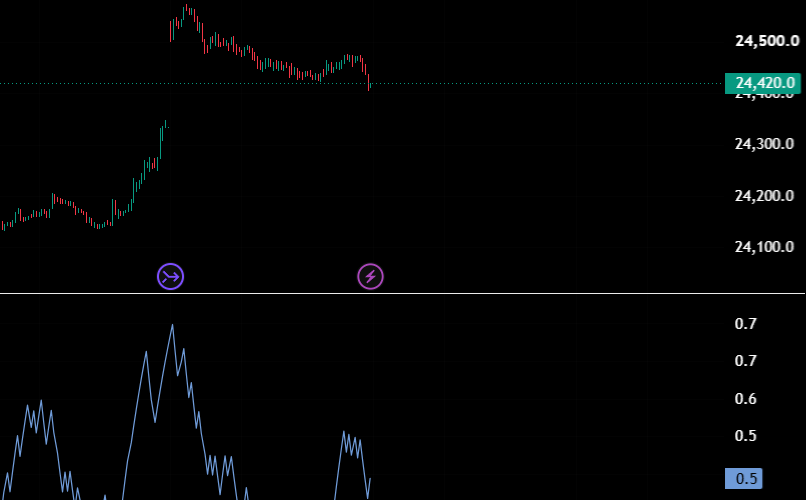
The progression
It follows the standard escalation, each piece usable on its own:
rankWeight — a static, normalized weight from an importance rank (a Best-Worst-Method-style floor). The hand-set baseline the learner starts from.
reliability — an online EMA of “when this factor spoke, did the outcome agree.” The simplest learned weight: a live hit rate.
adamWeight — a single factor’s weight learned by the Adam optimizer, stepped on each resolved forward-test outcome.
blend — mix a learned weight with the static base by a capped fraction, so an unlucky stretch can’t dominate. The anti-overfit control.
normalize / dot — turn a weight set into a bounded weighted composite.
The functions
rankWeight(rank, n) — inverse-rank weight (1 = most important) among n factors, normalized so the set sums to 1.
reliability(resolve, agreed, alpha, floorW) — trust score in [floorW, 1]. Call every bar; set resolve = true on the bar a forward outcome resolves, with agreed = (the factor’s direction matched the realized move). alpha ≈ 2/(N+1) sets the memory. A factor that keeps being right drifts toward 1; one that’s coin-flip sits near 0.5.
adamWeight(resolve, scoreAtSignal, win, lr, cap, w0) — the factor’s weight learned by Adam, bounded to [0, cap]. On each resolved outcome the gradient is g = (win ? +1 : −1) · scoreAtSignal (the factor’s score on the signal bar); Adam adapts the step size from the running gradient moments. Deterministic and repaint-free. w0 is the starting weight.
blend(base, learned, frac) — (1−frac)·base + frac·learned. Keep frac modest (0.3–0.5) so the learned component is a nudge, not a takeover.
normalize(w) — normalize a weight array to sum to 1 (negatives floored at 0; all-equal if the sum is 0).
dot(scores, weights) — the weighted composite Σ scoreᵢ·weightᵢ. Pass a normalized weight array for a bounded result.
How to use
Weight three factors by their learned reliability, blended onto a rank floor:
//version=6
indicator(“Example — adaptive confluence”, overlay = false)
import Market_Logic_India/ml_weights/1 as wt
// your three factor scores in [-1,+1] and their directional agreement at resolution …
f1 = ta.rsi(close,14)/50 – 1, f2 = ta.cci(close,20)/200, f3 = math.sign(ta.change(close,5))
// forward-test resolution (host-side): set resolve=true when an outcome resolves, and each
// factor’s `agreed` = did it point the right way. Here shown schematically:
resolve = barstate.isconfirmed
r1 = wt.reliability(resolve, math.sign(f1[10]) == math.sign(close-close[10]), 0.05, 0.1)
r2 = wt.reliability(resolve, math.sign(f2[10]) == math.sign(close-close[10]), 0.05, 0.1)
r3 = wt.reliability(resolve, math.sign(f3[10]) == math.sign(close-close[10]), 0.05, 0.1)
// blend each learned weight onto a Best-Worst rank floor, normalize, and combine
w = array.from(wt.blend(wt.rankWeight(1,3), r1, 0.4),
wt.blend(wt.rankWeight(2,3), r2, 0.4),
wt.blend(wt.rankWeight(3,3), r3, 0.4))
wn = wt.normalize(w)
composite = wt.dot(array.from(f1, f2, f3), wn)
plot(composite, “Adaptive composite”)
Notes
Non-repainting: weights advance only on the bars you mark resolve, which you should drive from a forward-test resolution on barstate.isconfirmed. No ta.* inside, so nothing short-circuits; each call keeps its own state, so give every factor its own call site.
Anti-overfit is your job too: keep the blend fraction modest, cap adamWeight, and always render the live forward-test edge next to the weighted vote so a learned weight is never trusted blindly.
Types: simple for the ranks, learning rate, cap and blend fraction; series for the scores and resolution flags; array
Gradient-boosting is intentionally omitted — it doesn’t fit Pine’s execution model; the Adam + reliability path covers the useful, transparent middle.
Concept credits
The Best-Worst-Method for deriving weights from importance ranks is Jafar Rezaei’s. The Adam optimizer is Kingma & Ba (2015). Reliability / inverse-variance weighting and forward-testing follow standard quantitative practice. This library is an original, dependency-free Pine v6 packaging of those public techniques; it is not affiliated with, nor endorsed by, any originator.
License
Mozilla Public License 2.0 — as required for TradingView libraries (open source). Free to import and build on.
Library “ml_weights”
rankWeight(rank, n)
Parameters:
rank (simple int)
n (simple int)
reliability(resolve, agreed, alpha, floorW)
Parameters:
resolve (bool)
agreed (bool)
alpha (simple float)
floorW (simple float)
adamWeight(resolve, scoreAtSignal, win, lr, cap, w0)
Parameters:
resolve (bool)
scoreAtSignal (float)
win (bool)
lr (simple float)
cap (simple float)
w0 (simple float)
blend(base, learned, frac)
Parameters:
base (simple float)
learned (float)
frac (simple float)
normalize(w)
Parameters:
w (array
dot(scores, weights)
Parameters:
scores (array
weights (array
Source link
Author

- Ytv Market News
- Share-market news writer and analyst with deep experience covering equities, commodities, forex, and cryptocurrencies for readers in the USA, UK, Canada, and Australia. Ytv Market News delivers timely market updates, practical trading insights, and clear explanations of macro and company-level catalysts that move prices. Combines on-the-ground financial reporting with technical analysis, using concise charts and actionable ideas to help investors and traders make smarter decisions.
Latest entries
 UsaAugust 27, 2026Press Release: Rick Larsen Responds to Trump Administration Kennedy Center Demolition Threat
 Crypto NewsAugust 27, 2026Bitcoin dominance holds strong at over 60% — Is altseason still on hold?
 Commodities NewsAugust 27, 2026Weak Asian Oil Imports Challenge Claims of Surge in Hormuz Transits
 Investing InsightsAugust 27, 2026TSMC’s CoWoS Hits Yield and Cost Bottlenecks; Analysts Say Intel’s EMIB Is Poised to Gain Ground — BigGo Finance