


Watching for new or strengthening partnerships in the artificial intelligence (AI) realm is a great way to keep tabs on which companies are excelling and which ones are floundering. AMD (AMD -1.63%) spent the better part of the first few years of the AI arms race floundering, but it has made some strides in 2026. One partner AMD has been deepening its relationship with is Microsoft (MSFT -3.04%). Microsoft has long looked to diversify its relationship with computing unit suppliers, and its latest deal with AMD is a sure sign of that.
But how big of a deal is this for AMD? Let’s find out.

Image source: Getty Images.
Microsoft is using more AMD technology
AMD recently announced a new partnership with Microsoft to deploy its Helios platform, which is AMD’s AI rack system. This includes AMD graphics processing units (GPUs), central processing units (CPUs), networking, and software, so it’s an all-encompassing solution that allows users to completely get away from rival Nvidia products.
Microsoft will be using this to power frontier model inference, which brings up a few interesting points. First, frontier AI models are the most advanced, so using AMD’s hardware in this application showcases that Microsoft believes that these are some of the best options available. Second, they are using them for inference. That’s another big deal, as inference with an AI model occurs after they’re trained. Inference is a completely different type of workload than training, and using AMD’s likely cheaper products for inference makes sense because having the best product there doesn’t matter quite as much as it does for training AI. So, the takeaway here is that Nvidia isn’t necessarily losing the technological battle to AMD; it may just not have as cheap a product in inference settings.

Today’s Change
(-1.63%) $-8.39
Current Price
$506.00
Key Data Points
Market Cap
Day’s Range
$504.52 – $517.35
52wk Range
$149.22 – $584.73
Volume
20.1M
Avg Vol
29.9M
Gross Margin
50.37%
However, that’s not a bad thing for AMD. After the initial phase of AI is complete, inference will make up the majority of workloads versus training. If AMD can capture a large chunk of this market, then it could become a giant in this space and become more of a true rival to Nvidia, as right now it’s much smaller.
The primary problem here is that AMD already has a lot of this success priced into the stock.
AMD needs these partnerships to justify its current valuation
AMD has been a hot stock in 2026, more than doubling so far. However, a lot of that has come on expectations of success rather than several quarters of impressive results. Right now, AMD trades for a pretty pricey 68 times forward earnings.
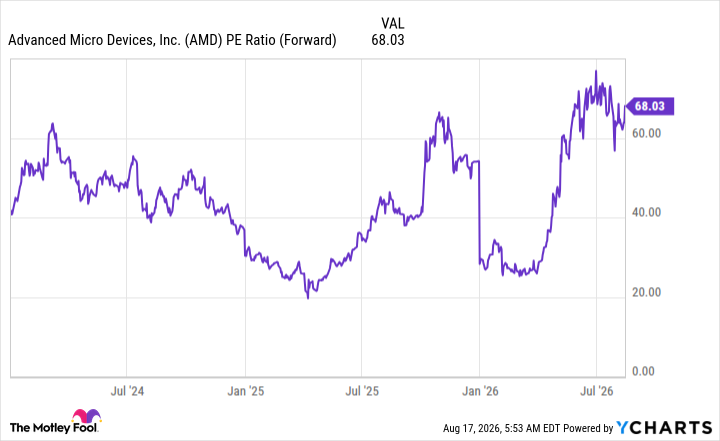
AMD PE Ratio (Forward) data by YCharts.
For comparison, Nvidia trades for 25 times forward earnings. That’s a huge premium over its peer, and AMD needs to deliver impressive growth to come back down to a more reasonable valuation.
This deal with Microsoft is a good start, but the market will need to see more from AMD from other clients if it’s going to grow into its pricey valuation.
So, is AMD a buy here? I’d say no. The stock has run up too far, too fast without any major, needle-moving deals. The Microsoft announcement was a good start, but it’s going to need a lot more than that to justify its price tag. I’d much rather invest in Nvidia, which is growing at a faster rate, is still the top option in the industry, and is trading at a far cheaper valuation.
Over the next few years, I’d expect Nvidia to outperform AMD, as AMD has a much higher starting point that could take multiple years of strong growth to return it to a normal valuation level. This is a red flag for me, so I’m steering clear of AMD’s stock for the time being.

