

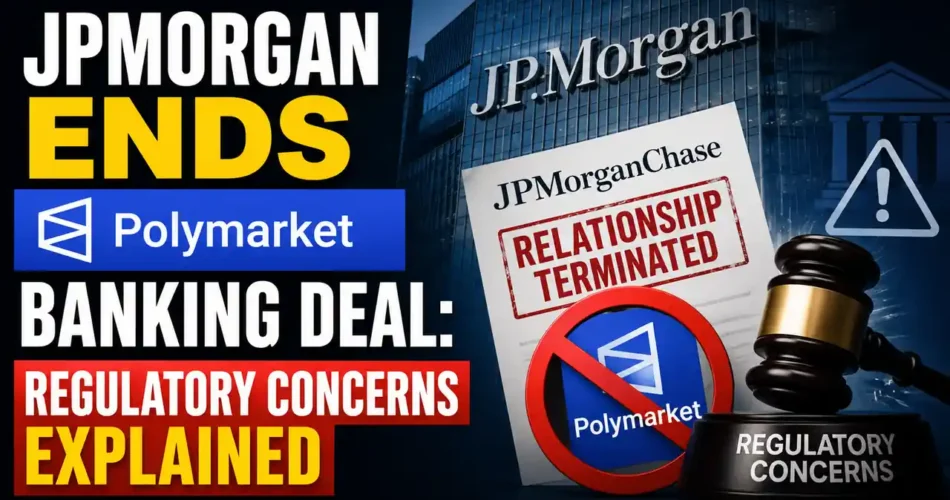
JPMorgan Ended Polymarket Banking Relationship Over Regulatory Concerns: What Happened and Why It Matters
JPMorgan Chase ended its banking relationship with Polymarket in 2025, citing regulatory concerns surrounding the prediction-market platform. The development highlights the increasingly complicated relationship between traditional financial institutions and prediction markets, particularly as platforms offering event-based contracts attract growing attention from investors, traders and regulators.
The decision also illustrates how banks assess relationships with companies operating in emerging financial sectors. While Polymarket has continued expanding its business, questions about regulatory status, market structure and compliance have remained central to the company’s operations.
JPMorgan and Polymarket: What Happened?
JPMorgan’s decision to end its banking relationship with Polymarket occurred in 2025. According to reporting on the matter, the bank’s concerns were linked to regulatory issues, particularly questions surrounding the legal status of prediction markets.
Polymarket operates a platform where users can trade contracts tied to the outcomes of future events. These markets can cover politics, economics, business, sports and other subjects. The model has attracted substantial interest because participants can effectively express views about future events through financial contracts.
For banks, however, relationships with companies in emerging industries can involve additional compliance and regulatory considerations. A bank may evaluate whether a client’s activities create legal, reputational, operational or regulatory risks before deciding whether to continue providing financial services.
Why Were Regulators Concerned About Polymarket?
Polymarket has previously faced regulatory scrutiny in the United States. In 2022, the Commodity Futures Trading Commission, or CFTC, announced an enforcement action involving Polymarket’s operation of an unregistered derivatives trading platform.
The regulatory history became an important part of the broader debate about prediction markets. Although the industry has developed significantly since then, questions remain about how event contracts should be classified and regulated.
The Difference Between Prediction Markets and Traditional Betting
Prediction markets can look similar to betting because participants take positions on future outcomes. However, companies operating these platforms have generally argued that their contracts function as financial instruments rather than conventional wagers.
That distinction is important because financial derivatives and gambling activities can be governed by very different legal frameworks.
As prediction markets have expanded, regulators and lawmakers have increasingly examined whether contracts covering political, sporting, economic or other events fit within existing financial-market rules.
Why Would a Major Bank End a Client Relationship?
Large financial institutions operate under extensive regulatory requirements. Maintaining a banking relationship with a company can involve assessments related to anti-money-laundering controls, sanctions compliance, customer due diligence, regulatory exposure, reputational risk and the legal structure of the client’s business.
When a client’s industry is subject to regulatory uncertainty, the bank may decide that the potential risks outweigh the commercial benefits of continuing the relationship.
In Polymarket’s case, the reported decision by JPMorgan reflects this broader risk-management approach. It does not necessarily mean that every aspect of Polymarket’s business was considered unlawful. Rather, the reported regulatory concerns demonstrate how uncertainty itself can influence banking decisions.
Polymarket’s Regulatory Journey
Polymarket’s history in the United States has been closely connected to the evolving regulatory debate around prediction markets.
The company previously reached an agreement with the CFTC following the agency’s 2022 enforcement action. That action involved allegations that Polymarket had operated an unregistered facility offering event-based contracts.
The company subsequently worked toward changing its position in the U.S. market. The regulatory environment nevertheless remained complicated, with questions continuing about the boundaries between prediction markets, derivatives markets and gambling.
Regulatory Uncertainty Remains a Major Issue
The prediction-market industry is developing faster than some existing regulatory frameworks. Platforms can offer markets on events that were not traditionally associated with financial trading.
This creates difficult questions for regulators. For example, authorities may need to consider whether a particular contract represents a legitimate financial instrument, an event contract, or a form of wagering that falls under a different regulatory regime.
For financial institutions, uncertainty surrounding those questions can create additional compliance challenges.
JPMorgan’s Decision Does Not Mean the Relationship Ended Completely
An important aspect of the situation is that ending a traditional banking relationship does not necessarily mean that every interaction between the companies stops.
Reporting indicates that JPMorgan has continued to have some involvement with Polymarket-related activities even after ending the banking relationship. The bank has reportedly maintained professional connections with the company and its executives, illustrating the distinction between providing banking services and participating in other business or investment-banking discussions.
This distinction is particularly significant because prediction markets have become increasingly prominent in financial and technology circles.
Why Prediction Markets Are Growing
Prediction markets have attracted attention because they offer a way to aggregate expectations about future events. Participants can trade contracts based on whether particular outcomes will occur, potentially creating continuously changing probabilities.
Supporters argue that markets can provide useful information because participants have financial incentives to form opinions based on available evidence.
Critics, meanwhile, question whether some markets cross the line into gambling or create inappropriate incentives around sensitive events.
Technology Is Changing the Industry
Modern online platforms have made prediction markets accessible to a much larger audience than traditional event-contract markets. Digital interfaces, real-time pricing and rapidly changing market probabilities have helped prediction markets gain visibility.
The growth has also attracted interest from traditional financial institutions. Banks and investment firms increasingly have to consider whether prediction markets represent a new financial-market opportunity or a compliance risk.
What JPMorgan’s Decision Means for the Banking Industry
The Polymarket relationship illustrates an important issue for banks: regulatory risk can influence business decisions even when a company operates in a rapidly expanding industry.
Traditional banks are heavily supervised and must maintain strong compliance programs. Their decisions about clients therefore involve more than simple commercial considerations.
The case may encourage other financial institutions to conduct additional due diligence before serving prediction-market companies, cryptocurrency businesses and other firms operating in emerging financial sectors.
At the same time, banks cannot ignore the potential commercial opportunities created by new financial technologies. If regulators establish clearer rules, traditional institutions may become more comfortable providing services to companies in these industries.
Could JPMorgan Reconsider Prediction Markets?
The future relationship between JPMorgan and the prediction-market industry could evolve as regulations become clearer.
JPMorgan Chief Executive Jamie Dimon has publicly indicated that the bank has studied prediction markets and could potentially become involved in the sector under the right circumstances. However, any future participation would likely involve significant compliance safeguards.
The bank’s approach demonstrates that financial institutions are not necessarily rejecting prediction markets outright. Instead, they appear to be evaluating the industry carefully as regulators determine how these platforms should operate.
What Investors Should Watch
Investors following prediction markets should focus on several developments.
1. U.S. Regulatory Decisions
Future decisions by the CFTC and other U.S. regulators could have a major impact on the industry. Clearer rules could reduce uncertainty, while additional enforcement actions could increase operating challenges.
2. Banking Relationships
Access to reliable banking and financial infrastructure remains important for companies operating in emerging financial markets. Changes in banking relationships can therefore affect business operations and investor sentiment.
3. Competition
The prediction-market industry is becoming increasingly competitive. Platforms will need to demonstrate strong technology, liquidity, compliance systems and user protection measures to maintain long-term growth.
4. Market Expansion
The ability to expand into new jurisdictions and introduce new categories of event contracts will depend heavily on local laws and regulatory approvals.
What This Means for Polymarket
For Polymarket, the loss of JPMorgan’s banking relationship represents a significant development but not necessarily an existential threat. The company has continued developing its platform and seeking ways to operate within changing regulatory frameworks.
The bigger question is whether prediction markets can establish themselves as a recognized part of the financial ecosystem without facing regulatory restrictions that limit their business models.
If regulators create a clear framework, companies such as Polymarket could benefit from greater certainty. Conversely, continued disputes over classification and jurisdiction could increase costs and complicate expansion plans.
Conclusion
JPMorgan’s decision to terminate its banking relationship with Polymarket in 2025 underscores the regulatory challenges facing prediction markets. The move was reportedly driven by concerns about the legal and regulatory environment surrounding the sector rather than simply commercial considerations.
The episode also highlights a broader transition taking place in financial markets. Prediction platforms are attracting substantial interest, while banks and regulators are still determining how these businesses should fit within established financial rules.
For investors, the key issue is not simply whether prediction markets continue to grow. Their long-term success will depend on regulatory clarity, banking access, compliance standards, liquidity and consumer confidence.
As regulators continue examining the industry, the relationship between traditional banks and prediction-market companies will remain an important indicator of how quickly this emerging sector can become part of mainstream finance.
FAQ
Why did JPMorgan terminate its banking relationship with Polymarket?
JPMorgan ended the relationship in 2025 amid regulatory concerns associated with Polymarket and the broader legal uncertainty surrounding prediction markets.
What is Polymarket?
Polymarket is an online prediction-market platform where users trade contracts tied to the outcomes of future events.
Has Polymarket faced regulatory action?
Yes. Polymarket faced a 2022 CFTC enforcement action related to allegations involving the operation of an unregistered derivatives platform.
Does JPMorgan’s decision mean prediction markets are illegal?
No. The termination of a banking relationship does not by itself establish that an entire industry is illegal. It reflects a particular institution’s assessment of regulatory and business risks.
Why are prediction markets attracting attention?
Prediction markets provide participants with a mechanism for expressing views about future events. Their growing popularity has attracted interest from traders, technology companies, financial institutions and regulators.
Could JPMorgan work with prediction markets again?
Potentially. If the regulatory environment becomes clearer and the associated risks can be managed, major financial institutions could reconsider their approach to the sector.
What should investors watch next?
Investors should monitor regulatory decisions, banking access, competition, market liquidity, platform growth and changes to rules governing event-based financial contracts.
External References

