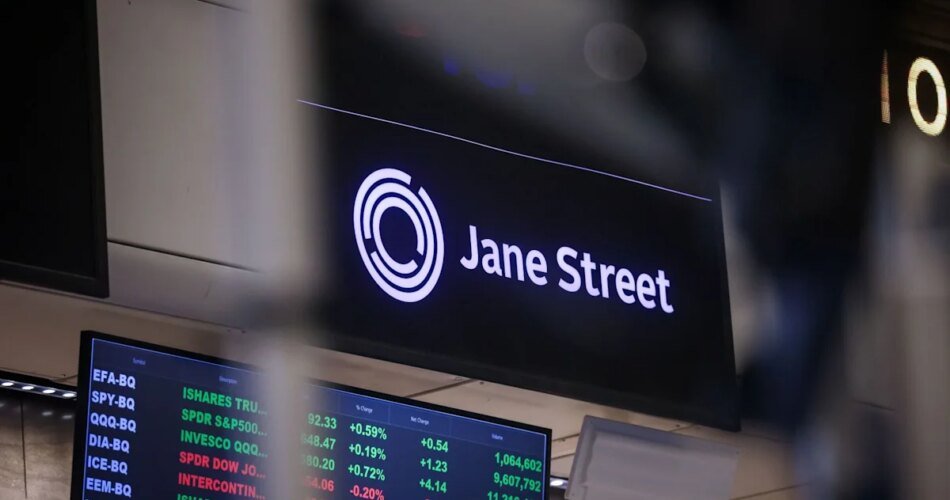
(Bloomberg) — The question pinged around Wall Street trading desks as they watched their rivals at Jane Street shatter record after record: Had they cracked the game, or were they playing a different one?
Most Read from Bloomberg
The trading firm’s massive July loss provided the answer.
Jane Street has long described itself primarily as a market-maker and liquidity provider. But the $15 billion hit last month rivaled the most infamous drops in hedge fund lore, and is all but unfathomable on the trading desk of a modern bank.
The July blunder — its first monthly downturn in a decade — didn’t sink Jane Street or even knock it off its pace to set a new annual record this year. But the slump did expose a level of directional risk that goes well beyond the traditional Wall Street middleman and showed how the lines between market-maker, proprietary trader and hedge fund have been blurring among the new power players in finance.
Even Jane Street is starting to acknowledge that. In its latest debt offering, the firm described its strategy as evolving to also include longer-term bets, in line with a hedge fund, according to people familiar with the matter who asked not to be identified citing private details. A spokesperson for Jane Street declined to comment.
The firm used to be more of a pure-play market-making firm. It got its start in 2000, trading American depositary receipts, and later specialized in exchange-traded funds. Since then, it has expanded across asset classes globally, often profiting from mismatches in prices.
As a market-maker, Jane Street steps in to take the other side of transactions. The firm uses technology and algorithms to forecast where the market is likely headed and to offset risk it takes across positions. Like bank trading desks, market-makers have benefited from volatility and the rise of retail trading coming out of the pandemic.
But in recent years, firms such as Jane Street and Hudson River Trading have also added trading strategies with longer time horizons, crafting strategies that more resemble hedge fund bets that tie up some of the firm’s balance sheet.
That’s pushed Jane Street’s annual trading haul to a new stratosphere: The company reeled in a record $39.6 billion of trading revenue last year, far outpacing the $35.8 billion JPMorgan Chase & Co.’s fixed income and equity traders hauled in over the same period.
But as the gap between Jane Street and its Wall Street rivals continued to widen in the first few months of this year, many veteran bankers pointed to the fact that it was taking outsize bets on private companies like Anthropic PBC — something they’ve been prohibited from doing since the aftermath of the financial crisis prompted regulators to rewrite the rules of proprietary trading.
Last month’s $15 billion plunge — which amounted to losing about $650 million each trading day in July — lays bare the risk of such a strategy. In contrast, the trading desk at Goldman Sachs Group Inc. didn’t lose more than $100 million in a single day at all last year.
Citadel Securities, one of Jane Street’s largest market-making rivals, has been setting records of its own, outside of its sister hedge fund, which functions as a separate entity. While Citadel Securities’ focus on being a market-maker can limit its upside compared with peers that seek to do both, it also helps minimize its risk during wild market swings.
Situational Awareness
Jane Street’s investment in Situational Awareness, the AI hedge fund started by Leopold Aschenbrenner, was one of those longer-term bets. The hedge fund plunged last month as AI shares tumbled, forcing the young founder to offload most of its public equities book to meet margin calls.
Situational Awareness remains standing, but not without some bumps and bruises for investors including Jane Street, which said the downturn left its stake flat on the year. The month was also tough for Jane Street’s bets in Asian equity markets.
Jane Street acknowledged to investors that it has cut risk since.
“We’ve closed a significant portion of our risk in the specific areas we lost on in July, and have also reduced risk-taking in other strategies,” Turner Batty, a Jane Street partner, said in an internal note. “Our positions currently seem appropriate for our present risk tolerance.”
The magnitude of Jane Street’s loss rivals, and sometimes outpaces, major trading blowups in history. In 2007, Morgan Stanley posted more than $7 billion of losses tied to subprime mortgages. In 2012, the London Whale incident at JPMorgan fueled a $6.2 billion loss.
Losses of that magnitude are more of a rarity inside traditional banks after regulations were tightened following the financial crisis, though there have been recent meltdowns tied to proprietary trading at investment firms. In just two days in 2021, for instance, trader Bill Hwang lost $20 billion as his Archegos Capital Management imploded.
In the end, Jane Street’s staggering loss in July didn’t derail its full-year revenue push. The company has already generated more than $40 billion of net trading revenue so far this year — surpassing its 2025 haul — and a level that’s “significantly stronger than what we expected at the beginning of the year,” Batty said in the note.
Most Read from Bloomberg Businessweek
©2026 Bloomberg L.P.