

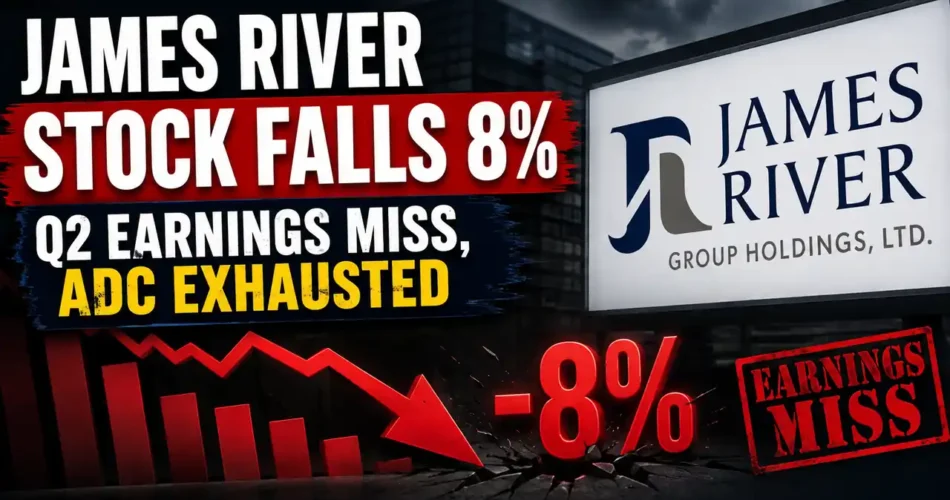
James River Shares Drop 8% After Q2 Earnings Miss and ADC Exhaustion Confirmed
James River’s stock plunged about 8% after the company reported weaker-than-expected second-quarter results and confirmed that its Alternative Debt Capacity (ADC) has been exhausted. Investors reacted swiftly, selling shares as concerns rose over the company’s near-term growth prospects and ability to deploy capital.
Disappointing Q2 Results
James River posted revenue and earnings for the second quarter that fell short of analyst estimates. The company’s top-line growth slowed due to softer demand in key segments and the delayed contribution from newly announced initiatives. On the bottom line, adjusted earnings per share missed the consensus figure, driven by narrower margins and higher operating costs. Management cited several headwinds, including elevated marketing expenses to support recent product launches and incremental costs tied to regulatory compliance.
The earnings miss undermined confidence in the firm’s ability to deliver on its previously stated guidance. While management maintained its longer-term strategy, the near-term outlook became more uncertain, prompting many investors to reprice the stock.
What Drove the Miss
- Sales headwinds: A slowdown in core product demand and weaker performance in certain regional markets.
- Margin compression: Increased cost of goods sold and higher SG&A (selling, general & administrative) spending.
- One-time items: Some non-recurring charges and restructuring expenses that weighed on reported earnings.
- Timing of initiatives: Expected benefits from new projects didn’t materialize within the quarter.
These factors combined to produce numbers that fell short of market expectations and left analysts revising near-term forecasts.
ADC Exhaustion: Why It Matters
Alongside the earnings release, James River confirmed that its Alternative Debt Capacity (ADC) — a financing mechanism the company had relied on to fund acquisitions, share buybacks, or other capital deployment — is fully utilized. ADC exhaustion restricts the company’s immediate ability to pursue accretive growth opportunities without raising new capital.
ADC typically provides flexible funding when traditional debt or equity issuance is less attractive. With that option tapped out, James River now faces a few less-appealing choices: curtailing share repurchases, delaying M&A activity, tapping capital markets for new debt or equity, or shifting toward more conservative cash preservation.
Investor concern around ADC exhaustion stems from:
- Reduced financial flexibility: Limits on quick access to affordable funding.
- Growth constraint: Potential slowdown in acquisitions or investments that had been expected to boost future earnings.
- Signal of strain: Full utilization can suggest prior cash deployments were significant and that internal generation may be insufficient to cover planned outlays.
Market participants often price in a premium for companies that can easily pursue value-creating deals; the loss of that optionality contributed to the stock’s immediate decline.
Market Reaction and Analyst Response
Trading volumes surged the day the news broke, with the stock declining roughly 8% at the market open. Short-term traders and some hedge funds led the sell-off as they adjusted positions to the new risk profile. Longer-term investors were reported to be reassessing the company’s growth runway and capital allocation strategy.
Several analysts revised their models and price targets. Common adjustments included:
- Lowered near-term revenue and EPS estimates to reflect the Q2 miss.
- Reduced multiples or higher discount rates to account for funding constraints.
- Revised capital allocation assumptions, including fewer share buybacks and delayed acquisitions.
Not all commentary was uniformly negative. A subset of analysts emphasized that ADC exhaustion is a solvable problem — through refinancing, equity issuance, or improved cash generation — and recommended watching management’s follow-up actions closely.
Insider and Management Commentary
Company executives acknowledged the disappointing quarter and confirmed ADC was fully utilized. They emphasized commitment to long-term strategy, noted steps already underway to improve margins, and signaled plans to evaluate funding alternatives. Management indicated they were exploring options to restore financial flexibility while remaining mindful of dilution and cost of capital.
Key points from management included:
- Priorities to optimize operations and reduce non-essential spend.
- A plan to reassess capital allocation, potentially pausing or scaling back buybacks.
- Exploration of refinancing or targeted equity issuance if needed.
- Continued focus on strategic initiatives aimed at sustainable growth.
Investors will be watching upcoming conference calls and investor presentations for clearer timelines and concrete actions.
Strategic Implications and Scenarios
With ADC exhausted and earnings below expectations, James River faces several strategic scenarios over the coming quarters:
- Refinance or new capital raise: The company could obtain fresh debt or issue equity. This restores flexibility but risks higher costs or dilution.
- Operational improvement push: Focus on margin recovery and cash flow generation to reduce reliance on external financing.
- Strategic slowdown: Pause or slow M&A and buybacks until liquidity improves, potentially tempering near-term EPS growth.
- Asset sales: Divesting non-core assets to raise cash quickly and strengthen the balance sheet.
Each path has trade-offs: refinancing may be costly in a higher-rate environment; equity issuances dilute existing shareholders; operational fixes take time; asset sales can be non-repeatable. The market will weigh the credibility and speed of management actions when rerating the stock.
What Investors Should Watch Next
- Management guidance and updated forecasts on the next earnings call.
- Any announcements regarding refinancing, revolving credit facilities, or capital raises.
- Cash flow trends and margin improvement progress over the next two quarters.
- M&A activity or lack thereof, which will indicate how capital deployment strategy evolves.
- Insider buying or selling, which can signal confidence or concern among executives.
Short-term volatility is likely until the market gains confidence in the company’s plan to address funding and profitability challenges.
FAQ
Q: Why did James River shares fall after the announcement?
A: Shares declined because the company missed Q2 earnings expectations and disclosed its Alternative Debt Capacity (ADC) is fully used, reducing financial flexibility and raising doubts about near-term growth and capital deployment.
Q: What is ADC and why is exhaustion significant?
A: ADC (Alternative Debt Capacity) is a funding source companies use when traditional financing is less desirable. Exhaustion means James River has no remaining capacity from that facility, limiting quick access to low-cost capital for acquisitions or buybacks and signaling potential cash constraints.
Q: Will ADC exhaustion force James River to issue equity?
A: Not necessarily, but it’s one of the available options. The company could refinance, tap credit markets, improve internal cash flow, sell assets, or issue equity. Each option carries different costs and consequences.
Q: How should investors respond to this news?
A: Investors should review their time horizon and risk tolerance. Short-term traders may react to volatility; long-term investors should monitor management’s corrective actions, updated guidance, and cash flow improvements before changing positions.
Q: Could this be a buying opportunity?
A: It could be for investors who believe management can restore flexibility and improve profitability at acceptable cost. However, risks include further earnings pressure and potentially dilutive capital raises. Assess the company’s fundamentals and plan before buying.
Q: When will we know if James River has solved the issue?
A: The next two earnings reports and any communications about refinancing or capital raises will be key. Concrete steps on refinancing, cost controls, or asset sales will indicate progress.

