

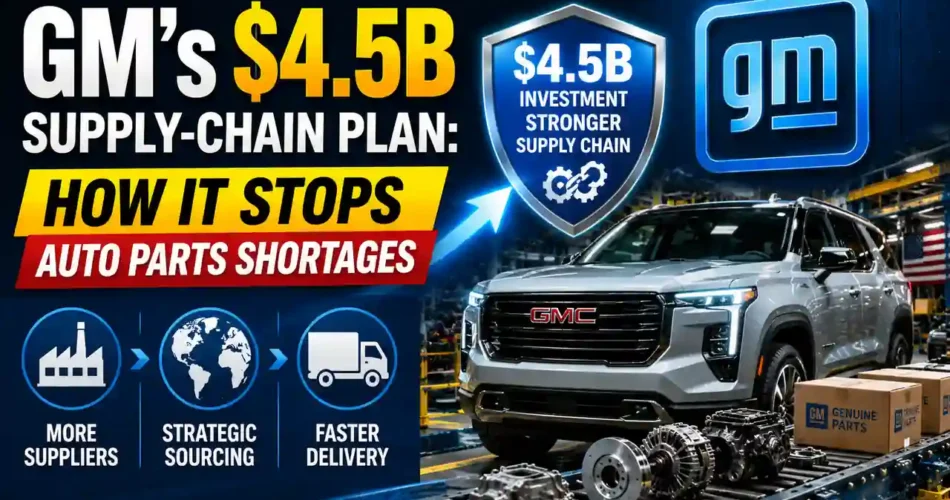
General Motors Builds a $4.5 Billion Supply-Chain Safety Net to Prevent Parts Shortages
General Motors (GM) is taking decisive steps to protect its production lines from the disruptions that plagued the auto industry in recent years. The company announced a $4.5 billion initiative designed to strengthen its parts supply chain, reduce the risk of production stoppages, and improve resilience against global shocks. This strategic investment is aimed at securing materials, bolstering supplier capacity, and enhancing operational flexibility so GM can continue meeting customer demand without costly interruptions.
Why GM is acting now
Supply-chain instability has become a central challenge for automakers. Pandemic-era factory closures, shipping delays, and fluctuating demand exposed vulnerabilities across the global supplier network. The resulting parts shortages forced several manufacturers to idle production, delay vehicle deliveries, and scramble for alternative sources. Even as the immediate crisis recedes, lingering issues such as geopolitical tensions, natural disasters, and limited manufacturing capacity for specialized components (notably semiconductors) continue to threaten steady vehicle production.
GM’s $4.5 billion plan signals recognition that episodic fixes aren’t enough. Instead of reacting to disruptions, the company is investing to prevent them, creating buffers and redundancies to ensure supply continuity in both routine and extreme scenarios.
Core elements of the safety net
GM’s program is multi-pronged and focuses on immediate risk reduction while building long-term supply resilience. Key components include:
Direct supplier financing
GM is setting aside funds to help suppliers expand capacity, modernize equipment, and stabilize operations. This finance can be used for working capital, new production lines, or facility upgrades, especially for smaller vendors that lack easy access to credit.
Inventory strategic reserves
The company will maintain larger strategic inventories of critical parts. By holding safety stock for high-risk components, GM aims to weather short-term disruptions without halting assembly lines.
Dual sourcing and nearshoring
GM plans to diversify its supplier base for vulnerable parts by adding alternate vendors and shifting some production closer to vehicle assembly plants. Nearshoring reduces lead times and transportation risk while supporting regional supplier ecosystems.
Long-term contracts and supplier partnerships
The automaker will pursue longer-term agreements that provide revenue stability for suppliers in exchange for prioritized capacity and guaranteed deliveries during demand spikes.
Supply-chain visibility and analytics
Investment in better forecasting tools and real-time tracking will allow GM to detect emerging bottlenecks earlier and respond faster. Advanced analytics will help identify the most critical nodes in the supply chain to prioritize protection efforts.
How the funding will be deployed
The $4.5 billion pool is not one-size-fits-all. GM will allocate capital based on supplier needs, component criticality, and risk assessments. A portion is earmarked for immediate relief—helping suppliers fix urgent constraints—while the remainder supports strategic initiatives such as capacity expansion and technology upgrades.
GM has emphasized that funds will be targeted to parts deemed essential to vehicle safety and production continuity. This includes semiconductors, powertrain components, and other modules that historically have created the most disruption when scarce.
Expected benefits for production and customers
The safety net aims to reduce production volatility and minimize the number of vehicles affected when shortages occur. Expected outcomes include:
- Fewer assembly-line stoppages and work schedule interruptions.
- More predictable delivery timelines for dealerships and customers.
- Improved ability to scale production during demand surges without compromising quality.
- Enhanced supplier financial stability, lowering the risk of vendor failure.
By smoothing production flows and strengthening supplier relationships, GM can better meet market demand for its vehicles, protect revenue, and maintain customer confidence.
Industry context and comparisons
GM is not alone in seeking supply-chain resilience; the auto industry broadly has been rethinking its sourcing strategies. Several competitors and suppliers have also increased inventory levels, invested in semiconductor partnerships, and explored regional manufacturing to mitigate exposure. What distinguishes GM’s approach is the scale and structured nature of a centralized fund specifically dedicated to supplier support and resilience-building.
For suppliers, GM’s move offers both relief and expectations: access to financing and contractual security in return for commitments to capacity and delivery performance. This mutual dependence could create a more stable supplier network, but it will also require robust governance to ensure funds are used effectively.
Potential risks and criticisms
Building resilience carries costs and trade-offs. Holding larger inventories ties up capital and can raise carrying costs; nearshoring can increase unit costs compared with low-cost overseas sourcing; and long-term contracts might lock GM into pricing that becomes less competitive if market conditions change.
Other concerns include equitable allocation of funds among suppliers and the risk of moral hazard—where companies might underinvest in their own resilience, relying instead on GM support. To minimize these pitfalls, GM will need transparent criteria for fund disbursement and clear performance expectations tied to financing.
Longer-term strategic impacts
Beyond immediate risk mitigation, the investment could influence broader strategic shifts:
- Acceleration of vertical integration for some components, especially where suppliers are scarce or high-tech.
- Greater regionalization of supply chains, as companies balance cost with reliability.
- Increased focus on digital supply-chain tools and predictive analytics to manage complexity.
- Stronger supplier consolidation or partnerships, as smaller vendors merge or are acquired to meet capital and technology demands.
If successful, GM’s initiative could set a precedent for how large manufacturers proactively manage supply-chain risk—shifting from reactive troubleshooting to structured resilience funding.
What suppliers stand to gain
Suppliers receiving support will gain access to capital and technical assistance that can help them modernize production, adopt automation, and meet stricter quality and delivery requirements. This capital infusion could accelerate upgrades that otherwise would have taken years to finance. In turn, suppliers that strengthen their operations may secure longer-term contracts and deeper collaboration with GM.
How this affects consumers and investors
Short-term, consumers may see more reliable delivery schedules and fewer model shortages, which helps maintain brand loyalty and sales momentum. For investors, the program represents a defensive investment to protect revenue streams, though it carries near-term costs that management must justify with improved operational stability and fewer lost sales.
FAQ
Q: Why did GM create a $4.5 billion fund?
A: To reduce the risk of parts shortages that can halt production by financing supplier capacity expansion, increasing strategic inventory, and improving supply-chain flexibility.
Q: Which suppliers will get the money?
A: GM will prioritize suppliers producing critical components—such as semiconductors and powertrain parts—and allocate funds based on assessed risk, supplier capability, and urgency.
Q: Will this make GM more expensive to operate?
A: The program increases upfront costs—inventory carrying, financing, and potential higher sourcing costs—but the goal is to prevent much larger losses from production stoppages and missed sales, which can be costlier.
Q: Could suppliers become dependent on GM support?
A: That risk exists. To avoid moral hazard, GM plans to attach performance expectations and use transparent criteria for disbursements so suppliers still invest in their own resilience.
Q: How soon will this reduce the chance of parts shortages?
A: Some measures—like immediate supplier financing—can act quickly. Capacity expansion and nearshoring take longer, so risk reduction will be both immediate (short-term relief) and gradual (long-term resilience).
Q: Does this mean GM will stop using overseas suppliers?
A: Not necessarily. GM will likely maintain a mixed strategy, keeping cost-effective global suppliers while adding regional and backup sources for critical parts.
- U.S. Department of Energy — automotive and supply-chain support news:
https://www.energy.gov/cmei/manufacturing/articles/biden-harris-administration-announces-nearly-71-million-continue
- U.S. Department of Energy — battery supply chain and EV manufacturing funding:
https://www.energy.gov/articles/us-department-energy-announces-131-million-boost-americas-battery-supply-chain-and
- U.S. Census Bureau — motor vehicle manufacturing data:
https://www.census.gov/library/visualizations/interactive/motor-vehicle.html

