
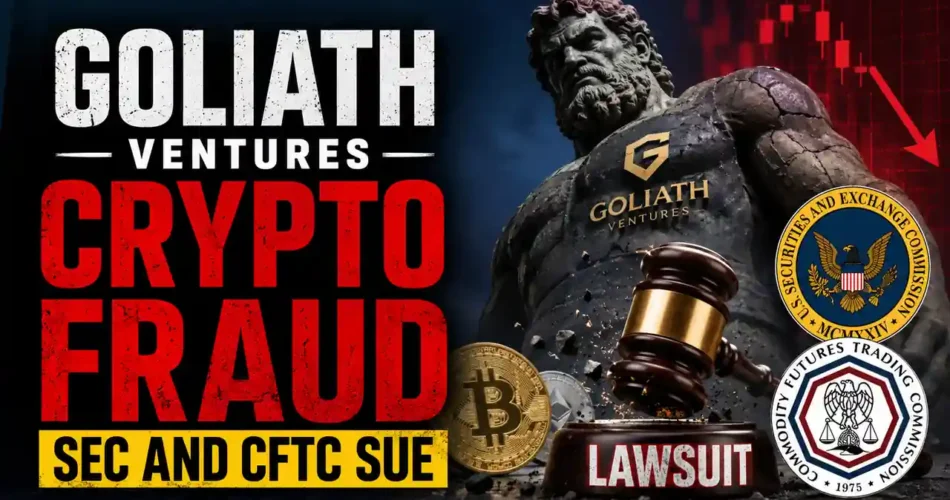
SEC and CFTC File Parallel Crypto Fraud Complaints Against Goliath Ventures
The U.S. Securities and Exchange Commission (SEC) and the Commodity Futures Trading Commission (CFTC) have filed separate civil complaints against Goliath Ventures Inc. and its founder and chief executive, Christopher A. Delgado. The regulators allege that the company operated a large cryptocurrency investment fraud scheme involving hundreds of millions of dollars.
The SEC says Goliath raised at least $425 million from more than 1,300 investors. The CFTC’s complaint refers to approximately 1,600 customers and at least $397 million in funds. The difference in the figures appears to reflect the agencies’ separate regulatory investigations and methods of calculating the alleged losses. SEC complaint details | CFTC complaint details
What the Regulators Allege
According to the SEC, Goliath promoted an investment program connected to cryptocurrency liquidity pools. Investors were allegedly told that their money would be combined with other funds and used to support trading activity involving digital assets.
The company allegedly promised monthly returns ranging from 3% to 10%, while also assuring investors that their original capital would be returned. Regulators claim these promises were misleading because the funds were not invested in the liquidity pools as represented.
Instead, the SEC alleges that Goliath used money from newer investors to pay returns to earlier participants. This type of arrangement is commonly described by regulators as a Ponzi-style structure because reported profits are allegedly funded by incoming investor money rather than genuine business activity.
Alleged Misuse of Investor Funds
The SEC complaint claims that Delgado personally misappropriated at least $51 million. The alleged spending included residential properties, luxury vehicles, a yacht, travel, and other personal expenses.
Regulators also allege that Goliath employed sales agents to recruit additional investors. The complaint states that some commissions were paid from investor funds rather than from legitimate profits generated by cryptocurrency trading.
Fictitious Account Information
Another major allegation concerns the information provided to customers. The SEC claims that Goliath created false account statements and investment performance figures to make it appear that customer funds were actively invested and generating profits.
These records allegedly showed account balances and returns that did not accurately reflect the company’s financial position. Such information can make it difficult for investors to identify warning signs, especially when statements appear to show consistent gains.
The agencies further allege that Goliath continued attracting new customers while using incoming funds to support payments to existing investors. The SEC says the operation began to collapse when the company could no longer raise money quickly enough to meet expected distributions.
Why Both Agencies Filed Cases
The SEC and CFTC have different areas of responsibility. The SEC generally oversees securities markets, securities offerings, and related investment fraud, while the CFTC regulates futures, swaps, certain derivatives, and commodity-market conduct.
Cryptocurrency businesses can sometimes operate across both areas. A company may market an investment contract that raises securities-law issues while also claiming to trade digital assets or offer products connected to derivatives markets. This overlap helps explain why the two agencies filed separate complaints against the same defendants.
SEC Allegations
The SEC alleges that Goliath and Delgado conducted an unregistered securities offering between at least January 2023 and January 2026. The agency also accuses the defendants of making materially false or misleading statements to investors.
The SEC’s complaint includes alleged violations of Sections 5(a), 5(c), and 17(a) of the Securities Act of 1933. It also alleges violations of Section 10(b) of the Securities Exchange Act of 1934 and Rule 10b-5. The complaint further accuses Delgado of violating Section 15(a)(1) of the Exchange Act.
CFTC Allegations
The CFTC says Goliath solicited customer funds for cryptocurrency trading involving assets such as Bitcoin and Ether. The agency alleges that the company misrepresented how customer money would be used and supplied fabricated records showing supposed trading profits.
The CFTC is seeking several remedies, including restitution for customers, repayment of allegedly obtained funds, civil monetary penalties, and permanent restrictions on trading and registration.
Related Criminal Case
The civil complaints came after Delgado pleaded guilty to federal criminal charges in June 2026, according to information released by the U.S. Department of Justice. The criminal case is connected to the alleged fraud and money-laundering activity involving Goliath Ventures.
A guilty plea in a criminal proceeding is separate from the civil cases filed by the SEC and CFTC. The civil actions will address regulatory violations and financial remedies sought by the agencies, while the criminal matter concerns potential violations of federal criminal law.
Potential Consequences
If the regulators succeed in their cases, Goliath Ventures and Delgado could face substantial financial and legal consequences. Possible remedies may include:
- Repayment of investor funds.
- Disgorgement of allegedly obtained profits.
- Civil monetary penalties.
- Restrictions or bans from participating in regulated markets.
- Orders preventing future securities or derivatives-related activity.
- Additional asset-recovery and investor-compensation proceedings.
The ultimate amount recovered by investors may depend on the defendants’ remaining assets, the outcome of the court proceedings, and the priority of competing claims. Civil enforcement actions do not automatically guarantee that every investor will recover the full amount of an alleged loss.
What the Case Means for Crypto Investors
The Goliath case highlights the risks associated with investment programs promising high and consistent monthly returns. In volatile markets, guaranteed profits and assurances that principal is protected should be treated cautiously, particularly when the investment strategy is difficult to verify.
Investors should examine whether a platform clearly explains how funds are held, where trades are executed, and how returns are generated. Independent audits, transparent custody arrangements, verifiable transaction records, and properly registered operators can provide important information, although they do not eliminate investment risk.
Warning Signs to Watch
- Guaranteed returns that appear unusually high.
- Pressure to recruit friends, family members, or additional investors.
- Statements showing profits that cannot be independently verified.
- Unclear explanations about custody, trading venues, or fund use.
- Difficulty withdrawing money or unexplained delays in payments.
- Promises that investment losses are impossible.
Frequently Asked Questions
What are the SEC and CFTC accusing Goliath Ventures of doing?
The agencies allege that Goliath operated a cryptocurrency investment fraud scheme, misrepresented how customer funds were used, created false performance information, and used money from newer investors to pay earlier participants.
How much money was allegedly involved?
The SEC alleges that at least $425 million was raised from more than 1,300 investors. The CFTC cites approximately $397 million from about 1,600 customers. The figures differ because the agencies filed separate complaints based on their own investigations.
What returns were investors allegedly promised?
The SEC says investors were promised monthly distributions of approximately 3% to 10%, together with assurances that their original investment would be returned.
Was the money actually invested in crypto liquidity pools?
The SEC alleges that Goliath did not invest investor funds or digital assets in the liquidity pools described in its promotional materials. The allegations remain subject to the legal process and court proceedings.
What happened to Goliath CEO Christopher Delgado?
Delgado pleaded guilty to federal criminal charges in June 2026 in a case related to the alleged scheme. The SEC and CFTC have also named him as a defendant in their separate civil complaints.
Can affected investors recover their money?
Investors may potentially receive funds through restitution, disgorgement, asset recovery, or other court-approved remedies. However, the amount and timing of any recovery will depend on the court cases and the assets available for distribution.
Does the case mean all cryptocurrency investments are fraudulent?
No. The allegations concern specific conduct by Goliath Ventures and its executives. However, the case demonstrates why investors should verify claims, review risk disclosures, and investigate the legal status and operating history of any crypto investment platform.
Conclusion
The parallel SEC and CFTC complaints against Goliath Ventures show how U.S. regulators are addressing alleged misconduct that crosses securities and digital-asset markets. The agencies claim that investors were promised cryptocurrency-based returns but that their funds were instead diverted, misrepresented, or used to support payments to earlier participants.
The case also reinforces the importance of transparency in the digital-asset industry. Investors should be especially careful with platforms offering guaranteed returns, limited-loss promises, or account statements that cannot be independently verified.
External References:
U.S. Securities and Exchange Commission: Crypto Enforcement Actions
U.S. Commodity Futures Trading Commission: Goliath Ventures Complaint
U.K. Financial Conduct Authority: Cryptoasset Regulation
U.K. Financial Conduct Authority: Cryptoasset Regime Policy Statements
Canadian Securities Administrators: Crypto Asset Trading Platforms
Disclaimer: This article is for informational purposes only and should not be considered financial, legal, or investment advice. The allegations described above are claims made in regulatory complaints and should not be treated as proven facts unless established by a court.

