

Gold (XAU/USD) remains on the back foot during American trading hours on Thursday as US Treasury yields rebound and the US Dollar stabilizes following the previous day’s sharp pullback. At the time of writing, XAU/USD trades around $4,486, easing from an intraday high of $4,527, its highest level since June 2.
The precious metal climbed over 4% on Wednesday after the US Treasury Department announced that it would increase its liquidity-support buybacks for longer-dated government securities. In reaction, the 30-year Treasury yield fell around 9 basis points (bps) to 5.18%, while the benchmark 10-year yield dropped about 5 bps to 4.63%.
The Treasury’s move provided some relief to the bond market after the 30-year yield climbed above 5.30% earlier this week, its highest level since 2007. However, both the 10-year and 30-year yields are up around 6 basis points on Thursday. The buybacks may ease pressure in the short term, but they do not address large fiscal deficits, heavy debt issuance or persistent inflation risks, analysts warn.
The US Dollar Index (DXY), which tracks the Greenback’s value against a basket of six major currencies, fell below 99.00 on Wednesday to a three-month low. At press time, the index trades around 98.80, recovering from an intraday low of 98.56.
The latest weekly labour-market data offers some support to the Greenback. Initial Jobless Claims fell to 206K, below market expectations of 210K and the previous reading of 212K (revised from 209K).
The recovery in the US Dollar and Treasury yields reduces the appeal of non-yielding Gold, pulling the metal lower from its highest level in more than two months.
Gold also remains sensitive to the Federal Reserve’s (Fed) monetary policy outlook. According to TD Securities, analysts highlight that “the signal of the Treasury looking to support the longer end, alongside a Fed willing to look past higher energy prices, should be enough to support the yellow metal in the near-term.”
However, they caution that the next meaningful advance may take time to emerge, noting that “with the market still pricing in hikes for 2027, the next leg higher for Gold is unlikely to materialize before the broader market becomes more convinced that the Fed remains on hold.”
According to the CME FedWatch Tool, markets price in a 65% chance that the Fed will keep rates unchanged in September, up from 35% a month ago.
Minutes from the Fed’s July meeting, released on Wednesday, showed that many policymakers judged higher interest rates would likely be needed if inflation failed to decline. Some officials also questioned whether financial conditions were restrictive enough to return inflation to the Fed’s 2% target.
Technical Analysis: XAU/USD stalls below the 200-day SMA
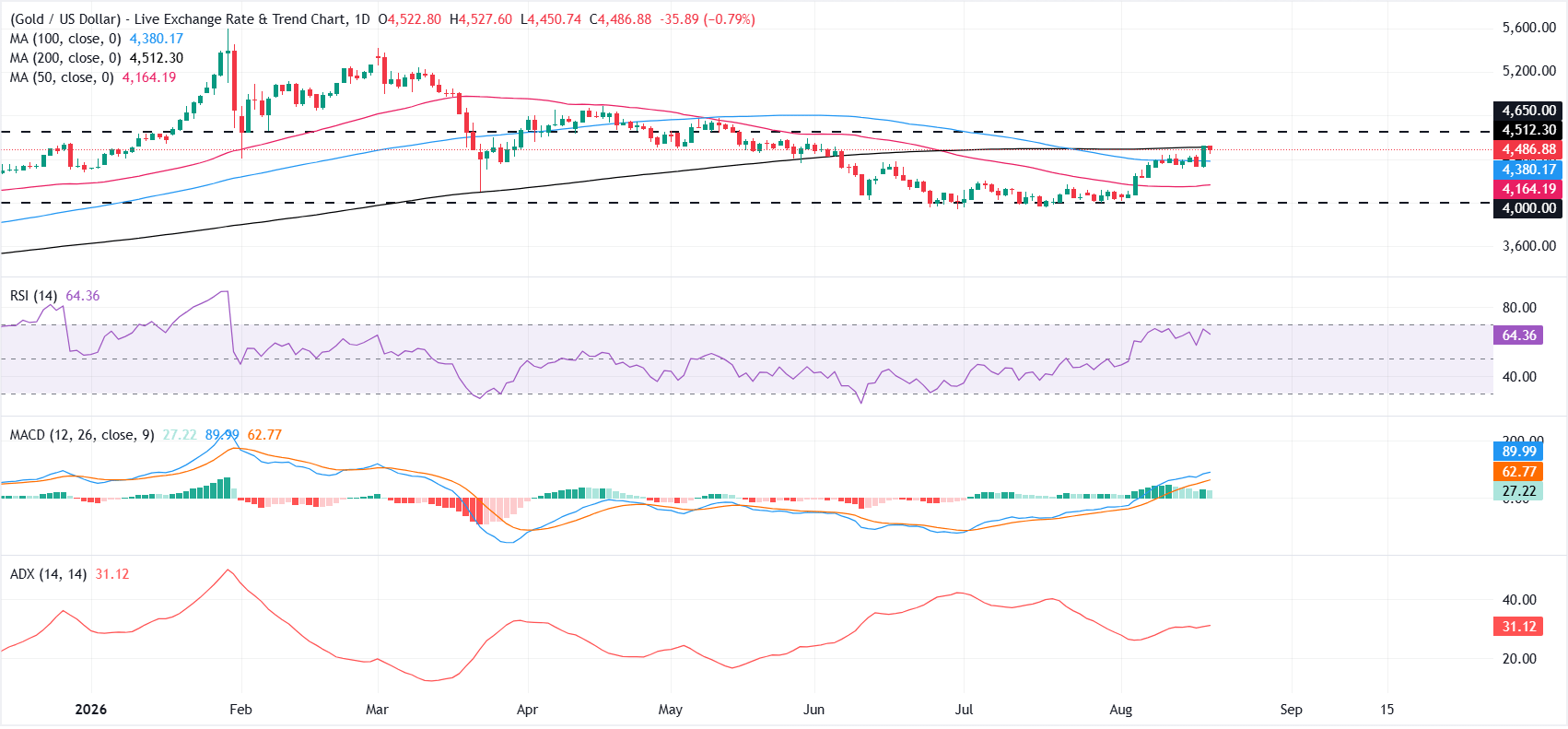
On the daily chart, XAU/USD retains a bullish near-term bias as prices hold above the 50-day and 100-day Simple Moving Averages (SMAs) at $4,164 and $4,380, respectively. The metal is now fluctuating near the 200-day SMA at $4,512 after briefly climbing above it.
The Relative Strength Index (RSI) stands near 65, while the Moving Average Convergence Divergence (MACD) histogram remains positive, pointing to firm upside momentum.
A daily close above the 200-day SMA could open the door toward the horizontal resistance at $4,650. On the downside, the 100-day SMA at $4,380 offers initial support, followed by the 50-day SMA at $4,164 and the $4,000 psychological mark.
(The technical analysis of this story was written with the help of an AI tool. Know more.)
Gold FAQs
Gold has played a key role in human’s history as it has been widely used as a store of value and medium of exchange. Currently, apart from its shine and usage for jewelry, the precious metal is widely seen as a safe-haven asset, meaning that it is considered a good investment during turbulent times. Gold is also widely seen as a hedge against inflation and against depreciating currencies as it doesn’t rely on any specific issuer or government.
Central banks are the biggest Gold holders. In their aim to support their currencies in turbulent times, central banks tend to diversify their reserves and buy Gold to improve the perceived strength of the economy and the currency. High Gold reserves can be a source of trust for a country’s solvency. Central banks added 1,136 tonnes of Gold worth around $70 billion to their reserves in 2022, according to data from the World Gold Council. This is the highest yearly purchase since records began. Central banks from emerging economies such as China, India and Turkey are quickly increasing their Gold reserves.
Gold has an inverse correlation with the US Dollar and US Treasuries, which are both major reserve and safe-haven assets. When the Dollar depreciates, Gold tends to rise, enabling investors and central banks to diversify their assets in turbulent times. Gold is also inversely correlated with risk assets. A rally in the stock market tends to weaken Gold price, while sell-offs in riskier markets tend to favor the precious metal.
The price can move due to a wide range of factors. Geopolitical instability or fears of a deep recession can quickly make Gold price escalate due to its safe-haven status. As a yield-less asset, Gold tends to rise with lower interest rates, while higher cost of money usually weighs down on the yellow metal. Still, most moves depend on how the US Dollar (USD) behaves as the asset is priced in dollars (XAU/USD). A strong Dollar tends to keep the price of Gold controlled, whereas a weaker Dollar is likely to push Gold prices up.
Source link