
The Indian Rupee (INR) snaps three-day losing streak against the US Dollar (USD) on Thursday. The USD/INR pair corrects to near 95.62 as a sharp decline in long-dated United States (US) bond yields, following the announcement from the Treasury Department that it plans to double its bond-buying operations, has weakened the US Dollar.
As of writing, the US Dollar Index (DXY), which tracks the Greenback’s value against six major currencies, seems vulnerable near its fresh seven-week low of 98.77 posted on Wednesday.
30-year US Treasury Yields are down almost 2% from Tuesday’s closing price to near 5.18%. Meanwhile, 10-year US Treasury Yields hold onto Wednesday’s losses near 4.64%.
Lower US bond yields improve the appeal of riskier currencies, such as the Indian Rupee.
US Treasury plans to double bond-buyback plan
Late Wednesday, the US Treasury Department announced that it would at least double the maximum size of its liquidity-support buyback operations for longer-dated nominal securities, The Wall Street Journal (WSJ) reported.
According to the report, the current maximum size of $2 billion per operation will be increased to at least $4 billion per operation. The plan to double bond-buying operations aims to curb a sharp increase in borrowing costs.
Many Fed officials support interest rate rise
The Federal Open Market Committee (FOMC) minutes from the July meeting released on Wednesday that many board members felt the need for interest rate hikes if inflation remains high. The minutes also showed that “a few opted out of an immediate hike, saying it could avoid the need for further increases later”.
Despite several Fed members supporting the need for a near-term interest rate hike, the odds of the US central bank holding interest rates steady in the September meeting remain unchanged.
According to the CME FedWatch tool, there is a 67% chance that the Fed will leave policy rates unchanged in September, marginally higher than the 64% recorded on Tuesday.
Analysts at Jefferies have commented that “economic data released since the meeting meant the minutes now give an outdated economic picture”.
The US economic data for July released this month has shown that there is a reduction in the overall labor force by 23K, and June’s Nonfarm Payrolls (NFP) data was also revised lower. Also, the US headline and core Consumer Price Index (CPI) grew at a moderate pace.
INR’s upside seems limited due to elevated oil prices
Strategists at OCBC highlight that the Indian Rupee will likely struggle to capitalise on the recent Dollar pullback, with elevated oil prices and importer dollar demand continuing to weigh.” They add that “RBI-linked USD sales appear to have helped contain losses and keep USD/INR from extending higher,” even as the global backdrop has turned more supportive.
In their view, “the overnight USD sell-off and lower US Treasury yields should offer some relief, but the divergence is telling – INR has so far struggled to benefit fully from the weaker USD backdrop while elevated oil prices remains the key headwind given India’s import dependence.” OCBC concludes that “as such, INR may continue to lag the broader Asian complex unless crude prices ease more meaningfully.”
USD/INR Technical Analysis
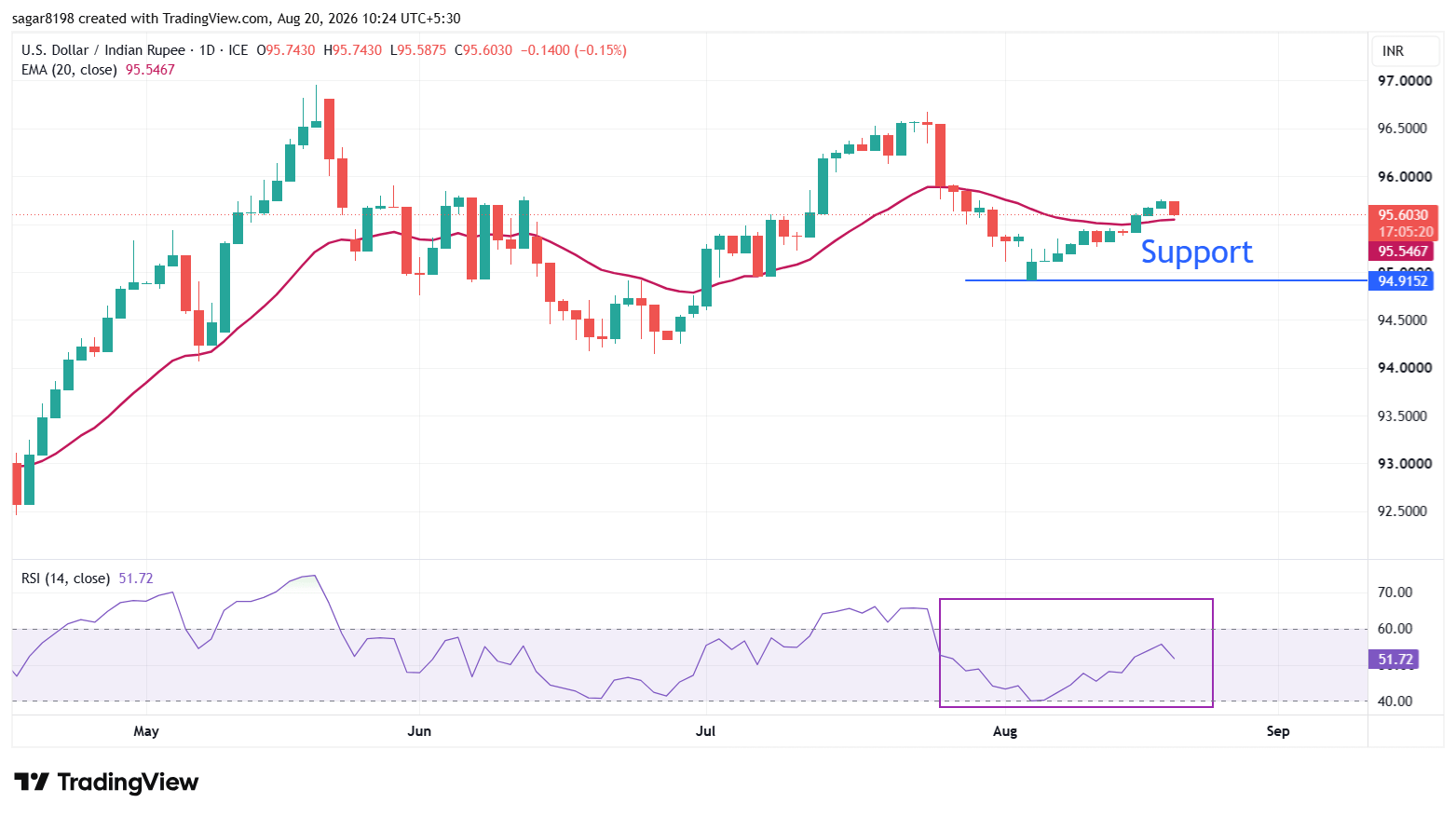
In the daily chart, USD/INR trades at 95.6350, holding slightly above the 20-period exponential moving average (EMA) at 95.55, which suggests a mildly constructive near-term bias.
The pair has been oscillating in a tight range, and the Relative Strength Index (RSI) at 51.72 sits just above the neutral line, hinting at modest buying interest rather than strong trend conviction.
On the downside, immediate support is seen at the 20-period EMA around 95.55, followed by the August 12 low at 95.29; below that, the August 5 low at 94.83 will be the major cushion for the pair. On the upside, the pair needs to break above the August 19 high at 95.76 decisively to extend the advance toward 96.00.
(The technical analysis of this story was written with the help of an AI tool. Know more.)
Economic Indicator
FOMC Minutes
FOMC stands for The Federal Open Market Committee that organizes 8 meetings in a year and reviews economic and financial conditions, determines the appropriate stance of monetary policy and assesses the risks to its long-run goals of price stability and sustainable economic growth. FOMC Minutes are released by the Board of Governors of the Federal Reserve and are a clear guide to the future US interest rate policy.
Last release:
Wed Aug 19, 2026 18:00
Frequency:
Irregular
Actual:
–
Consensus:
–
Previous:
–
Source:
Federal Reserve
Source link