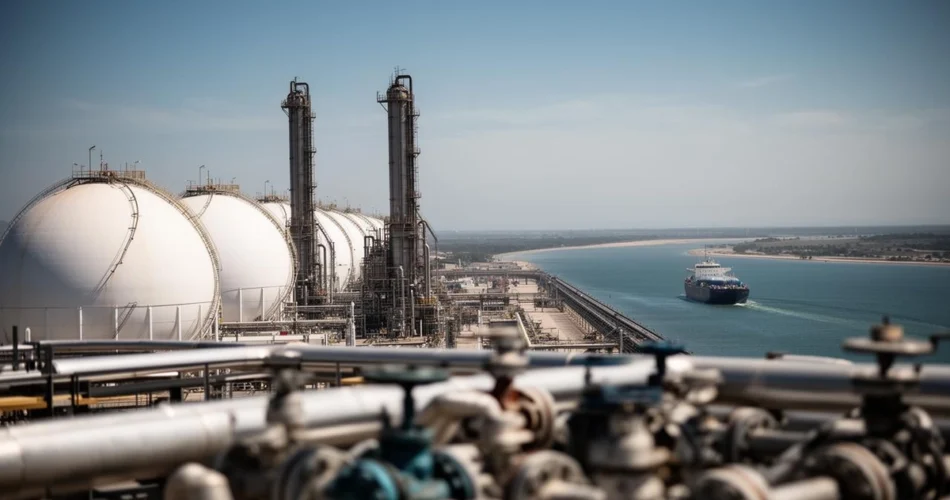
European liquefied natural gas (LNG) spot prices surged to their highest level in more than three years this week, as the impact of the Middle East conflict on global energy supply chains deepens. Blocked transit through the Strait of Hormuz, combined with low European inventories, is sharply intensifying market concerns over winter supply tightness.
According to energy pricing agency Argus Media, LNG spot prices in northwestern Europe rose to $22.83 per million British thermal units early this week, more than double year-ago levels and the highest since January 2023. Meanwhile, the Asian LNG benchmark Platts JKM has climbed 13% in August.
The price surge is transmitting multiple pressures through the market: European and Asian buyers are competing for limited cargoes, further driving up global prices. Goldman Sachs warned in a research note published Sunday that European benchmark gas prices would need to rise above 100 euros per megawatt-hour to “more significantly curb Asian LNG demand,” while current contract prices stand at around 66 euros per megawatt-hour, implying substantial further upside.
Strait blocked, LNG transit near standstill
The Middle East conflict has become the immediate trigger for this LNG price spike. The Strait of Hormuz normally handles about one-fifth of global LNG supply, but the number of vessels transiting has plummeted since the conflict erupted. According to commodity data provider Kpler, only eight LNG carriers exited the strait in July, compared with a pre-war average of roughly three per day.
The situation deteriorated further this week. Iran’s Persian Gulf Strait Authority on Sunday threatened fines or confiscation against dozens of vessels, with a blacklist covering 46 ships, including 10 LNG carriers. Martin Senior, head of LNG pricing at Argus, said market confidence in a near-term resumption of transit through the Strait of Hormuz is weakening.
Compared with crude oil, natural gas transportation is being hit more directly. Crude tankers are relatively versatile, and some have still departed the Gulf in recent months; LNG transport, by contrast, relies heavily on specialized vessels and supporting infrastructure. Once a critical chokepoint is blocked, alternative shipping options are significantly more limited, and the risk of supply disruption is higher.
Low European inventories, refill progress continues to lag
Europe is emerging as one of the most vulnerable markets in this supply shock. Even before the conflict, European gas inventories were already below levels typical for the same period in previous years; since the outbreak, Europe has further slowed injections to maintain current supply, causing refill progress to keep falling behind.
According to Gas Infrastructure Europe data, average daily net injections into European storage in August totaled just 3 terawatt-hours, down from 3.6 terawatt-hours in the same period last year. German gas storage facilities are currently only about 50% full. Under German regulations, if private companies fail to fully utilize booked storage capacity, the government is required to step in to purchase and store gas.
Europe’s overall strategic gas storage is only 62% full, far below normal levels for this time of year. The Dutch TTF benchmark gas price settled at 68.5 euros per megawatt-hour on August 24, more than double the 32 euros seen at the end of February.
Florence Schmitt, an analyst at Rabobank, noted that the outlook is “deteriorating by the day.” She identified three core risk factors: insufficient storage refill, the possibility of escalation in the Persian Gulf conflict, and reduced Norwegian gas exports due to infrastructure maintenance.
Germany, Europe’s largest gas consumer, is in a particularly dire situation. Since shutting down its nuclear power plants, Germany’s power generation has become heavily dependent on natural gas, further raising the price floor for the entire market. Belgium, while slightly advantaged by direct pipeline connections to the UK and Norway as well as the Zeebrugge LNG terminal, has storage levels even lower than Germany’s.
The risk of low inventories has been flagged by the market for months. At the same time, natural gas futures prices for the coming months have remained essentially flat, compressing the arbitrage spread between buying cheap in the off-season and selling high in winter, which has also weakened traders’ incentive to actively restock. As winter approaches, the market is closely watching whether European policymakers will intervene.
Asian demand rebounds, global supply-demand gap tightens
Asian demand has become another key variable determining the direction of global gas prices. In the early stages of the conflict, Asian buyers proactively cut LNG imports, which to some extent eased the competition for cargoes between Europe and Asia; but as the situation has dragged on, buying interest across Asian economies has rebounded, and the global LNG supply-demand gap is tightening further.
Goldman Sachs expects European natural gas prices will likely need to break above 100 euros per megawatt-hour before December 2026 to attract sufficient LNG cargoes from the global market and help the region complete storage refills ahead of winter. If European price competitiveness proves insufficient, the region will be forced into fierce competition with Asian customers in the global LNG market.
The impact on end consumers is already emerging. Fixed-price energy contracts have been sharply repriced upward since August, making them less attractive; users on variable-rate contracts will directly bear the pressure of persistently elevated market prices.
The following table summarizes key data points for the current European natural gas market:
| Indicator | Current Level | Comparison Benchmark |
|---|---|---|
| Northwestern Europe LNG spot price | $22.83/MMBtu | approximately $11 a year ago |
| TTF benchmark gas price | 68.5 euros/MWh | 32 euros/MWh at end-February |
| European strategic storage fill rate | 62% | Normally higher for this time of year |
| German storage fill rate | ~50% | Regulatory requirement to reach target before winter |
| August average daily net injections in Europe | 3 TWh | 3.6 TWh in same period last year |
| LNG carriers transiting Strait of Hormuz in July | 8 vessels | Pre-war average ~3 per day |
Note: Data compiled from Argus Media, Kpler, Gas Infrastructure Europe, and Goldman Sachs research.
From the perspective of global LNG trade flows, the blockage of the Strait of Hormuz is reshaping how market participants price risk. LNG carriers are highly specialized with limited alternative routes; if a critical chokepoint remains blocked for an extended period, the risk premium for supply disruption will continue to be embedded in prices. Europe, as a market highly dependent on imported LNG, faces a grim outlook for winter energy security under the combined pressure of insufficient inventories and geopolitical risk.
Source link
Author

- Ytv Market News
- Share-market news writer and analyst with deep experience covering equities, commodities, forex, and cryptocurrencies for readers in the USA, UK, Canada, and Australia. Ytv Market News delivers timely market updates, practical trading insights, and clear explanations of macro and company-level catalysts that move prices. Combines on-the-ground financial reporting with technical analysis, using concise charts and actionable ideas to help investors and traders make smarter decisions.
Latest entries
 Company NewsAugust 27, 2026Die Atom-Aktie bleibt ein Nischenwert ohne klare Marktdaten
 Crypto NewsAugust 27, 2026Quantum-Safe Bitcoin Transaction Lands on Mainnet
 Stock Market VideosAugust 27, 2026Sweetgreen CEO Says Cyclospora Hurt Sales
 UkAugust 27, 2026Macfarlane Group holds dividend as profit sags in “weak” environment