

Haidilao International Holding Ltd. (6862.HK) released its 2026 interim results on the evening of August 25, reporting first-half revenue of 22.34 billion yuan (approximately $3.3 billion), up 7.9% year-over-year and a record high for the period. Core operating profit came in at 2.51 billion yuan (approximately $374.6 million), up 4.4%, while net profit for the period rose a marginal 0.5% to 1.76 billion yuan (approximately $263.0 million).
The board declared an interim dividend of HK$0.377 per share (approximately $0.0481), up 11.5% year-over-year, payable on or before September 23, 2026.
By business segment, Haidilao restaurant operations remained the revenue foundation, contributing 17.84 billion yuan (approximately $2.7 billion) in the first half, or 79.9% of total revenue, though this represented a 4% year-over-year decline, primarily due to a reduction in the number of company-operated restaurants. As of June 30, the Haidilao brand operated 1,389 restaurants in total, comprising 1,267 company-operated locations in mainland China, 23 company-operated locations in Hong Kong, Macau, and Taiwan, and 99 franchised restaurants. During the first half, the company opened 24 company-operated and 14 franchised restaurants, converted 6 company-operated locations to franchised, and closed 32 restaurants due to reasons including facility aging and relocation, as well as underperformance relative to expectations.
On operational efficiency, the average table turnover rate for company-operated Haidilao restaurants improved to 3.9 times per day from 3.8 times per day in the same period last year, while same-store table turnover held steady at 3.9 times per day. Average customer spending dipped slightly to 97 yuan from 97.9 yuan, with per-capita spending in China’s first-tier cities declining from 105.2 yuan to 104.2 yuan, and in Hong Kong, Macau, and Taiwan from 205.8 yuan to 196.6 yuan.
Delivery becomes fastest-growing segment
The delivery business was the standout growth driver in this earnings report. First-half delivery revenue reached 2.05 billion yuan (approximately $305.7 million), surging 121.2% year-over-year, with its share of group revenue jumping from 4.5% in the prior-year period to 9.2%.
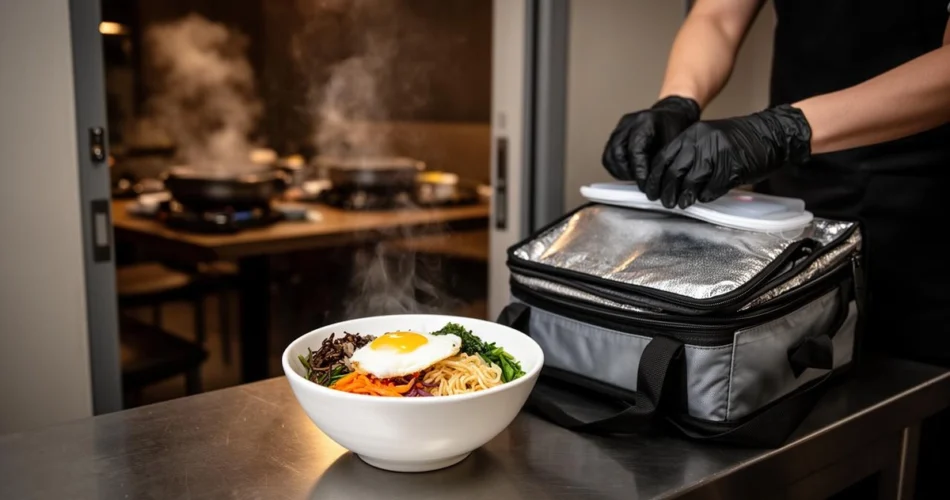
The company attributed the growth to two factors. First, an expanded product mix: sales of single-serve meal products, led by bibimbap-style rice bowls, rose sharply year-over-year, transforming delivery from an extension of the hotpot dining occasion into a standalone category covering everyday meals, with the new product line now in the refinement and market-testing phase. Second, denser delivery station coverage: the company continued to advance its self-operated delivery station model, improving coverage density and fulfillment efficiency while reducing strain on in-store kitchen capacity.
Multi-brand restaurant operations also delivered strong performance. Revenue from other restaurant operations reached 1.27 billion yuan (approximately $189.5 million), up 113.1% year-over-year, lifting its share of group revenue to 5.7%. The growth was primarily driven by the steady development of innovative restaurant brands under the “Pomegranate Plan,” as well as contributions from diverse dining formats including camping hotpot and late-night hotpot.
Combined revenue from non-Haidilao restaurant operations—including delivery, other restaurants, and condiment sales—accounted for more than 20% of total group revenue, indicating that a second growth curve has begun to take shape.
Pomegranate Plan shifts focus to profitability
Under the “Pomegranate Plan,” Haidilao is sharpening its focus on market-validated, high-potential projects, shifting from scale expansion to profitability enhancement. Resources are being concentrated on supporting proven ventures with strong potential, while stores or brands with immature business models are being adjusted or consolidated. New store expansion now requires more rigorous feasibility validation, supported by a monthly dynamic assessment mechanism.
Among these initiatives, the Dai Pai Dong hotpot and sushi formats have developed relatively mature single-store models and are entering a phase of scaled replication. Unlike the earlier approach where entrepreneurial teams explored independently, the subsequent expansion and operations of these two formats will be centrally managed by the corporate middle office. The company expects both formats to begin scaling up in the second half of 2026 and to become significant contributors to other restaurant revenue growth in 2027.
Haidilao has designated 2026 as the “inaugural year of middle-office development.” Historically, the company’s growth relied primarily on store-level management capabilities, with strong incentives for store managers but relatively lean headquarters functions. Starting this year, the company is building out middle-office management capabilities, with the growth engine gradually shifting from a “single-store-driven” model to a “headquarters platform-driven” model. The headquarters is strengthening its talent pipeline, consolidating operational knowledge, and coordinating strategies, initiatives, and resources to deliver unified support to stores. Stores, in turn, are returning to their core mission of focusing on “customers in one hand and employees in the other.”
Intelligent technology is a key component of middle-office capability building. The company said it will continue to enhance its data infrastructure and information security systems, and explore applications of artificial intelligence in areas such as operational analytics.
With initial results from middle-office development now visible, Haidilao expects to enter a new phase in 2027 that balances store revitalization with incremental expansion. For the core brand, the company plans to systematically upgrade its store network, leveraging different store models delivered by the middle office to accelerate new store openings in premium shopping malls in higher-tier cities as well as in mass-market locations in lower-tier markets, with the pace of new openings expected to pick up compared with 2026.
Costs and supply chain
As of the end of the first half, Haidilao Group employed 113,325 staff, a reduction of nearly 12,300 from the end of last year. Labor costs rose 1.5% year-over-year to 7.09 billion yuan (approximately $1.1 billion), but the labor cost ratio declined from 33.8% in the prior-year period to 31.8%, primarily due to changes in the group’s revenue mix.
On the supply chain front, affiliated party Yihai International (01579.HK) released its interim results the same day, reporting a 21.4% year-over-year increase in net profit to 376 million yuan (approximately $56.0 million), with revenue up 14.3% to 3.35 billion yuan (approximately $498.9 million). Revenue from compound seasoning products sold to related parties surged 143.1% to 99.87 million yuan (approximately $14.9 million), driven by the delivery business. Related-party customers—including Haidilao Group, Super Hi International, and Shuhai Supply Chain—accounted for 29.9% of revenue, up 0.4 percentage points from the prior-year period.
Yihai International’s gross margin improved by 4.1 percentage points to 33.6% from 29.5% a year earlier, driven by lower raw material prices, improved production efficiency, and reduced product discount-related expenses.
As of the Hong Kong market close on August 25, Haidilao shares traded at HK$11.41 (approximately $1.5), up 1.78%.
Source link
Author

- Ytv Market News
- Share-market news writer and analyst with deep experience covering equities, commodities, forex, and cryptocurrencies for readers in the USA, UK, Canada, and Australia. Ytv Market News delivers timely market updates, practical trading insights, and clear explanations of macro and company-level catalysts that move prices. Combines on-the-ground financial reporting with technical analysis, using concise charts and actionable ideas to help investors and traders make smarter decisions.
Latest entries
 Crypto NewsAugust 25, 2026Jackson Hole Symposium analysis: Cryptocurrency investors could earn $17,100 in Bitcoin monthly through ASDeFi
 Politics News TodayAugust 25, 2026Usha Vance fires back at El-Sayed over remark critics deem racist
 Market Movers TodayAugust 25, 2026VF Corp, Levi’s, Under Armour, Deckers, and Crocs Stocks Trade Down, What You Need To Know
 Forex NewsAugust 25, 2026US Dollar: Debasement fears meet historical skepticism – MUFG

