

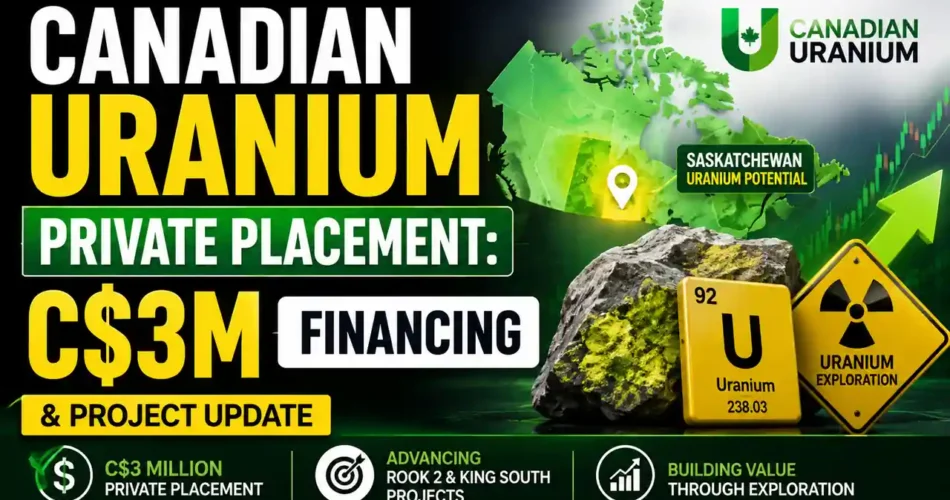
Canadian Uranium Announces Closing of Non-Brokered Private Placement and Provides Corporate Updates
Canadian Uranium Corp. (CSE: CANU) is strengthening its financial position and exploration strategy as it advances a growing portfolio of uranium assets in Saskatchewan. The company recently announced an expansion of its previously proposed non-brokered private placement, increasing the potential financing from C$2 million to as much as C$3 million. The financing is designed to support exploration at the company’s Rook 2 and King South projects while also providing working capital.
The financing update comes at an important stage for Canadian Uranium. The company has expanded its uranium portfolio through acquisitions and property agreements during 2026, including the completed acquisition of Rook 2 Uranium Corp. That transaction added exposure to a sizeable Saskatchewan exploration property and helped establish the company’s current exploration platform.
For investors, the latest financing developments are significant because junior uranium companies typically require substantial capital to fund geophysical surveys, drilling, field programs and property commitments before exploration assets can potentially advance toward development.
Canadian Uranium Expands Its Private Placement
Canadian Uranium originally announced a non-brokered private placement on June 23, 2026, targeting gross proceeds of up to C$2 million. The original structure contemplated as many as 2 million units priced at C$1.00 per unit. Each unit consisted of one common share and one-half of one common share purchase warrant.
On August 4, the company announced that the financing had been increased to as much as C$3 million. The expanded offering consists of two components: a non-flow-through portion of up to C$2 million and a flow-through portion of up to C$1 million.
How the Expanded Financing Is Structured
The non-flow-through portion may include up to 2 million units at C$1.00 each. Each unit includes one common share and one-half of a warrant. The warrants are exercisable at C$1.50 for 24 months following the closing of the offering.
The flow-through portion may include up to 833,334 units priced at C$1.20 per unit. Each flow-through unit contains one common share issued on a flow-through basis and one-half of one warrant. The warrants attached to the financing are exercisable at C$1.50 for 24 months after closing.
Canadian Uranium also stated that the offering may be increased by up to 15% for over-allotments, subject to the applicable requirements and approvals.
What the Financing Means for Canadian Uranium
The most important feature of the financing is its intended use. Canadian Uranium plans to direct proceeds toward exploration of its Rook 2 and King South projects, while also allocating part of the funds to general working capital. The flow-through proceeds are specifically intended for eligible Canadian exploration expenses that qualify under Canada’s tax rules for flow-through critical mineral mining expenditures.
This structure can be particularly useful for mineral exploration companies because flow-through financing is designed to help fund qualifying exploration expenditures. For Canadian Uranium, the arrangement provides an opportunity to direct fresh capital toward field activities while maintaining funding for broader corporate requirements.
Potential Shareholder Dilution
As with most equity financings, investors should consider dilution. The issuance of additional common shares increases the number of shares outstanding, meaning existing shareholders will own a smaller percentage of the company following the financing unless they participate proportionally.
The attached warrants introduce another potential source of future dilution. However, if the warrants are exercised, Canadian Uranium would receive additional capital. That could provide another source of funding for exploration and corporate activities if the company’s share price performs strongly enough to make the warrants attractive to holders.
Rook 2 Adds a Major Saskatchewan Exploration Opportunity
One of Canadian Uranium’s most important recent developments has been its acquisition of Rook 2 Uranium Corp. The transaction was completed in June 2026 and brought an exploration property in Saskatchewan comprising 21 mineral claims covering approximately 18,941 hectares.
The Rook 2 project is positioned outside the Athabasca Basin and includes historical uranium occurrences. Canadian Uranium has described exploration plans involving prospecting, ground geophysics and subsequent diamond drilling.
The company has indicated that an initial drilling campaign is expected to target historical mineralized areas, including the Fisher Hayes and Higginson Lake deposits. A planned program is intended to improve the understanding of these historical targets and identify opportunities for additional mineralization.
King South Provides Athabasca Basin Exposure
King South represents another important component of Canadian Uranium’s exploration strategy. The project is located within the Wollaston-Mudjatik Transition Zone, an area associated with major uranium deposits and mines in Saskatchewan.
According to the company’s August corporate update, King South is located approximately 67 kilometres southwest of the Key Lake Mine. The project’s exploration targets include multiple northeast-trending conductive anomalies that could warrant further investigation.
The combination of Rook 2 and King South gives Canadian Uranium exposure to different geological exploration opportunities within Saskatchewan’s uranium sector.
Canadian Uranium’s Broader Corporate Strategy
The financing should be viewed in the context of Canadian Uranium’s broader transformation during 2026. The company has completed several transactions and expanded its exploration footprint while working to establish itself as a uranium-focused exploration company.
The Canadian Securities Exchange identifies Canadian Uranium Corp. as an active mining issuer under the symbol CANU. The company is headquartered in Vancouver, British Columbia.
The company’s strategy is centered on building a portfolio of prospective uranium assets and advancing exploration through systematic technical programs. This approach is common among junior exploration companies, where success depends heavily on identifying mineralization that can eventually support a larger-scale resource-development strategy.
More Than 40,000 Hectares of Prospective Land
Canadian Uranium has stated that its combination of the King South and Rook 2 assets, together with its Castle South option agreement, gives the company more than 40,000 hectares of prospective landholdings in the Athabasca region and surrounding Saskatchewan exploration areas.
Large land packages can provide exploration companies with multiple targets and flexibility when allocating capital. However, land size alone does not establish an economic uranium resource. Exploration success will ultimately depend on geological results, drilling, assays, permitting, infrastructure and the company’s ability to fund future programs.
Why the Private Placement Matters for Investors
The financing gives Canadian Uranium additional financial resources at a time when the company is moving from portfolio building toward exploration execution. Capital availability is particularly important for uranium explorers because drilling and geophysical programs can require significant amounts of funding.
If exploration results identify encouraging mineralization, the company could potentially use those results to justify larger exploration programs and pursue additional financing. Conversely, unsuccessful exploration could limit the value of the assets and require the company to reassess its capital allocation.
Investors should therefore view the financing as an enabler of exploration rather than evidence of a successful uranium discovery. The key future catalysts are likely to come from field work, drilling, assays, technical interpretations and potential resource-development milestones.
Key Risks to Consider
Canadian Uranium remains an exploration-stage company, which means investment risk is substantial. Exploration programs may fail to identify economically significant mineralization, while commodity prices, financing conditions, regulatory requirements and market sentiment can affect the company’s ability to advance its projects.
Equity financing also creates dilution, while warrants can increase the number of shares outstanding if exercised. Investors should carefully review the company’s regulatory filings and technical disclosures before making investment decisions.
There is also no guarantee that the company’s exploration targets will result in a mineral resource or commercially viable uranium project. Historical occurrences and geological anomalies can be useful exploration indicators, but they do not necessarily demonstrate economic viability.
What Comes Next for Canadian Uranium?
The next stage for Canadian Uranium is likely to focus increasingly on exploration execution. With financing directed toward Rook 2 and King South, investors will be watching for updates on field programs, geophysical work, target generation and drilling.
The company has outlined an ambitious exploration approach for Rook 2, including an initial program designed to evaluate historical uranium occurrences before moving toward diamond drilling. King South could also receive exploration attention as the company investigates conductive anomalies within a highly prospective uranium region.
At the corporate level, management must balance exploration spending with working-capital requirements and future financing needs. The ability to deploy capital efficiently while generating meaningful technical results will be an important factor in determining the company’s progress.
Conclusion
Canadian Uranium’s private placement and corporate updates mark another step in the company’s effort to build a significant uranium exploration platform in Saskatchewan. The financing has been expanded to as much as C$3 million, with separate non-flow-through and flow-through components designed to support exploration and qualifying Canadian exploration expenditures.
With Rook 2, King South and other exploration interests, Canadian Uranium has assembled a broader portfolio than it had at the beginning of 2026. The company’s immediate challenge is now to convert that land position and newly available capital into meaningful exploration results.
For investors, the story remains highly speculative. The financing provides additional resources, but the ultimate value of Canadian Uranium will depend on what its exploration programs discover and whether those discoveries can eventually support economically viable uranium projects.
FAQ
What is Canadian Uranium Corp.?
Canadian Uranium Corp. is a Canadian mineral exploration company focused on uranium and energy-metal opportunities, with a growing portfolio of exploration assets in Saskatchewan and elsewhere in Canada.
How much is Canadian Uranium seeking to raise?
The company’s expanded private placement is for up to C$3 million, consisting of up to C$2 million in non-flow-through units and up to C$1 million in flow-through units.
What will Canadian Uranium use the financing for?
The company expects to use proceeds for exploration of its Rook 2 and King South projects and for working capital. Flow-through proceeds are intended for eligible Canadian exploration expenditures.
What is the Rook 2 project?
Rook 2 is a Saskatchewan uranium exploration opportunity consisting of 21 mineral claims covering approximately 18,941 hectares. Canadian Uranium completed its acquisition of Rook 2 in June 2026.
What is King South?
King South is a uranium exploration project in Saskatchewan’s Wollaston-Mudjatik Transition Zone. Canadian Uranium is investigating multiple conductive anomalies as potential exploration targets.
Does the private placement dilute existing shareholders?
Yes. The issuance of additional common shares can increase the total shares outstanding and therefore reduce existing shareholders’ proportional ownership. Warrants attached to the units could create additional dilution if exercised.
Is Canadian Uranium a high-risk investment?
As an exploration-stage mining company, Canadian Uranium carries significant risks. Exploration results are uncertain, projects require additional capital, and there is no guarantee that exploration targets will become economically viable uranium deposits.
What should investors watch next?
Investors should monitor financing completion, exploration results, geophysical surveys, drilling activity, assay results, technical reports, regulatory filings and future financing requirements.
External References
- Natural Resources Canada – Uranium in Canada
- Government of Canada – Nuclear, Oil and Gas, and Mining Regulations
- Government of Saskatchewan – Critical Minerals
- Government of Saskatchewan – New Uranium Mines Will Power Economic Growth
- Government of Saskatchewan – Uranium Mining and the Northern Saskatchewan Environmental Quality Committee

