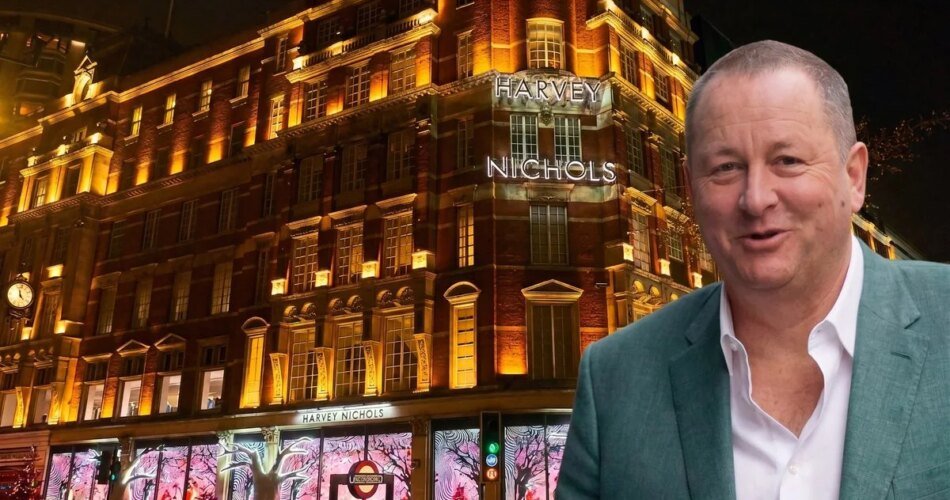
Can Mike Ashley make Harvey Nichols absolutely fabulous again?
(LS)
In the same week Andy Burnham announced a drive to revive the British high street and John Lewis warned of “really tough” trading in its department stores, Mike Ashley swooped in and bought Harvey Nichols. He likes being contrary, does Ashley. It’s how he has amassed a fortune worth £3.44 billion at the most recent estimate, making him comfortably one of the richest people in Britain.
The 61-year-old was a county squash player in his youth and planned to turn professional, until an injury ended his playing career. He became a coach before moving into selling sports gear. At 18, he opened his first shop in Maidenhead, armed with a £10,000 family loan.
From then and into the 1990s, he was building a sports retail empire, snapping up mostly tired mid-tier brands — among them Slazenger, Dunlop, Donnay and Lonsdale — and swamping his Sports Direct chain with cut-price deals of their products. He breathed life into them when others couldn’t.
He also chose to ignore the old quip about the fastest way to become a millionaire — start as a billionaire and buy a football club. He bought Newcastle United in 2007 and sold it in 2021, netting a near £200 million profit.
Throughout, he gained a reputation for speaking his mind, forcing a hard bargain, exhibiting commercial ruthlessness and not behaving like a staid corporate boss — he once hosted a business meeting in a pub, drank 12 pints and vomited into a fireplace.
The idea he would end up owning Harvey Nichols would have been anathema to its customers at the height of its success. This, don’t forget, was “Harvey Nicks”, the iconic shopping magnet for London and the world’s best-dressed women, including Princess Diana, and enshrined forever by Patsy and Edina in Absolutely Fabulous.
The Sports Direct, pile it high, sell it cheap king, calling the shots at the famous Knightsbridge shrine
Now it has fallen to this most rumbustious of characters — at least, that is Ashley’s public image. In private he tends to be reserved and low key. Nevertheless, the shock is palpable. The Sports Direct, pile it high, sell it cheap king, calling the shots at the famous Knightsbridge shrine. Just thinking of what he might do with Harvey Nichols’s shop windows must be provoking a collective shudder in the smartest salons.
Except that as many grand buildings, churches and temples evoke only former glories, so it is with Harvey Nichols. For years, it has been trading on its past.
There has been no sign of a profit since 2019. Ashley is thought to have paid £40 million to take it and its six satellites off the hands of the administrator in a “pre-pack” arrangement, whereby the debts are scrubbed and he can take charge afresh.
Such a lowly sum would previously have been unthinkable. But needs must. This is desperate, backs-to-the wall stuff, or as he told the Financial Times from his villa in Mallorca, the moment “to show a bit of Dunkirk spirit — quote me, I don’t care”.
Dunkirk is not a word you would ever associate with ultra-glamorous, haute couture. A collection inspired by terrified men dressed in drab khaki waiting on the beach to be rescued will not be making a catwalk appearance anytime soon.
But that’s Mike Ashley. He tells it how it is, and that’s what his new, highfalutin employees had better get used to. Or else.
Even then, it might not be enough. In 2023, Ashley bought online retailer Matches Fashion and barely three months later called in the administrators, leaving hundreds of suppliers, among them Gucci and Prada, facing the prospect of receiving only a penny for every pound they were owed.
(Lucy North/PA Wire)
Ashley’s company, Frasers — itself born out of another foray into department stores, with the acquisition of the House of Fraser group — recouped its investment, unlike the trade creditors.
His defence was that Matches was in a worse financial position than he realised. “It should have been shut down years ago — it was trading insolvent,” he said. “Sometimes the hole is too big.”
Matches came and went; other Ashley luxury purchases remain. In the Frasers “premium” collection are Savile Row tailor Gieves & Hawkes, Agent Provocateur lingerie, preppy Jack Wills, the 50-strong Flannels store chain and what is left of the House of Fraser shops. He has stakes in Burberry and Mulberry and is currently trying to wrest control of Hugo Boss, where he holds 48 per cent of the shares. Last year, he picked up multi-brand US fashion retailer The Webster.
He has had his sights set on Harvey Nichols for a long time, watching as the company drifted further into seemingly inexorable decline. Last year its losses increased, from £34 million to £49 million. It was, said Ashley, in “a death spiral”. So, he has made his move. This, you feel, is a final throw of the dice where Harvey Nichols is concerned. What does Ashley see that others don’t? What will he do that its last owner — Hong Kong magnate Sir Dickson Poon — failed to do?
For a start, it will not be Ashley doing it. Admitting “I’m Marmite, I’m not everyone’s cup of tea,” he has handed over the day-to-day reins of Frasers to his 36-year-old son-in-law, Michael Murray.
The fashionistas should find Murray more relatable. Keen on fitness and wellbeing, he is most definitely not a “power drinker”, as Ashley once labelled himself.
They know that customers who choose to shop at Harvey Nichols want and demand a smarter level of personal service
Ashley and Murray are big on staff incentivisation, encouraging their managers to go the extra mile. They’re not stupid — they know that customers who choose to shop at Harvey Nichols want and demand a smarter level of personal service. That means investing in training.
They’ve got form, too, for trusting those who know the business better than them. Ashley went into Burberry because he was impressed with its chief executive, Joshua Schulman.
Julia Goddard, the highly rated new chief executive of Harvey Nichols — she was appointed from Alexander McQueen 12 months ago — might be given every chance to prove herself.
Her initial, public reaction has been positive. Goddard said Ashley’s arrival marked “an important milestone” for the company and “provides a strong platform for the next phase of the business’s evolution”.
Goddard is likely to be told to watch costs — Harvey Nichols’s expenditure rose by 10 per cent as sales fell by 20 per cent between 2019 and 2025.
(PA)
Ashley and his son-in-law are clever at positioning the clothing labels they own or have stakes in alongside their retail outlets. The two fit together: Flannels sells a lot of Burberry; the pair have substantial shares in Burberry. So, expect to see Burberry, Mulberry and Hugo Boss promoted in Harvey Nichols.
Their declared philosophy is that of collaboration, not confrontation, with the top marques. Working with them, not rowing and chipping away. The ambition, Murray says, is “to create a scaled luxury ecosystem where brands can grow with us”. They want the design houses to view Frasers as “a strategic partner”.
But there is no getting away from the reality that Harvey Nichols is not the only department store group to be suffering. John Lewis is in difficulty, Fenwick has vanished from New Bond Street and other once premium stores, including dozens of Ashley’s House of Fraser branches, have gone. Nor is this a UK-only problem — in the US alone, Sears, JCPenney, Barneys and Saks have all paid the ultimate price in recent years.
Somehow, Ashley and Murray need to make Harvey Nichols the go-to destination again, for those who once went and shopped there as well as for newer, younger generations. They must restore the pizzazz that has been so lost. It’s a name that once stood for class but also excitement. They have to make it so again.
Ashley has paid £40 million for a fading star which yes, appears crazily ill-timed. But he has also bought Harvey Nichols — Harvey Nichols! — for £40 million. Is he mad or has he grabbed a bargain? Time will tell.