

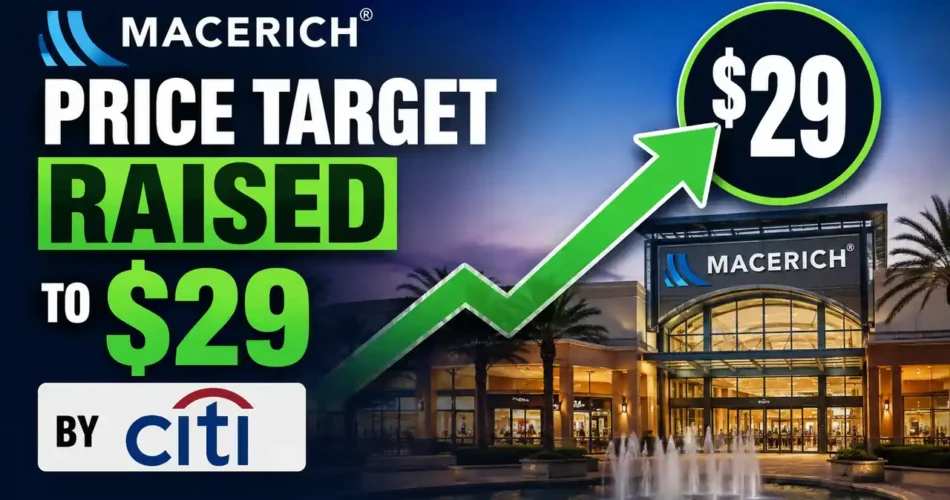
Macerich Price Target Raised to $29 per Share From $28 by Citigroup
Citigroup has reportedly raised its price target for The Macerich Company (NYSE: MAC) to $29 per share from $28. The adjustment reflects a modestly more optimistic view of the mall-focused real estate investment trust and its efforts to improve operations, strengthen its financial position, and unlock value from its property portfolio.
Although the increase is only $1 per share, analyst price-target changes can attract attention because they offer insight into how financial institutions are evaluating a company’s future prospects. Investors should still treat the updated target as an estimate rather than a guarantee of future performance.
Citigroup Raises Macerich Price Target
The revised target indicates that Citigroup has made a small upward adjustment to its valuation assumptions for Macerich. The bank’s latest view suggests that the company may have additional upside if its turnaround strategy continues to deliver results.
Citigroup previously assigned Macerich a price target of $28 per share. The new $29 target represents an increase of approximately 3.6% from the earlier estimate. While this is not a major revision, it may indicate improving confidence in Macerich’s business outlook.
Earlier reports also indicated that Citigroup upgraded Macerich from Neutral to Buy and raised its target from $24 to $28, citing the company’s turnaround efforts, balance-sheet improvements, and potential acquisition opportunities. [web:1]
Why Macerich Is Receiving Attention
Macerich owns, operates, and manages a portfolio of shopping centers in major markets across the United States. Its properties include large regional malls and retail destinations that serve both local communities and affluent metropolitan areas.
The company has faced many of the challenges affecting the traditional shopping-center industry, including changes in consumer behavior, competition from e-commerce, tenant bankruptcies, and elevated borrowing costs. At the same time, well-located malls have continued to attract shoppers, restaurants, entertainment businesses, and service providers.
Focus on High-Quality Properties
One factor supporting Macerich’s investment case is its exposure to strategically located retail properties. High-quality malls in densely populated markets can be more resilient than weaker properties because they benefit from stronger consumer demand, limited nearby competition, and better access to transportation.
These locations may also offer opportunities for redevelopment. Underused retail space can potentially be converted into restaurants, entertainment venues, medical facilities, offices, residences, or other mixed-use developments.
Portfolio Improvement Efforts
Macerich has been working to improve the performance of its portfolio through leasing initiatives, redevelopment projects, asset management, and efforts to enhance tenant quality. A stronger tenant mix can increase customer visits and improve the long-term attractiveness of a shopping center.
Experiential businesses are especially important in the modern retail environment. Fitness centers, cinemas, food halls, specialty entertainment, and other service-oriented tenants can encourage customers to visit physical locations rather than shop exclusively online.
What the $29 Target Means
A price target is an analyst’s estimate of where a stock could trade over a specific period, often approximately 12 months. Citigroup’s $29 target suggests that the firm believes Macerich shares could move higher if the company performs in line with the assumptions used in its valuation model.
However, price targets are not promises. Analysts build their estimates using expectations for revenue, occupancy, rental income, funds from operations, interest rates, asset values, and other financial factors. If those assumptions change, the target can be revised again.
Investors should also compare Citigroup’s target with estimates from other research firms. A single analyst update can influence sentiment, but a broader pattern of improving ratings and rising targets may provide a stronger indication of changing market expectations.
Important Macerich Metrics to Monitor
Occupancy and Leasing Activity
Occupancy is one of the most important indicators for a mall REIT. Higher occupancy generally means more rental income and a stronger shopping environment. Investors should monitor new leases, lease renewals, tenant demand, and the company’s ability to replace departing retailers.
Leasing spreads are also important. When newly signed or renewed leases generate higher rents than previous agreements, the trend can support future revenue growth.
Same-Property Net Operating Income
Same-property net operating income, commonly called same-property NOI, measures the performance of properties owned during comparable periods. Growth in same-property NOI may indicate that the existing portfolio is becoming more productive.
Investors should review whether NOI growth is coming from sustainable rent increases, better occupancy, stronger tenant sales, lower expenses, or one-time factors.
Funds From Operations
Funds from operations, or FFO, is a widely followed performance measure for real estate investment trusts. It adjusts traditional earnings to better reflect the recurring performance of real estate assets.
FFO per share can help investors assess whether a REIT is generating enough recurring cash flow to support dividends, reduce debt, and fund redevelopment projects.
Debt and Interest Costs
Interest rates have a significant effect on REITs because these companies commonly use debt to acquire, maintain, and redevelop properties. Higher rates can increase borrowing costs and reduce the value investors assign to income-producing real estate.
Macerich’s ability to refinance debt, extend maturities, maintain liquidity, and manage interest expenses will remain important to its investment outlook.
Risks Investors Should Consider
Despite Citigroup’s more positive view, Macerich remains exposed to several risks. A slowdown in consumer spending could reduce tenant sales and make retailers less willing to expand. Weak tenant performance may eventually affect occupancy, rental growth, and property-level income.
Interest-rate movements are another major risk. If financing costs remain elevated, redevelopment plans could become more expensive and the company may face greater pressure when refinancing existing obligations.
Retail industry changes also require close monitoring. E-commerce has permanently altered shopping habits, even though many consumers continue to value physical stores and entertainment-focused destinations. Macerich must continue adapting its properties to remain relevant.
Investors should also consider the risks associated with individual tenants, asset sales, redevelopment delays, economic weakness, and changes in commercial real estate valuations.
How Investors May Interpret the Update
Long-term investors may view the higher target as a sign that Citigroup sees potential in Macerich’s turnaround strategy. However, they should evaluate the company’s balance sheet, property quality, dividend policy, and operating performance before making an investment decision.
Income-oriented investors may pay particular attention to dividend coverage and recurring cash flow. A higher share-price target does not automatically mean that the dividend is safe or that future distributions will increase.
Short-term traders may react to the headline, but analyst revisions can produce only temporary price movements. Broader market conditions, interest-rate expectations, trading volume, and the company’s next earnings report may have a greater effect on the stock.
Frequently Asked Questions
What is Macerich’s new Citigroup price target?
According to the update provided, Citigroup raised its price target for Macerich to $29 per share from $28.
Does the higher target mean Macerich stock is guaranteed to rise?
No. A price target is an analyst estimate based on financial assumptions. The stock can move above or below the target depending on company results, interest rates, investor sentiment, and market conditions.
Did Citigroup also change its rating on Macerich?
Earlier reports stated that Citigroup upgraded Macerich from Neutral to Buy while raising its price target from $24 to $28. [web:1] Investors should check the latest research note to confirm whether the rating remains unchanged alongside the $29 target.
Why are interest rates important for Macerich?
Interest rates affect the cost of borrowing and the valuation of commercial real estate. Higher rates can increase financing expenses and put pressure on REIT share prices.
What should investors watch after the price-target revision?
Key items include occupancy, leasing spreads, same-property NOI, FFO per share, debt maturities, interest expense, redevelopment progress, tenant sales, and management guidance.
Is Macerich suitable for every investor?
No. Macerich is exposed to retail, commercial real estate, interest-rate, tenant, and financing risks. Investors should consider their objectives, time horizon, and risk tolerance and conduct independent research before investing.
Final Perspective
Citigroup’s reported increase in Macerich’s price target from $28 to $29 reflects a cautiously improved outlook for the mall REIT. The adjustment may signal greater confidence in the company’s portfolio strategy, financial management, and potential for operational improvement.
Still, the revised target should be viewed as one research opinion rather than a standalone investment signal. Macerich’s future performance will depend on leasing demand, tenant health, consumer spending, interest rates, balance-sheet execution, and the company’s ability to make its properties more productive.
This article is for informational purposes only and does not constitute investment advice. Always verify financial information and consult a qualified professional before making investment decisions.

