

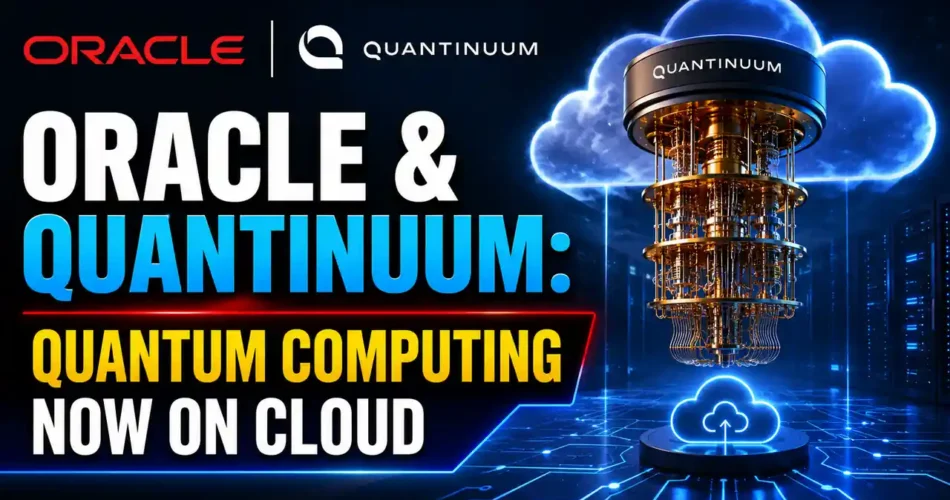
Oracle and Quantinuum Partner to Bring Quantum Computing to the Cloud
Oracle and Quantinuum have announced a strategic collaboration to make quantum computing more accessible through cloud services. The alliance aims to combine Oracle’s cloud infrastructure and enterprise software expertise with Quantinuum’s advanced quantum hardware and software tools. Together, the companies plan to offer developers, researchers, and enterprise customers on-demand access to quantum processors, integrated development environments, and hybrid workflows that connect classical and quantum resources.
Why the partnership matters
Quantum computing promises to solve certain classes of problems faster than traditional computers, with potential advantages in optimization, materials science, cryptography, and machine learning. However, barriers such as specialized hardware, complex software stacks, and limited interoperability have slowed wide adoption. By integrating Quantinuum’s quantum systems into Oracle Cloud, the partnership reduces friction in three important ways:
- Infrastructure scale: Oracle’s global cloud footprint provides the network, storage, and compute integration needed to serve enterprise workloads at scale.
- Accessibility: Cloud-based access removes the need for customers to maintain their own quantum hardware, enabling pay-as-you-go experimentation and development.
- Hybrid workflows: Enterprises can more easily connect classical cloud services—databases, analytics, and AI tools—with quantum processors to build end-to-end solutions.
For businesses already invested in Oracle infrastructure, this means a lower barrier to trialing quantum-enhanced applications without deep investment in specialized equipment or in-house quantum staff.
What each partner brings
- Quantinuum: Known for its trapped-ion quantum processors and evolving software stack, Quantinuum specializes in high-fidelity qubits and error-mitigation techniques. It supplies the quantum hardware and tools that make reliable quantum experiments possible today.
- Oracle: Offers the cloud platform, identity and access management, large-scale networking, and enterprise-grade security. Oracle will integrate quantum services into its cloud marketplace and developer tooling so customers can discover and launch quantum resources alongside existing cloud services.
This combination is intended to deliver a seamless developer experience: users can provision quantum compute instances through Oracle’s console, run hybrid jobs that use both classical and quantum resources, and manage workloads with familiar cloud governance and security controls.
Use cases and early applications
The initial focus is likely to be on early-adopter use cases where quantum advantage—or at least a demonstrable benefit—can surface sooner:
- Optimization: Quantum algorithms can accelerate solutions for complex optimization problems in logistics, portfolio optimization, and supply chain design.
- Chemistry and materials: Quantum simulations may better model molecular interactions, speeding R&D for new materials, catalysts, and pharmaceuticals.
- Machine learning: Hybrid quantum-classical models can augment certain parts of machine learning pipelines, such as feature preparation or optimization of model parameters.
- Finance: Portfolio risk modeling, option pricing, and scenario analysis could benefit from quantum-enhanced sampling and optimization techniques.
Because practical, universal quantum advantage is still emerging, expect most early workloads to involve tightly scoped problems, benchmarking, and hybrid approaches that rely heavily on classical pre- and post-processing.
Developer experience and tooling
To attract a broader developer base, the partnership will emphasize developer-friendly tooling and integration:
- SDKs and APIs: Language bindings and software development kits to submit quantum jobs, manage resources, and retrieve results programmatically.
- Notebooks and workflows: Integrated notebook environments that let researchers experiment with quantum circuits and hybrid pipelines alongside classical data analysis.
- Simulation and testing: High-performance quantum simulators for debugging and validating algorithms before committing scarce quantum runtime.
- Training and templates: Example workloads, templates, and documentation to shorten the learning curve for cloud-native and enterprise developers.
Oracle’s enterprise customers should benefit from the same governance, identity controls, and cost-management tools they use for other cloud services, making it simpler to run quantum experiments within enterprise compliance frameworks.
Security and compliance
Quantum technologies intersect with security in two ways: the potential to break certain cryptographic algorithms in the long term, and the need to secure today’s quantum workloads. The partnership highlights:
- Access control: Integration with cloud identity and access management so organizations can govern who can run quantum jobs and access results.
- Data governance: Tools to ensure sensitive data used in quantum experiments follows compliance requirements and retention policies.
- Post-quantum readiness: While universal quantum computers able to break widely used public-key cryptography are not yet available, Oracle and Quantinuum can help organizations assess risk and plan migration to post-quantum cryptographic schemes on a controlled timetable.
These aspects are crucial for regulated industries—finance, healthcare, and government—that require audited, compliant environments for experimentation.
Business and market implications
Bringing quantum computing into a mainstream cloud environment accelerates enterprise experimentation and could spur broader commercial interest. Key implications include:
- Market adoption: Lower friction means more organizations can pilot quantum approaches, generating case studies and accelerating real-world applications.
- Competitive dynamics: Public cloud providers that offer robust quantum services may gain an advantage for customers seeking an integrated path to quantum innovation.
- Talent and skills: As cloud-based quantum services spread, demand for quantum-literate engineers, hybrid algorithm designers, and domain experts will grow.
- Ecosystem growth: Independent software vendors, startups, and research groups may build quantum-native or quantum-enhanced solutions that plug into Oracle Cloud’s ecosystem.
For regional markets like India, easier cloud access enables startups and academic groups to experiment without procuring expensive dedicated hardware, potentially broadening the quantum talent pool.
Limitations and realistic expectations
It’s important to keep expectations anchored. Quantum computing is advancing quickly but remains nascent for many enterprise applications. Practical limitations include:
- Noise and scale: Current quantum processors are error-prone and limited in qubit count; many algorithms still require error correction that isn’t yet practical at scale.
- Algorithm maturity: Not all problems will see speedups from quantum approaches; algorithm design and problem mapping remain active research areas.
- Cost and availability: Quantum runtime will be a premium resource initially, so hybrid strategies and careful benchmarking are necessary to justify costs.
The collaboration is best viewed as infrastructure enabling experimentation and incremental progress, not an immediate replacement for classical systems.
How enterprises should prepare
Organizations looking to explore quantum via Oracle–Quantinuum should consider:
- Identifying candidate problems: Start with narrowly defined optimization, sampling, or simulation problems that map well to current quantum approaches.
- Building hybrid workflows: Design pipelines that combine classical preprocessing, quantum compute, and classical post-processing to maximize value.
- Training teams: Upskill data scientists and engineers with quantum fundamentals, tooling, and hybrid architecture patterns.
- Establishing governance: Set access controls, budgeting, and compliance checks to manage quantum projects within enterprise policies.
A staged approach—proof of concept, benchmarking, pilot, then scale—reduces risk while providing measurable learning outcomes.
Frequently asked questions
What does this partnership actually provide?
It integrates Quantinuum’s quantum hardware and software stack into Oracle Cloud, enabling on-demand access to quantum processors, SDKs, simulators, and hybrid workflow tools under Oracle’s cloud governance and billing framework.
Who should use these services first?
Early adopters such as research teams, universities, large enterprises in finance, pharma, logistics, and startups focused on quantum applications are likely first users. Organizations with well-defined optimization or simulation problems will find the offering most applicable.
Is this ready to replace classical computing?
No. Current quantum systems complement classical computers for specific tasks. Most real-world solutions will be hybrid, relying primarily on classical compute with targeted quantum acceleration where beneficial.
How is security handled?
Quantum services will be managed through Oracle’s cloud identity and access controls, data governance policies, and compliance tooling. The partnership also supports planning for long-term cryptographic risks and post-quantum transitions.
What does this mean for developers?
Developers get SDKs, APIs, notebook integration, and simulators to prototype quantum circuits and hybrid jobs. Familiar cloud tools and templates aim to shorten the learning curve.
When will this be available?
Exact rollout schedules depend on both companies’ deployment plans and regional availability. Expect staged availability—initial regions and partners first, followed by broader rollout.
Here are three authoritative U.S. government reference links:
National Quantum Initiative (official site)
https://www.quantum.gov/
Home of the U.S. National Quantum Initiative, with updates on federal programs, agencies, and quantum research efforts.
National Quantum Initiative Act (Congress.gov – full text PDF)
https://www.congress.gov/115/plaws/publ368/PLAW-115publ368.pdf
Official text of the National Quantum Initiative Act (Public Law 115-368), which established the coordinated federal program for quantum R&D.
Department of Energy – Quantum Computing Research Funding Announcement
https://www.energy.gov/science/articles/department-energy-announces-65-million-quantum-computing-research
DOE press release detailing $65 million in funding for quantum computing research projects under the National Quantum Initiativ

