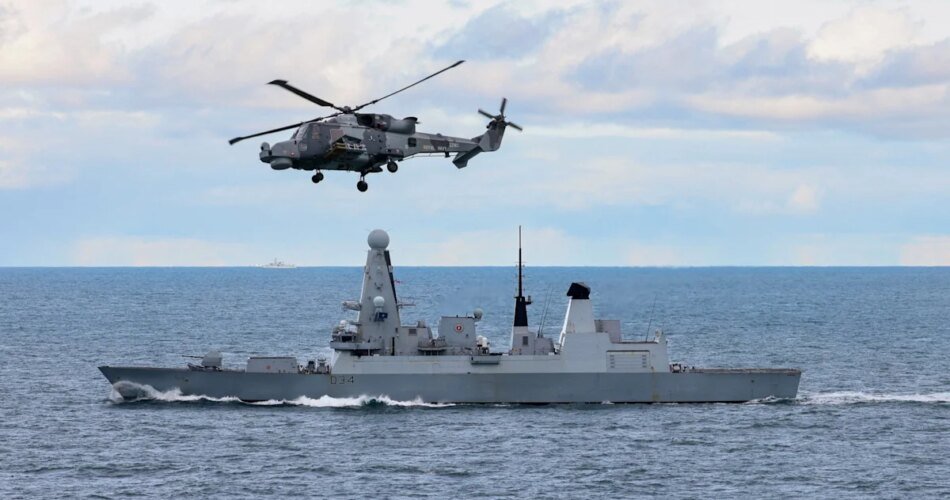

Britain is exploring whether to deploy Australian-made radars on Royal Navy warships under a new agreement struck with Canberra.
Luke Pollard, a defence minister, said the “world-leading” systems had the potential to improve air defences and the Ministry of Defence was deliberately taking a “broad” view of their potential.
It is understood that the Government currently views the radar, developed by CEA Technologies, as a particularly promising candidate for naval and land platforms.
Currently, the Navy’s aircraft carriers, Type 45 destroyers and the under-construction Type 26 submarine-hunting frigates all use British radars made by BAE Systems.
But Mr Pollard said the radars developed by CEA would be considered in future as well, as the Navy prepares to order a plethora of drones and six manned common combat vessels to act as motherships.
Speaking to The Telegraph, Mr Pollard said: “The threats we’re facing as a nation mean that having a more detailed air picture is getting more vital every day and the CEA radar can see smaller objects, and more of them, further away than established radar technology.
“That, for me, is the military opportunity that this could present [an] offer to the UK Armed Forces. And at the moment, we’re open to what platforms and what domains it could be used in – the statement of intent is deliberately broad.”
Mr Pollard signed a statement of intent to explore opportunities with the Australian government, CEA and British defence contractor QinetiQ last week during a trip to Australia and New Zealand. QinetiQ will evaluate the technology’s potential.

The cutting-edge radars developed by CEA are seen as impressive because of their capabilities and unconventional design.
Unlike most radars, which spin their antennas to achieve 360-degree coverage, CEA’s scanned array systems are made up of multiple square “tiles” that can electronically direct their beams.
To achieve 360-degree coverage, the tiles are placed on all sides of a warship’s mast. Meanwhile, they are better at tracking multiple targets, are more resistant to failure when individual tiles are damaged and can be easily scaled up or down in size.
At the moment, Britain’s Type 45s use highly advanced Sampson radars made by BAE Systems. These have a range of about 250 miles and can track hundreds of targets simultaneously.
The Queen Elizabeth-class aircraft carriers and the Type 26 submarine-hunting frigates, meanwhile, use lighter Artisan radars also made by BAE. Both systems use rotating antennas.
Source link