

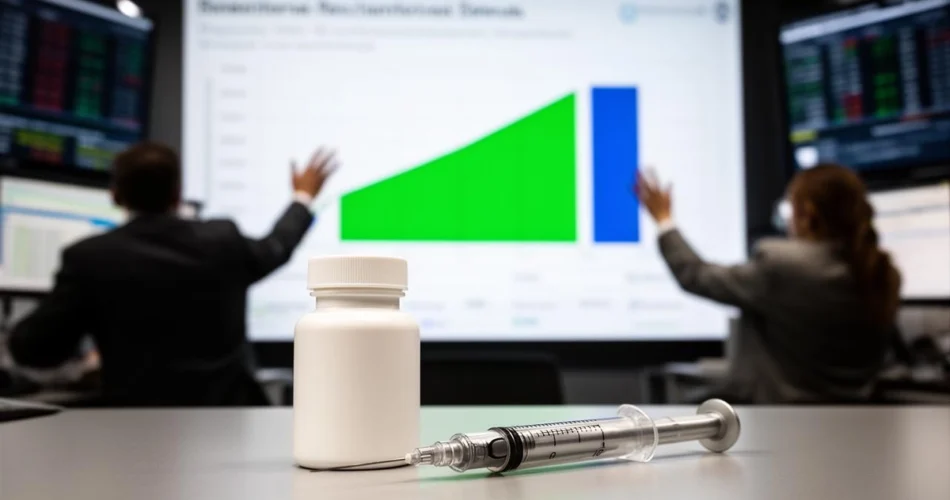
In the first half of this year, the world’s best-selling medicine was no longer a cancer drug but an obesity treatment. Obesity drugs have displaced cancer therapies, which had held the top spot for three years following the COVID-19 vaccines, to claim the title of “world’s highest-revenue medicine.” The growth potential is considered even greater given that obesity drugs’ therapeutic mechanism spans the broader spectrum of metabolic diseases, including diabetes.
According to industry sources on the 24th, Eli Lilly’s (LLY) metabolic disease treatment Mounjaro posted second-quarter revenue of approximately $9.9 billion (about 13.67 trillion won), outpacing MSD’s (Merck & Co., MRK) immuno-oncology drug Keytruda family by roughly 19.3% for the quarter. This marks the second consecutive quarter of dominance this year. When including Zepbound, an obesity drug containing the same tirzepatide active ingredient as Mounjaro, the gap widens further.
The global obesity drug market is currently split between Lilly and Novo Nordisk (NVO). Both companies’ obesity drugs utilize glucagon-like peptide-1 (GLP-1) class ingredients. GLP-1 class drugs work like the satiety hormone secreted after meals, suppressing appetite. Additionally, they offer the benefit of improving overall metabolic health, including blood sugar stabilization.
Obesity alone affects one in eight people worldwide, representing enormous potential demand. For pharmaceutical companies, developing a single molecule successfully allows them to expand their product lineup across multiple indications, including diabetes and cardiovascular disease.
Patent Expirations Accelerate Competitive Dynamics
Another variable fueling market expansion is patents. Starting this year, the substance patent for semaglutide, the active ingredient in Novo Nordisk’s obesity drug Wegovy, is expiring sequentially in India, Canada, and other countries. In India, more than 12 semaglutide-based generics have already been launched.
As a result, formulation expansion, including administration routes, is progressing rapidly. The most significant change is the emergence of oral (pill-form) obesity drugs. One of the barriers to entry for obesity drugs has been aversion to injections. A considerable number of patients discontinued treatment due to the need for self-administered abdominal injections.
Novo Nordisk launched oral Wegovy in the U.S. market in January, introducing the world’s first pill for obesity treatment. Lilly followed with its oral obesity drug Foundayo in April. Total revenue for oral obesity drugs in the first half of this year reached approximately $950 million (about 1.31 trillion won). In other words, a trillion-won market was formed within just six months of launch.
Among latecomers, extending dosing intervals is also being considered. Competition is intensifying beyond once-weekly dosing toward once-monthly formulations. In September last year, Pfizer (PFE) acquired Metsera, a biotech venture with long-acting injectable technology, for approximately $10 billion (about 14 trillion won). The decision was aimed at establishing a foothold to enter the obesity drug market as a latecomer.
A representative from the Korea Biotechnology Association’s Bioeconomy Research Center said, “As of October last year, more than 193 obesity treatments were in development,” adding, “Innovation is accelerating through various administration routes such as oral formulations and ultra-long-acting injectables.” The representative added, “If many countries recognize obesity as a chronic disease, policy and reimbursement systems will also undergo changes.”
Kwon Hae-soon, an analyst at Eugene Investment & Securities, said, “The obesity and metabolic disease treatment market is expected to grow by more than 50% over the next four to five years,” explaining that “product differentiation will begin as oral obesity drugs launch beyond injectables and treatments with new mechanisms emerge.” The analyst forecast, “Considering the development stage of latecomers’ obesity drugs, new product launches are expected after 2028.”
‘Diversified Market’ Rather Than ‘Winner-Take-All’
Novo Nordisk CEO Mike Doustdar pointed out in a Reuters interview on the 13th that investors are underestimating the potential for market fragmentation in the obesity drug space. He pushed back against the notion that Novo and Lilly are engaged in a zero-sum competition for the same patient population.
CEO Doustdar argued that the market will diversify like “Coca-Cola, Pepsi, Fanta, Dr Pepper, and Red Bull” rather than “Coca-Cola versus Pepsi.” His explanation is that patients will disperse across various GLP-1 options rather than gravitating toward a single winner. He emphasized that Novo’s oral Wegovy has already secured 90% market share in the oral GLP-1 market.
However, Novo’s next-generation obesity drug CagriSema showed an average weight loss of 23% in clinical trials, trailing Lilly’s Zepbound, which recorded over 25%. CEO Doustdar acknowledged that the drug has been “effectively ignored by investors.”
According to analyst estimates, the obesity drug market where the two companies compete is projected to grow to over $100 billion annually (about 138 trillion won) by 2030. This is why even small market share shifts carry enormous financial implications. Lilly’s market capitalization has surpassed $1 trillion (about 1,380 trillion won), while Novo’s market capitalization has fallen significantly from its 2024 peak.
South Korea’s First Domestically Developed Obesity Drug: Will It Trigger Price Competition?
With Hanmi Pharmaceutical preparing to launch EPPE (active ingredient: efpeglenatide), its independently developed obesity treatment, market attention is focused on the supply price. EPPE has been designated for the Ministry of Food and Drug Safety’s “Global Innovative Product Fast-Track (GIFT)” program and is expected to receive approval as early as October. The company stated, “We plan to launch the product as early as October upon approval, or by year-end at the latest.”
According to data compiled by a South Korean healthcare platform, the average price per pack of Mounjaro at pharmacies in Seoul ranges from 300,500 won (approximately $220) for the 2.5mg dose to 701,780 won for the 15mg dose. Wegovy ranges from the low 200,000 won range (approximately $140) to around 400,000 won (approximately $290) per month depending on the dose. Since obesity drugs are not covered by insurance, patients must bear the full cost of medication.
Some industry observers suggest that EPPE’s price could be set at half the level of Mounjaro’s initial dosing price of around 300,000 won (approximately $220) per month. On the other hand, there are views that a price in the 100,000 won range (approximately $72) would be difficult to achieve considering R&D investment costs, production costs, and profitability.
Hanmi Pharmaceutical’s strategy is to leverage its strengths in pricing and supply stability based on its domestic production base. The calculation is that compared to Wegovy and Mounjaro, which are imported as finished products from overseas, logistics costs and currency exchange impacts can be reduced. However, the company has stated that it has not yet determined a specific supply price.
The South Korean subsidiaries of global pharmaceutical companies with obesity drugs are also closely watching Hanmi Pharmaceutical’s strategy. An industry source said, “Eli Lilly and Novo Nordisk are on high alert because EPPE’s pricing could influence not only the South Korean market but also existing Asian markets and global obesity drug pricing policies.”
Treatment efficacy is just as important as price. According to Hanmi Pharmaceutical, in a Phase 3 clinical trial involving 448 South Korean adult obesity patients, the efpeglenatide treatment group showed an average weight reduction of 9.75% from baseline after 40 weeks. Of the treatment group, 79% lost more than 5% of body weight, and approximately half lost more than 10%. Wegovy showed an average weight loss of 14.9% in a 68-week trial, while Mounjaro showed an average of 16.0–22.5% depending on dose in a 72-week trial. However, direct comparison is limited due to differences in trial duration and patient composition across studies.
Hanmi Pharmaceutical explained that gastrointestinal adverse reactions such as vomiting and nausea were relatively less frequent or milder compared to clinical data from other obesity drugs. EPPE incorporates “LAPSCOVERY” technology, which slowly releases the drug to maintain prolonged efficacy. The company is also pursuing a strategy of combining the drug with digital therapeutic solutions.
An industry source said, “Once EPPE launches, Wegovy and Mounjaro will ultimately have to cut prices as well.” The assessment is that EPPE’s market success depends on how quickly it can win over healthcare providers and patients in a domestic market preempted by global pharmaceutical giants.
Source link
Author

- Ytv Market News
- Share-market news writer and analyst with deep experience covering equities, commodities, forex, and cryptocurrencies for readers in the USA, UK, Canada, and Australia. Ytv Market News delivers timely market updates, practical trading insights, and clear explanations of macro and company-level catalysts that move prices. Combines on-the-ground financial reporting with technical analysis, using concise charts and actionable ideas to help investors and traders make smarter decisions.
Latest entries
 Forex NewsAugust 25, 2026United States Dollar Index holds gains near 99.00 amid escalating geopolitical risks
 IndiaAugust 25, 2026SEBI drops case against Max Financial, Max Life, Axis entities in ₹3,911 crore case
 Company Press ReleasesAugust 25, 2026#26-298 Listing of Derivatives at NGM
 Company NewsAugust 25, 2026Die Almonty-Industries-Aktie legt nach Q2-Zahlen und Buyback zu


