

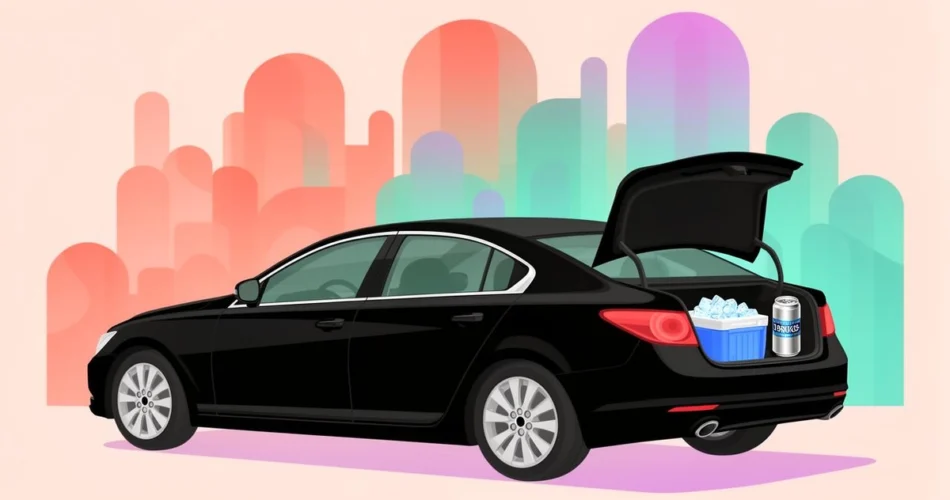
Didi Chuxing (DIDIY.US) has recently begun piloting complimentary Coke Zero in its premium ride-hailing service across 12 Chinese cities including Beijing, Shanghai, Guangzhou, and Shenzhen, aiming to create a differentiated riding experience with a 300-milliliter bottle of carbonated beverage. The summer-limited campaign has sparked widespread discussion on social media, with feedback from riders and drivers showing clear divergence.
According to Didi Premier’s rider-side customer service, participating vehicles in the pilot program offer complimentary Coke Zero to riders in addition to the existing bottled water, with the campaign running through October 15 and no current plans to continue thereafter. Customer service emphasized that the original complimentary water service remains in place—typically one bottle of Ganten mineral water in the front and two small bottles of cola in the back for riders to choose from.
Regarding whether the cola procurement costs are borne by drivers or the platform, rider-side customer service did not provide a direct response. Driver-side customer service stated that specific policies could only be disclosed after providing the driver’s registered phone number.
Riders: Small delight meets indifference
Numerous riders have posted real photos from their trips on social media. Many short-distance summer travelers said that receiving an ice-cold cola upon boarding in sweltering heat delivered an unexpected sense of delight, and also created a more tangible service distinction between Didi Premier and standard ride-hailing. The zero-sugar formula reduces concerns about sugar intake, and such thoughtful details earned praise from some riders.
But complaints are equally common. In the view of some riders, carbonated drinks have far fewer consumption scenarios than bottled water, with virtually no demand during morning rush hours or business trips. A more practical issue is that cola tends to spray or drip when jostled during the ride, potentially soiling clothing or the vehicle interior. Multiple riders also reported that due to the limited cooling capacity of onboard coolers and ice packs, the cola they received was often only slightly chilled—far from the ice-cold expectation—significantly diminishing the experience.
Drivers: Lower paper costs, higher hidden burdens
Driver sentiment is similarly polarized. Some drivers revealed that first-time participants must purchase 96 bottles of cola themselves, with the platform providing an additional 24 bottles free of charge. The per-bottle purchase price is on par with bottled water at 1 yuan each. After completing tiered performance tasks such as zero complaints and order volume targets, the effective per-bottle cost can be 0.4 yuan lower than bottled water. The platform provides coolers and ice packs free of charge, but beverage procurement funds still require upfront payment by drivers, creating cash flow pressure.
Trunk space constraints represent another prominent friction point. With the need to simultaneously store bottled water, cola, coolers, and ice packs, luggage space is noticeably compressed when handling orders with bulky baggage. One six-seat Didi Premier driver described a real experience to media: picking up a family of four with six suitcases, the trunk simply could not accommodate everything. The driver had to temporarily leave the cooler at the passenger’s residential security booth and return to retrieve it after completing the trip.
Unpredictable consumption rates also make it difficult for drivers to plan inventory. A Beijing Didi Premier driver said that after the program launched, she drove for six days and completed 76 orders, but only 20 bottles of cola were consumed—far below expectations—while bottled water consumption dropped to just three bottles. Most passengers were careful when opening the cola, and some simply took the cola with them. The primary consumers were children and young adults. If the cola was not fully consumed that day, she needed to take it home for refrigeration and bring it back to the car the next day.
However, other drivers reported the opposite: 120 bottles of cola were exhausted within two weeks, with many passengers taking bottles with them even if they did not drink in the car. Faster-than-expected consumption actually drove up costs. A Chengdu Didi Premier driver candidly acknowledged understanding the platform’s intent to enhance the experience, but noted that carbonated drinks are prone to spraying when opened during bumpy rides, and expressed hope that the platform would fully communicate with both drivers and riders before planning such campaigns.
A low-cost experiment under the service-tiering strategy
From an execution standpoint, the platform adopted a “self-purchase + subsidy + incentive” hybrid model. The program exhibits clear screening characteristics: in Shanghai, for example, some six-seat Didi Premier drivers were excluded due to insufficient service scores or online hours; those who qualified could also voluntarily opt out. According to Didi’s estimates, overall Didi Premier driver participation stands at approximately 30%, reflecting a “non-mandatory, non-universal” operational logic.
The concept of upgrading select vehicles into “cola surprise cars” aligns with Didi’s strategy of segmenting vehicle categories into multiple tiers such as Qingxiang, Zhenxuan, six-seat, and Premier—pushing service differentiation rather than price wars, with the goal of reinforcing riders’ memory of “booking the right car, riding in a good car.” Previously, Didi’s complimentary colored masks and children’s stickers also garnered positive social media exposure and praise.
The per-bottle net concession of approximately 0.4 yuan in this cola experiment is modest in cost, but against Didi’s current financial backdrop, its significance extends beyond a “summer experience.”
According to Didi’s second-quarter 2026 financial report, core platform order volume reached 5.052 billion orders, up 13.2% year-over-year, while platform gross transaction value (GTV) reached 133.9 billion yuan (approximately $19.9 billion), up 22.2% year-over-year. Revenue for the quarter came in at 62.52 billion yuan (approximately $9.3 billion), up 10.8% year-over-year; China mobility revenue was 54.78 billion yuan (approximately $8.1 billion), up 8.8% year-over-year, with adjusted EBITA of 4.17 billion yuan (approximately $619.8 million), up 15% year-over-year. However, continued losses in the international business dragged the group to a first-half net loss attributable to shareholders of 354 million yuan (approximately $52.7 million), presenting a pattern of “revenue growth without profit growth.”
The following is a summary of Didi’s core financial data:
| Metric | Q2 2026 | YoY Change |
|---|---|---|
| Core platform order volume | 5.052 billion orders | +13.2% |
| Platform GTV | 133.9 billion yuan | +22.2% |
| Total revenue | 62.52 billion yuan | +10.8% |
| China mobility revenue | 54.78 billion yuan | +8.8% |
| China mobility adjusted EBITA | 4.17 billion yuan | +15.0% |
Note: Data sourced from Didi’s Q2 2026 financial report disclosures.
Against this operating backdrop, the platform is no longer inclined toward large-scale cash-burning subsidies, instead pivoting to low-cost, scenario-based refinements to optimize the rider experience. Cross-brand beverage partnerships represent one such low-cost marketing approach, and also help further widen the service gap between Didi Premier and standard ride-hailing. Data disclosed by Didi shows that the tiered Zhenxuan service has launched in 24 cities, with post-upgrade complaint rates down 46.32%, a satisfaction rating of 98%, and Zhenxuan drivers earning approximately 130 yuan more per week on average.
However, some analysts point out that the core foundation of premium ride-hailing should be smooth driving, clean vehicles, and standardized driver service—these baseline experiences—while add-on perks can only serve as icing on the cake. If the additional hassles from supplementary services outweigh the benefits to drivers and riders, then regardless of marketing volume, long-term sustainability will be difficult. The reason bottled water has endured is its broad applicability, stable consumption, and low cleanup costs from spills; cola, by contrast, carries multiple uncertainties in terms of universal appeal, drinking risks, and consumption stability.
Whether this “Coke Zero experiment” can evolve from a summer-limited campaign into a long-term service standard depends on whether the platform can find a sustainable balance between enhanced rider experience and driver cost burdens.
Source link
Author

- Ytv Market News
- Share-market news writer and analyst with deep experience covering equities, commodities, forex, and cryptocurrencies for readers in the USA, UK, Canada, and Australia. Ytv Market News delivers timely market updates, practical trading insights, and clear explanations of macro and company-level catalysts that move prices. Combines on-the-ground financial reporting with technical analysis, using concise charts and actionable ideas to help investors and traders make smarter decisions.
Latest entries
 AustraliaAugust 24, 2026Mithril Silver and Gold Targeting High-Grade Expansion in Mexico’s Sierra Madre
 AustraliaAugust 24, 20263 reasons why the Zip share price could be a great buy
 Crypto NewsAugust 24, 2026Super League secures $2.3M through first ATM offering
 Politics News TodayAugust 24, 2026NFL Sunday Ticket is no longer worth the price | Bobby Burack


