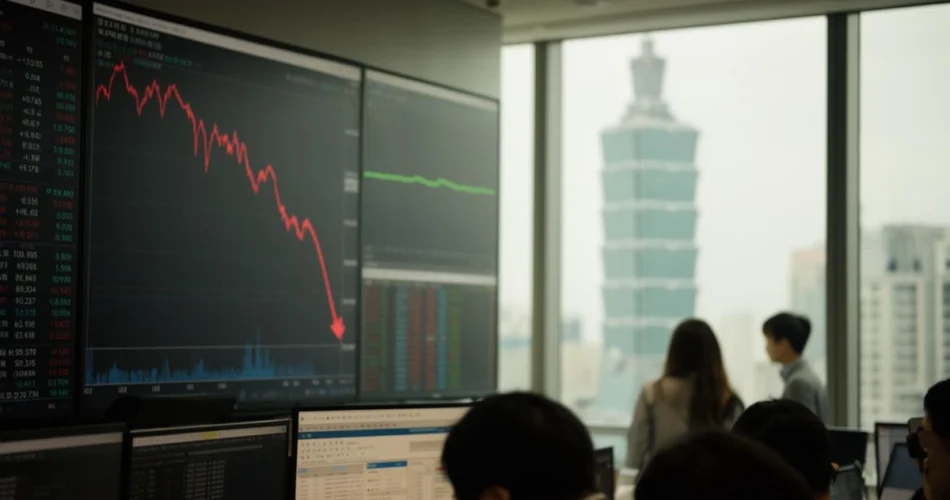
Global equity markets broadly declined last week as the stalemate in U.S.-Iran negotiations and a rebound in oil prices pushed U.S. Treasury yields higher, with multiple headwinds weighing on market sentiment. E.SUN Securities Investment Trust’s latest fund flow report shows a clear divergence in foreign investor positioning across Asian markets. South Korea’s stock market bore the brunt of selling, with net outflows of $1.604 billion (approximately NT$51 billion) last week, bringing the year-to-date cumulative net selling to more than $103.5 billion (approximately NT$3.3 trillion) — the highest across Asian equities. In contrast, Taiwan’s stock market still attracted a modest net inflow of $21 million (approximately NT$670 million) last week, joining India and Indonesia among the few markets with positive foreign fund flows.
Asian markets were mixed last week, with ASEAN countries relatively resilient. Vietnam and Indonesia rose 2.26% and 1.93%, respectively, while Malaysia and Thailand also closed modestly higher. Northeast Asia was comparatively weaker, with Taiwan down 1.28% and South Korea down 0.93%. E.SUN Securities Investment Trust noted that Taiwan’s sector performance was markedly divergent, with only groups benefiting from gold and energy price strength bucking the trend. The electronics sub-index fluctuated near its quarterly moving average, as funds rotated toward names with lower correlation to high AI valuations in search of safety.
Taiwan Q3 Outlook: Rangebound Pattern Taking Shape
Liao Bing-kun, manager of the E.SUN High Growth Fund, noted that based on Federal Reserve officials’ remarks at the Jackson Hole Global Central Bank Symposium, the upward trajectory in bond yields is exerting valuation pressure on growth stocks. Although Taiwanese corporate earnings continue to be revised upward — with Taiwan’s Directorate-General of Budget Accounting and Statistics having sharply raised its 2026 GDP growth forecast to 11.05% from the 9.65% projected in May — market positioning remains relatively disorderly, and with substantial gains already accumulated in the first half, he expects the broader market to remain rangebound in the third quarter.
Liao added that this week’s market focus includes Taiwan’s M1B/M2 money supply data, as well as U.S. PCE and core PCE inflation indicators and annualized quarterly GDP growth due on August 26. The U.S. earnings season is drawing to a close, with Marvell and Nvidia set to report their latest results in the early hours of August 27. Nvidia’s earnings and guidance are viewed as the most critical catalyst, one that will set the tone for investment sentiment across the global AI supply chain.
Fund Flow Adjustment Nearing an End; Korean Stocks Showing Rebound Potential
Tseng Hsun-yi, manager of the E.SUN Emerging Trends Fund of Funds, noted that international capital had previously been excessively concentrated in the semiconductor sector. As technology stocks experienced heightened volatility at elevated levels, emerging Asia — with its high correlation to semiconductors — suffered a more pronounced negative impact, with Taiwan and South Korea, both heavily tied to the chip sector, seeing relatively deeper declines. However, she pointed out that foreign fund flows within the Asia-Pacific region are clearly diverging, and multiple near-term headwinds are being digested. The correction risk stems primarily from fund flow adjustments, and deleveraging activity has largely returned to prior average levels. Correction-driven volatility is expected to ease, with capital gradually flowing back into fundamentally sound hardware technology names.
From an investment strategy perspective, corporate earnings performance remains the key bright spot in Northeast Asia, led by Taiwan and South Korea. Tseng noted that South Korean corporate earnings growth remains robust, and the recent deleveraging-driven correction has created a divergence between the index and earnings per share (EPS) trends, giving Korean stocks near-term upside potential. Additionally, India’s economic outlook has improved, and oil prices have fallen notably from levels seen before the Middle East conflict, easing import inflation pressures. Indian equities, which declined sharply in the first half, could see a near-term rebound.
U.S. Treasury Yields Surge; High-Valuation Sectors Under Pressure
Huang Hsiang-tzu, manager of the E.SUN Global Multinational Blue Chip 100 ETF (009810), said U.S. Treasury yields have continued to climb recently, reflecting the combined capital demand from AI infrastructure investment and substantial government financing needs. This also signals lingering market concerns about tight capital supply-demand dynamics and upside risks to long-term interest rates. If U.S. real yields continue to rise, financing costs for corporations and households will increase, dampening investment and consumption momentum. At the same time, higher discount rates could pressure equity valuations, with high-valuation and growth stocks particularly affected. Overall, U.S. equity fundamentals remain intact, but yield trends warrant close monitoring.
From a valuation standpoint, Huang noted that most markets and sectors remain reasonably valued, though Taiwan and Japan’s forward 12-month price-to-earnings ratios are at relatively elevated historical levels, while other markets are mostly within reasonable ranges. On strategy, market breadth has been expanding recently, with capital rotating from mega-cap technology stocks into financials, industrials, healthcare, and other sectors benefiting from improving economic conditions and earnings. He recommends positioning in ETFs with cross-sector and cross-regional balanced exposure, focusing on quality assets with cash flow advantages, pricing power, and earnings visibility to balance growth opportunities with portfolio resilience.
Taiwan’s stock market fell 586 points, or 1.28%, last week to close at 45,224, but left a substantial 916-point lower shadow, indicating strong buying support at lower levels. Institutional investors noted that July export orders reached $97.94 billion (approximately NT$3.1 trillion), a record monthly high, with the first seven months totaling $602.03 billion (approximately NT$19.2 trillion). Listed companies posted aggregate second-quarter profits of NT$1.8 trillion (approximately $56.6 billion), a record high, with earnings momentum spreading from the AI supply chain to non-AI sectors, providing solid support for the broader market.
From a technical perspective, the market has rebounded after correcting from its highs. Last week’s pullback featured declining prices on shrinking volume, with no signs of panic selling. After reclaiming its quarterly moving average on Thursday, the index filled a bearish gap on Friday to close at 45,224, returning to near its 5-day moving average and temporarily alleviating downside risks. Institutional investors believe that with Nvidia’s earnings and the global central bank symposium on the calendar, market caution is rising, and trading volume will be the key factor in determining whether the index can challenge the prior high of 46,402. If volume recovers to the monthly average of approximately NT$955.1 billion (approximately $30.0 billion), bulls could regain momentum; otherwise, sideways consolidation is likely to prevail. Investors should also monitor whether the TPEx index strengthens on expanding volume.
Source link
Author

- Ytv Market News
- Share-market news writer and analyst with deep experience covering equities, commodities, forex, and cryptocurrencies for readers in the USA, UK, Canada, and Australia. Ytv Market News delivers timely market updates, practical trading insights, and clear explanations of macro and company-level catalysts that move prices. Combines on-the-ground financial reporting with technical analysis, using concise charts and actionable ideas to help investors and traders make smarter decisions.
Latest entries
 UsaAugust 24, 2026$NGS stock fell 7% this week. Here’s what we see in our data.
 Crypto NewsAugust 24, 2026As Bitcoin (BTC) Surpasses $79,000, All Eyes Turn to the Jackson Hole Meeting! A Critical Warning Comes from an Analysis Company! Here Are the…
 Investing InsightsAugust 24, 2026Didi pilots free Coke Zero in premium cars across 12 Chinese cities, drawing mixed reactions from drivers and riders — BigGo Finance
 GermanyAugust 24, 2026Miners support FTSE 100 as investors eye key events