
Ripple (XRP) holds above $1.40 support on Wednesday, as bulls return to take control following three consecutive days of declines. The remittance token’s upside appears capped at $1.50 while extended gains would face additional resistance at $1.70. A break above $2.00 would mark a potential regime shift from bearish to bullish.
XRP whales increase accumulation
XRP rallied by 72% last week, hitting highs around $1.70 before a correction to test support at $1.40 earlier this week. The rally was fueled by increased liquidity as the United States (US) Treasury launched long-term bond buybacks and higher demand through spot Exchange-Traded Funds (ETFs) and derivatives.
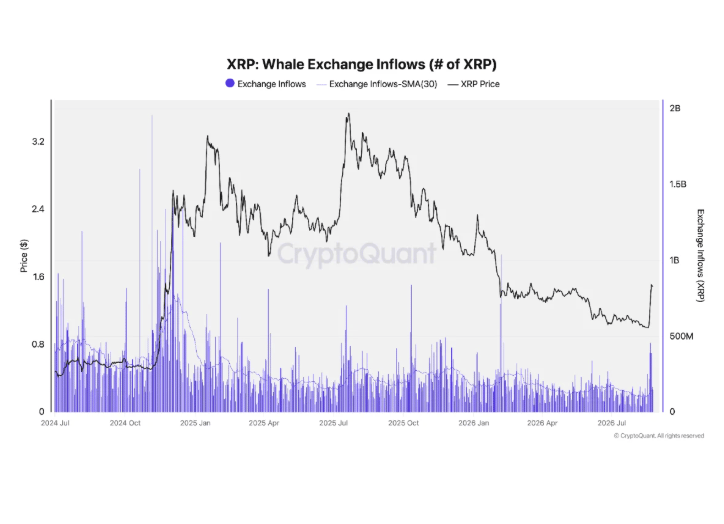
This reinforced expectations of easier financial conditions and revived demand for risk assets. Whale inflows surged to approximately 460 million XRP, the highest since February.
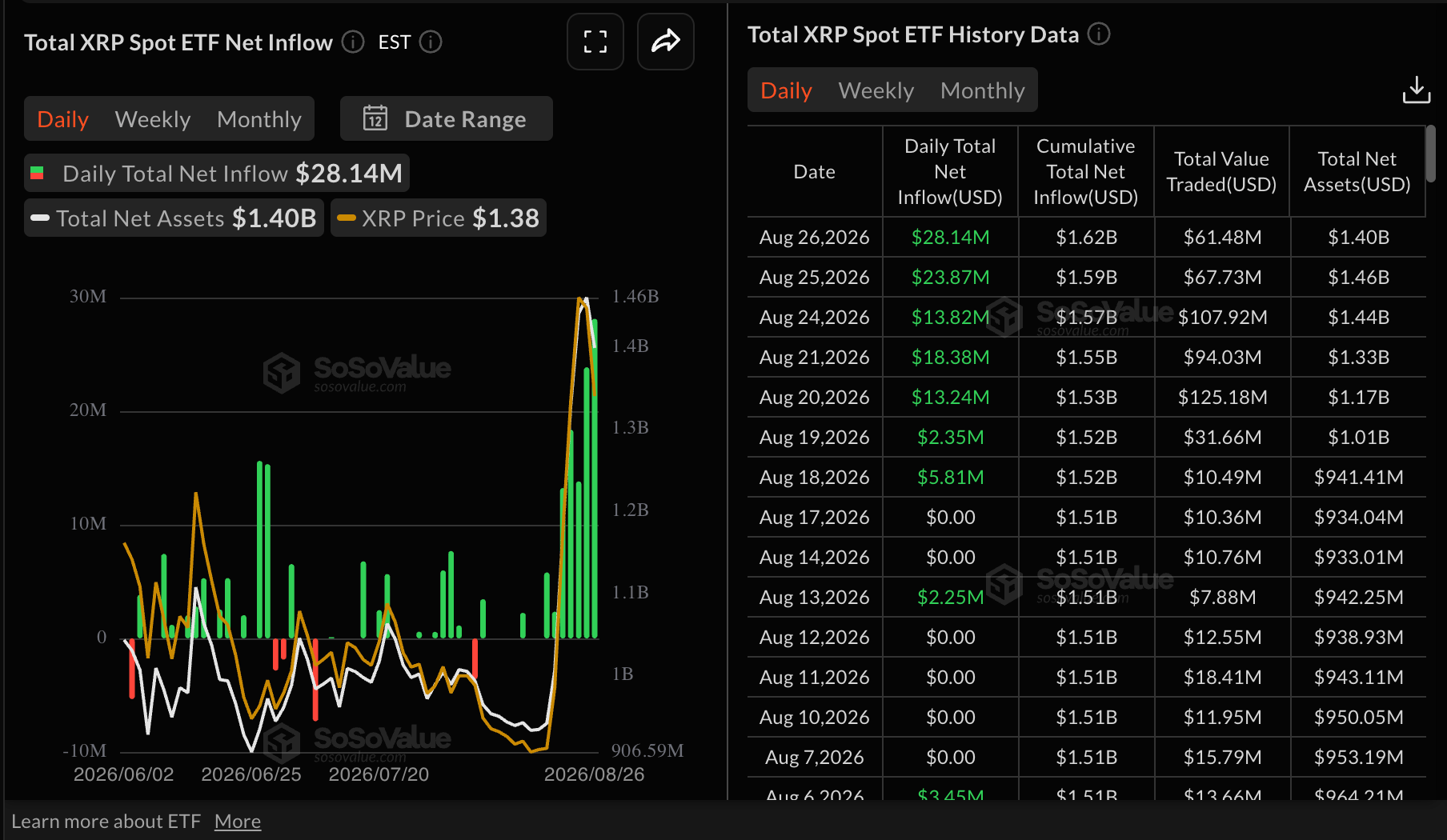
XRP spot ETFs continue to gain momentum, with inflows surging to $28 million on Wednesday, up from $24 million the previous day. This pushed cumulative inflows to $1.62 billion. Meanwhile, total assets under management average $1.40 billion.
However, the correction over the last three days was driven mainly by profit-taking and significantly overheated market conditions.
Technical analysis: XRP retains bullish momentum
XRP trades around $1.44, extending its break above the key Exponential Moving Averages (EMAs) and reinforcing a bullish near-term bias. The spot price holds well above the 50-day EMA at $1.17, the 100-day EMA at $1.20 and the 200-day EMA at $1.35, suggesting a solid underlying demand zone after reclaiming the prior trendline break area around $1.00.
Momentum is constructive, with the Relative Strength Index (RSI) hovering in bullish territory near 73 and the Moving Average Convergence Divergence (MACD) remaining positive, hinting that buyers still control the tape despite stretched short-term conditions.
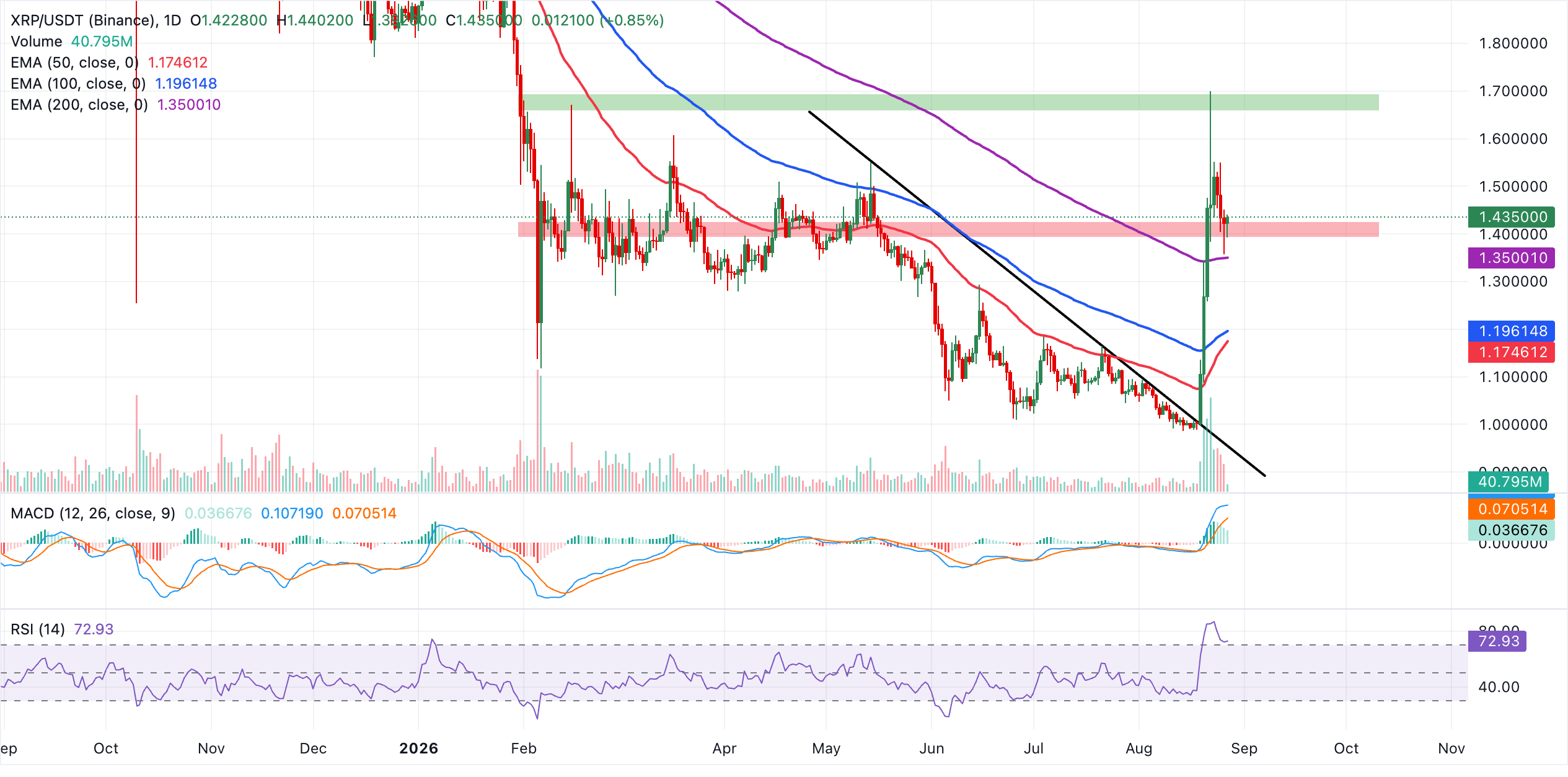
Initial support emerges at the current price area around $1.44, ahead of a deeper layer formed by the 200-day EMA at $1.35 and the cluster of shorter EMAs near $1.20-$1.17, followed by the former break zone close to $1.00. On the topside, the next meaningful hurdle is the descending resistance trendline drawn from $1.66, which remains the first structural cap. A daily close above that barrier would open the way for further gains, while failure to clear it would likely trigger consolidation or a corrective pullback toward the highlighted support band.
(The technical analysis of this story was written with the help of an AI tool. Know more.)
Crypto ETF FAQs
An Exchange-Traded Fund (ETF) is an investment vehicle or an index that tracks the price of an underlying asset. ETFs can not only track a single asset, but a group of assets and sectors. For example, a Bitcoin ETF tracks Bitcoin’s price. ETF is a tool used by investors to gain exposure to a certain asset.
Yes. The first Bitcoin futures ETF in the US was approved by the US Securities & Exchange Commission in October 2021. A total of seven Bitcoin futures ETFs have been approved, with more than 20 still waiting for the regulator’s permission. The SEC says that the cryptocurrency industry is new and subject to manipulation, which is why it has been delaying crypto-related futures ETFs for the last few years.
Yes. The SEC approved in January 2024 the listing and trading of several Bitcoin spot Exchange-Traded Funds, opening the door to institutional capital and mainstream investors to trade the main crypto currency. The decision was hailed by the industry as a game changer.
The main advantage of crypto ETFs is the possibility of gaining exposure to a cryptocurrency without ownership, reducing the risk and cost of holding the asset. Other pros are a lower learning curve and higher security for investors since ETFs take charge of securing the underlying asset holdings. As for the main drawbacks, the main one is that as an investor you can’t have direct ownership of the asset, or, as they say in crypto, “not your keys, not your coins.” Other disadvantages are higher costs associated with holding crypto since ETFs charge fees for active management. Finally, even though investing in ETFs reduces the risk of holding an asset, price swings in the underlying cryptocurrency are likely to be reflected in the investment vehicle too.
Source link
Author

- Ytv Market News
- Share-market news writer and analyst with deep experience covering equities, commodities, forex, and cryptocurrencies for readers in the USA, UK, Canada, and Australia. Ytv Market News delivers timely market updates, practical trading insights, and clear explanations of macro and company-level catalysts that move prices. Combines on-the-ground financial reporting with technical analysis, using concise charts and actionable ideas to help investors and traders make smarter decisions.
Latest entries
 Company Press ReleasesAugust 27, 2026Bio-Works brings forward the publication of its interim report for the third quarter of 2026
 Company NewsAugust 27, 2026Die Adecco-Aktie bleibt nach solider Gewinnentwicklung im zweiten Quartal stabil
 Crypto NewsAugust 27, 2026XRP Ledger: 500,000 Is the New Reality
 Stock Market VideosAugust 27, 2026Ancora Comfortable With Its Offer for H.B. Fuller Unit