

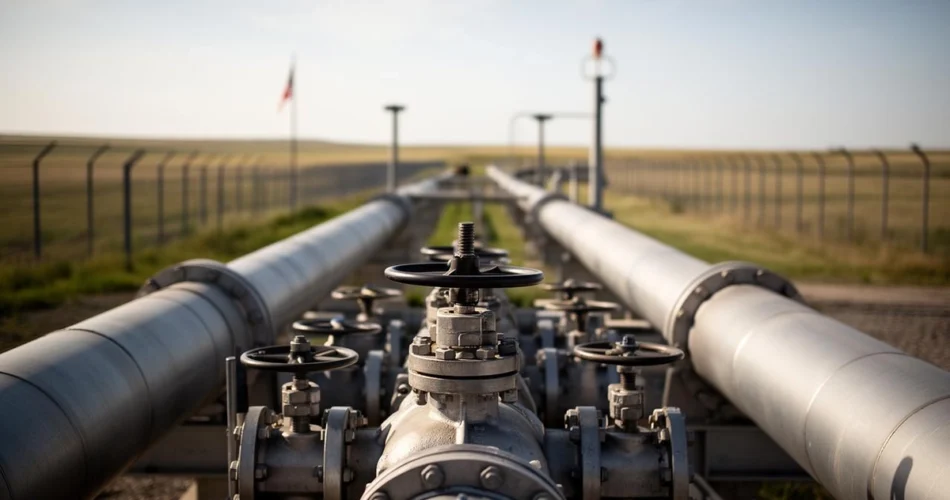
The collapse of US-Canada trade negotiations on August 21 has once again exposed the roughly 4 million barrels per day of crude oil trade linking the two countries as a strategic vulnerability. Canadian crude accounts for 63% of US imports, and refineries across the US Midwest and Gulf Coast have been designed over decades to process heavy sour crude from Alberta. At the same time, Canada depends on the United States for export revenue and for its eastern supply network — using oil as a retaliatory weapon would deeply wound its own economy.
The two governments offer diametrically opposed accounts of what triggered the breakdown. Janice Charette, Canada’s chief negotiator, disputed the US version of events in an exclusive interview with CBC’s “The House.” Jamieson Greer, head of the Office of the United States Trade Representative (USTR), had accused Canada this week of attempting at the last minute to include heavy trucks in the automotive sector negotiations. Howard Lutnick, the US Commerce Secretary, also said at a press conference on the 21st that Canada had deliberately sabotaged the talks.
Charette pushed back, saying, “Secretary Lutnick was not in the room.” She said the heavy truck issue had been raised consistently by the Canadian side from Monday through Thursday, and that the United States had in fact been seeking tariff relief for similar vehicles.
The points of contention extend beyond automobiles. Prime Minister Mark Carney has asserted that the United States demanded at the final stage the removal of protections for French-language content in video streaming services, as well as restrictions on Canada’s ability to enter free trade agreements with third countries. Lutnick dismissed these claims as “election-driven fiction,” but Charette said that “until the final session on Friday night, the US side continued to demand the removal of those provisions.”
Crude oil as a double-edged sword
Canadian crude flows to the United States seven days a week, 365 days a year. In 2025, Canada accounted for 63% of total US crude oil imports. For Canada, that 4 million barrels per day represents the bulk of its exports, and no market exists that could immediately absorb the same volume outside the United States.
US refining capacity — particularly the complex facilities in the Midwest and Gulf Coast — has been purpose-built to process heavy sour crude with high density and sulfur content. Switching to light crude from the Permian Basin and elsewhere is not feasible in the short term. If Canadian crude supplies are disrupted, refinery utilization rates would fall sharply, and gasoline and diesel prices would spike further from current elevated levels.
Canada has serious vulnerabilities of its own. Crude oil exports to the United States are a major source of revenue for the Canadian economy, and redirecting them to alternative destinations is not easy. Moreover, eastern Canada receives nearly all of the oil it consumes via the United States. Because the federal government has for years failed to advance domestic pipeline construction, the pipelines running from west to east pass through northern US states including Minnesota, Wisconsin, and Michigan — leaving supply to eastern cities such as Ottawa, Toronto, and Montreal dependent on the United States.
At a press conference, Prime Minister Carney declared, “We were attacked. When you’re attacked, that’s war. We were attacked,” signaling retaliation. Additional tariffs of 50% have already been imposed on approximately $20 billion (about ¥3.2 trillion) worth of Canadian products, and the Canadian government has announced counter-tariffs on $27.6 billion worth of US goods.
Shaken assumptions underpinning cross-border infrastructure
The intensifying trade conflict also casts a shadow over multi-billion-dollar pipeline projects. US President Donald Trump has hinted at reviving Keystone XL, but the project actually moving forward is a redesigned version known as Prairie Connector.
The project would connect Hardisty, Alberta, to the US border, with a planned capacity of 550,000 barrels per day. Operator South Bow has signed 20-year firm transportation contracts with nine shippers, securing a combined 465,000 barrels per day. A final investment decision is targeted for mid-2027.
However, cross-border energy infrastructure requires more than just permits. Political trust in the counterpart country and commercial confidence are essential — and the breakdown in negotiations and the war of words are eroding both. If the impasse continues, tightness in refined product markets and price increases are likely to hit consumers and businesses on both sides of the US-Canada border.
Charette said, “Canada has put down the pen, but the door remains open,” indicating willingness to reach an agreement on terms that do not compromise sovereignty. She added, however, that “trust has to be earned,” suggesting that repairing the bilateral relationship will take time.
| Indicator | Figure |
|---|---|
| Canadian crude exports to the US | 4 million barrels per day |
| Canada’s share of US crude oil imports | 63% |
| Additional tariffs on Canadian products | 50% (approximately $20 billion worth) |
| Value of Canadian counter-tariff targets | $27.6 billion worth |
| Prairie Connector planned capacity | 550,000 barrels per day |
Note: Figures are based on 2025 trade statistics and published project documents.
Source link
Author

- Ytv Market News
- Share-market news writer and analyst with deep experience covering equities, commodities, forex, and cryptocurrencies for readers in the USA, UK, Canada, and Australia. Ytv Market News delivers timely market updates, practical trading insights, and clear explanations of macro and company-level catalysts that move prices. Combines on-the-ground financial reporting with technical analysis, using concise charts and actionable ideas to help investors and traders make smarter decisions.
Latest entries
 IndiaAugust 29, 2026Lalitha Jewellers to go global by opening its showrooms in Malaysia, Singapore
 Company NewsAugust 29, 2026Die Oceaneering-International-Aktie reagiert auf frische Gewinnprognosen und Anlegerzuflüsse
 Crypto NewsAugust 29, 2026Oscar Winner Matt Damon to Headline Ripple Event as Featured Speaker
 Stock Market VideosAugust 29, 2026Treasuries Will Have a Tough End to 2026: 3-Minutes MLIV

