

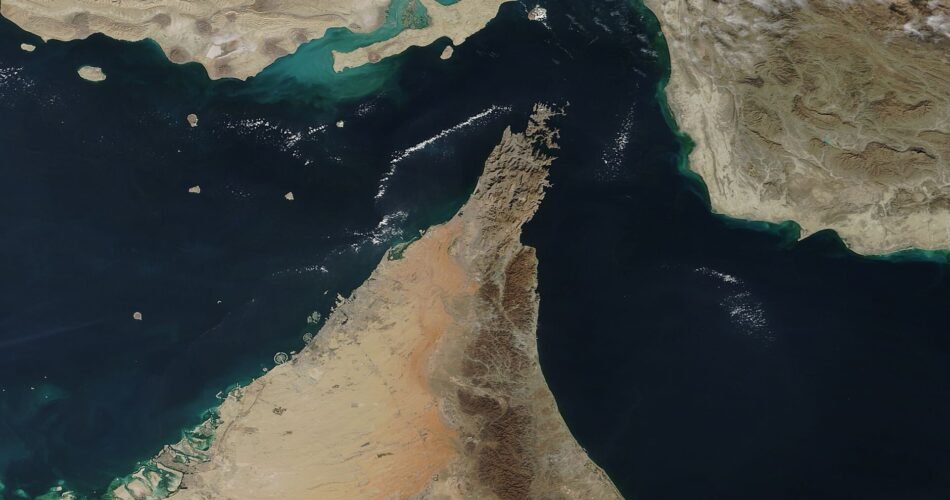
The security situation around the Strait of Hormuz deteriorated over the past week, with multiple commercial vessels attacked and shipping traffic remaining far below prewar levels. The United Arab Emirates blamed Iran for drone attacks on two state-owned tankers, while another outbound vessel was struck by an unidentified projectile days later. Iran has continued to link unrestricted passage to broader political and economic demands, as U.S.-Iran negotiations remain stalled. Although U.S. officials say a protected corridor is moving significant amounts of oil through the strait, commercial tracking data indicates that overall traffic is still sharply constrained. The disruption matters globally because the strait normally carries a major share of international oil and liquefied natural gas trade.
Background
The Strait of Hormuz connects the Persian Gulf with the Gulf of Oman and the Arabian Sea. Before the current conflict, more than 20 million barrels per day of oil and petroleum products moved through it, alongside roughly one-fifth of global liquefied natural gas trade. Iran lies to the north and Oman to the south. Saudi Arabia and the UAE have pipelines that bypass the strait, but most Gulf exporters have limited alternatives. Shipping has been severely disrupted since the U.S.-Israeli war with Iran began in February 2026.
Current Situation
New attacks again demonstrated the risks facing ships attempting to use the waterway. On August 13, two tankers associated with the Abu Dhabi National Oil Company were attacked while transiting the strait. The UAE said Iranian drones were responsible and described the incidents as acts of piracy. ADNOC reported no injuries and said the situation aboard the vessels had been brought under control. Iran did not immediately accept responsibility.
Shipping slowed further after the attacks. Data reported by the Associated Press showed 95 confirmed crossings during the following weekly reporting period, a decline of nearly 20%. Only three confirmed vessels crossed on August 16. Some ships may not have been counted because they switched off or restricted their automatic identification transmissions, a practice intended to make vessels harder to track. Even allowing for those “dark” movements, normal commercial activity has not been restored.
On August 18, the United Kingdom Maritime Trade Operations center reported that an unidentified projectile struck another vessel as it sailed out of the strait through Omani waters. The impact damaged the engine room and caused a crew casualty. The remaining crew received assistance from the Omani Coast Guard. No environmental damage was initially reported, and responsibility for the attack was not immediately established.
The incidents came as diplomacy lost momentum. An interim U.S.-Iran arrangement reached in June had temporarily reduced some tensions, but its 60-day period expired on August 17 without a comprehensive agreement. President Donald Trump said on August 18 that no talks with Iran were planned and maintained that the strait was open and operating. Iranian officials, by contrast, said unrestricted passage would depend on conditions including an end to the U.S. blockade of Iranian shipping, access to frozen assets, sanctions relief and an end to military operations.
Oman has continued efforts to mediate and has discussed a proposed system with Iran for managing commercial traffic. Supporters of an Omani role argue that coordination between the two coastal states could provide a practical route toward safer passage. U.S. officials have raised concerns that an agreement could grant Iran excessive influence over international shipping. The dispute illustrates that the crisis involves not only physical security but also competing claims about who should regulate access.
There are conflicting indications about how much oil is getting through. The U.S. Energy Information Administration estimated that flows fell from 21.6 million barrels per day in the fourth quarter of 2025 to 4.9 million in the second quarter of 2026. However, U.S. officials told Axios this week that the military had quietly helped establish a southern corridor through which 15 to 20 tankers had moved in and out on some nights during the previous two weeks. Differences between those figures may reflect changing traffic levels, untracked voyages and different methods for counting vessels and cargo.
The crisis is also becoming more closely connected to broader regional hostilities. The UAE announced a suspension of economic and financial transactions with Iran after renewed attacks, increasing pressure between two countries with extensive commercial ties. Meanwhile, attacks linked to Yemen’s Houthi movement have continued to threaten shipping and energy facilities near the Bab el-Mandeb and Red Sea. The simultaneous insecurity around both maritime routes complicates efforts to redirect Gulf exports.
Oil prices rose to around a three-week high on August 19 as traders assessed the tanker attacks, the UAE-Iran confrontation and fading prospects for a diplomatic settlement. Prices remain influenced by inventories and global demand as well as the conflict, but uncertainty surrounding Hormuz continues to add a security premium to energy markets.
Outlook
The immediate questions are whether attacks continue, whether commercial traffic increases through the U.S.-supported corridor and whether Oman can revive negotiations. Shipping companies will closely monitor insurance costs, naval guidance and the reliability of protected routes before returning at scale. Further escalation between Iran and the UAE could create additional risks for ports and energy infrastructure. Conversely, even a limited arrangement establishing recognized transit procedures could encourage more vessels to cross. A return to prewar shipping levels would probably require sustained security improvements rather than a single diplomatic announcement.
Sources
Disclaimer: This analysis was generated with the help of AI. Please double-check the information provided for mistakes.
Source link


