

Scott Kirby has spent a decade transforming United Airlines into the second-most profitable U.S. carrier, and the 59-year-old chief executive is now charting an even more ambitious course: expanding at New York’s John F. Kennedy International Airport, deepening the airline’s reach into South America, and navigating the prolonged delays of Boeing’s 737 Max 10.
In a wide-ranging interview with CNBC during a ride from Midtown Manhattan to United’s hub at Newark Liberty International Airport, Kirby outlined a strategy that touches nearly every corner of the airline’s operations, from premium cabin seating to artificial intelligence, while leaving the door open to the kind of megamerger that would redraw the U.S. aviation landscape.
United already leads U.S. carriers in international flying, a position Kirby has aggressively cultivated since taking the top job in May 2020. The airline is preparing to announce another batch of overseas routes this week, following recent additions such as Ulaanbaatar, Mongolia and Bilbao, Spain. But Kirby acknowledged that two geographic gaps remain stubbornly difficult to close without a partner.
“Those are two places that are holes for United that are hard to fix on a stand-alone basis,” Kirby said, referring to South America and the southeastern United States, where the airline lacks a strong hub. He identified Miami International Airport as the best gateway for South American service, a market where American Airlines held more than 60% of passenger enplanements in fiscal 2025.
The JFK question is equally pressing. United plans to return to the congested New York airport through a partnership with JetBlue Airways as early as next year, and Kirby said the airline is actively exploring ways to acquire slots from carriers that aren’t operating profitable routes out of JFK.
“We got a bunch of irons in the fire to try to find ways to do it,” he said.
The 737 Max 10 Problem
Perhaps the most tangible headache for United right now involves Boeing’s repeatedly delayed 737 Max 10. The aircraft was originally expected to enter service in 2020, but United now anticipates its first deliveries in summer 2027. The airline has 167 Max 10s on order.
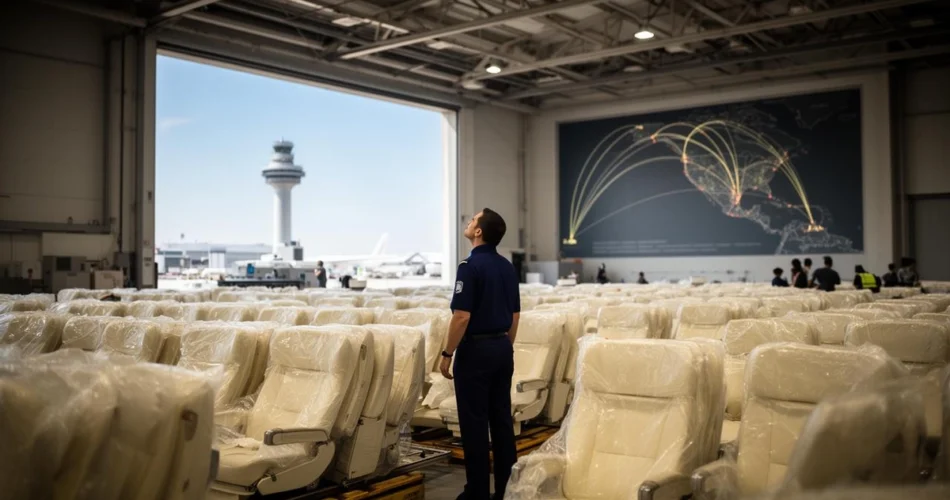
The delay has left United with an unusual inventory problem: hundreds of lie-flat seats designed specifically for the Max 10’s premium cabin, now sitting in storage with no aircraft to put them in.
“We got a bunch of lie-flat seats that we don’t know what to do with,” Kirby said. “They don’t fit on other airplanes.”
United has already adapted by upgrading a subfleet of Airbus A321neo aircraft with 20 Polaris suites, premium economy seats, and other redesigned interiors. The carrier has branded this group the “Coastliner,” which will serve transcontinental routes.
The seat dilemma underscores a broader theme in Kirby’s strategy: premium travel is where the money is, and United is determined to capture more of it. The airline continues to invest heavily in higher-end cabins as travelers show greater willingness to pay for comfort on long-haul flights.
Merger Ambitions and Industry Consolidation
Kirby has not been shy about his interest in transformative combinations. Over the past year, he has floated the idea of megamergers with both Delta Air Lines and American Airlines, moves that would create airlines of unprecedented scale.
Both approaches have so far been rebuffed. People familiar with the matter said Delta rejected an approach from United, as The Wall Street Journal first reported last month. American publicly turned down a merger proposal this spring.
Robert Isom, who replaced Kirby as American’s president in 2016 and became CEO in late 2021, dismissed the prospect of a deal.
“At the end of the day, we spend time looking at things that have a chance of happening. We don’t spend a lot of time pursuing impossibilities,” Isom told CNBC in an interview in late June.
Kirby, however, argues that concerns about airline consolidation are based on an outdated premise.
“All of the objections are based on a premise that the airline industry is a commodity,” he said, pointing to the differentiation that Delta and United have built through their networks, onboard cabins, and other products.
He also made clear that United is not interested in acquiring a smaller carrier like JetBlue. “Everything I say would require a willing partner,” Kirby said.
The personal history between Kirby and American adds a layer of intrigue to the merger talk. American fired Kirby in August 2016 when he was president of the carrier, and United announced his appointment almost immediately afterward.
“I joke that most people take a few weeks, a couple months between jobs. I took 60 seconds,” Kirby said.
He acknowledged that the experience shaped his approach to leadership. “One of the things also I learned at American: There’s only so much change you can make as the No. 2. You can push too hard and you get fired.”
AI, Reliability, and the Long Game
Beyond network expansion and consolidation, Kirby is betting on artificial intelligence to improve both the customer experience and operational reliability. He envisions AI tools that help travelers navigate disruptions and give employees better decision-making support when weather, airport constraints, or mechanical problems strike.
He wants delays expressed in clear English to customers. “I firmly believe in no excuses, and so we don’t make excuses,” he said.
The reliability push comes as United still trails some competitors on operational metrics. In the first half of the year, United ranked behind Delta and Alaska Airlines for on-time arrivals, according to the U.S. Transportation Department.
Kirby, who became United CEO in May 2020 as the industry was reeling from the Covid-19 pandemic, said his focus is on building a company that can withstand future shocks.
“Our employees often ask me like, ‘What keeps you awake at night,’ and I tell them, ‘nothing,'” he said. “My job is to set the company up so none of you ever have to have a sleepless night worrying about your jobs.”
He said his goal is to never have another furlough at the airline.
When Kirby joined United in 2016, the company was in the midst of upgrading its cabins, including the rollout of Polaris pod seats for long-haul business class. But his first order of business, he said, was going through money-losing routes with a highlighter to identify what was working and what wasn’t.
The company considered closing its bases at Los Angeles International Airport and Washington Dulles International Airport in Virginia. Kirby stopped that idea, and both stayed open. The airports have since proven critical: LAX is one of United’s most important hubs, and Kirby recently joined President Donald Trump in the Oval Office to unveil a $22.5 billion revamp of Dulles.
As for his own future, Kirby said he hopes to know when to step aside.
“I hope I will know when to retire and do it gracefully with a great transition with great people,” he said.
Source link
Author

- Ytv Market News
- Share-market news writer and analyst with deep experience covering equities, commodities, forex, and cryptocurrencies for readers in the USA, UK, Canada, and Australia. Ytv Market News delivers timely market updates, practical trading insights, and clear explanations of macro and company-level catalysts that move prices. Combines on-the-ground financial reporting with technical analysis, using concise charts and actionable ideas to help investors and traders make smarter decisions.
Latest entries
 IndiaAugust 24, 2026Hy-Tech Engineers IPO opens today: Price, dates, lot size and key details
 Company Press ReleasesAugust 24, 2026Net Asset Value(s) – Janus Henderson ICAV
- Company NewsAugust 24, 2026Die Novartis-Aktie bleibt stabil während neue Krebsarznei Rückenwind …
 Stock Market VideosAugust 24, 2026Modi Puts Chips, Nuclear Power at Heart of India Push


