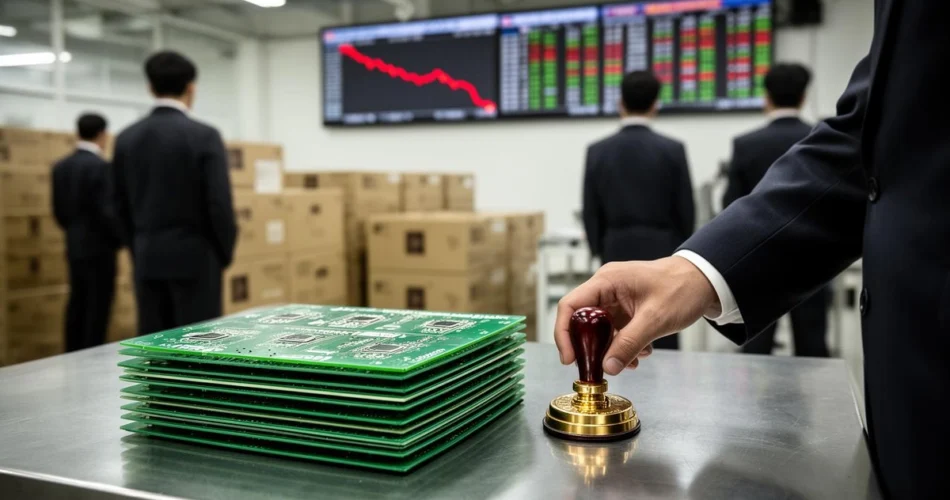
ABF substrate leader Unimicron Technology (3037.TW) saw its shares tumble on August 28 after the Taoyuan District Prosecutors Office directed the Market Investigation Division to raid the company on suspicion of shipping China-made printed circuit boards (PCBs) back to Taiwan, relabeling them, and passing them off as Taiwan-made. The stock surged to an all-time high of NT$1,230 intraday before reversing sharply, closing down NT$70 at NT$1,110 — a single-day decline of 5.93%. On August 29, the Taoyuan District Prosecutors Office confirmed that five senior company executives face serious charges including forgery of private documents and false product labeling, and were released on bail ranging from NT$300,000 (approx. $9,500) to NT$15 million (approx. $470,000).
According to prosecutors, Unimicron allegedly transported PCBs manufactured in mainland China back to Taiwan, relabeled them, and falsely presented them as Taiwan-made for export. The August 28 raid on the company’s Guishan headquarters in Taoyuan and its Zhongli plant resulted in 14 executives and employees being taken in for questioning, along with four witnesses. After interrogation, the PCB division’s General Manager Wang was released on NT$15 million bail (approx. $470,000), Vice President Wu on NT$12 million (approx. $380,000), Plant Manager Tseng on NT$5 million (approx. $160,000), Manager Chou on NT$2.5 million (approx. $79,000), and sales representative Liu on NT$300,000 (approx. $9,500). The remaining defendants were released without bail.
Unimicron issued a material announcement on the evening of August 28 confirming the raid by the Taoyuan District Prosecutors Office and the Taoyuan Market Investigation Division, stating the investigation centers on the “Offense of Impeding Agriculture, Industry and Commerce.” The company emphasized full cooperation with investigators to clarify the matter, asserting that the incident has no material impact on its financials or operations, and that business remains normal.
Two Scenarios for Country-of-Origin Fraud Risk
Investment expert Shih Ya-tang analyzed the situation on Facebook, noting that the “Offense of Impeding Agriculture, Industry and Commerce” cited in Unimicron’s announcement covers a broad range of conduct — potentially including hoarding to manipulate prices, trademark counterfeiting, and what the market fears most: “false labeling of a product’s country of origin or quality,” which in plain terms means country-of-origin fraud.
He argued that the key factor for Unimicron’s share price lies in the facts uncovered by the ongoing investigation. If the issue is ultimately limited to country-of-origin or quality labeling problems on individual products, with modest amounts involved and no customer impact, the legal liability would be relatively contained, and the long-term fundamental impact on Unimicron would be minimal.
However, if the case involves China-made products transshipped through Taiwan or processed in a way that alters their country-of-origin designation before export to the United States, the severity escalates dramatically. This could trigger customer supply chain audits, export eligibility reviews, tariff reassessments, and potentially prompt major American clients to reallocate orders. In that scenario, Unimicron’s real risk would not be the fine amount itself, but whether orders get diverted to competitors.
▲ The two scenarios outlined by Shih Ya-tang: the real dividing line for risk is whether the origin change involves evading U.S. export tariffs.
Policy Backdrop: U.S. Recently Intensified Crackdown on Country-of-Origin Fraud
The Unimicron case unfolds against a backdrop of heightened enforcement by both Taiwan and the United States against “country-of-origin fraud” — the practice of misrepresenting goods actually produced in China or elsewhere as Taiwan-made to secure lower U.S. import tariffs. Reuters reported that the White House earlier this month released a report estimating the U.S. loses approximately $19 billion to $26 billion annually in tariff revenue due to goods transshipped through third countries to evade import duties, with the majority of such goods originating from China.
Taiwan’s Customs Administration under the Ministry of Finance stated that since April 2025, it has established a three-tier defense against illegal transshipment: pre-emptive prevention, rigorous mid-process inspection, and severe post-violation penalties. As of early August 2026, authorities had reviewed over 43 million customs declarations and identified 413 suspected illegal transshipment cases. This indicates the Unimicron case emerged at a time when routine government enforcement has been intensifying — rather than being a one-off targeted action — but it also means that once violations are confirmed, the subsequent handling standards may be stricter.
Active ETFs Face a Test on Monday
Following the news, actively managed ETFs with heavy Unimicron exposure have come under market scrutiny. According to data compiled by Shih Ya-tang, the top five ETFs by Unimicron weighting are all actively managed products:
| ETF Name | Ticker | Unimicron Weighting |
|---|---|---|
| President Active Taiwan Growth | 00981A | 8.25% |
| Taishin Active Advantage Growth | 00987A | 7.36% |
| Fuh Hwa Active Future 50 | 00991A | 6.84% |
| Capital Active Tech Innovation | 00992A | 6.70% |
| First Active Taiwan Equity | 00994A | 6.64% |
Note: Data compiled from Shih Ya-tang’s Facebook post.
He pointed out that since all top five are actively managed ETFs, when markets reopen Monday, it’s not just Unimicron shareholders who should be nervous — the managers of these ETFs face a critical investment decision as well: whether to cut positions and reduce exposure, or to add during the market panic.
Kinsus and Nan Ya PCB Seen as Potential Beneficiaries
As for potential beneficiaries of this incident, Shih Ya-tang named Kinsus Interconnect Technology (3189.TW) and Nan Ya PCB (8046.TW), both of which also have ABF substrate exposure. He noted that AI, ASIC, and CPU applications are currently driving demand growth for high-end ABF substrates. If clients begin diversifying orders based on supply chain risk considerations, some orders originally placed with Unimicron could be reallocated to other suppliers.
He suggested monitoring three indicators simultaneously on Monday: whether Unimicron’s share price continues to slide, whether actively managed ETFs show signs of position adjustments, and whether Kinsus and Nan Ya PCB attract notable capital inflows. He stressed that it is far too early to write off Unimicron, but until the full scope of the case is clarified, what the market fears most is never the bad news itself — it is not knowing how bad the news really is.
Source link
Author

- Ytv Market News
- Share-market news writer and analyst with deep experience covering equities, commodities, forex, and cryptocurrencies for readers in the USA, UK, Canada, and Australia. Ytv Market News delivers timely market updates, practical trading insights, and clear explanations of macro and company-level catalysts that move prices. Combines on-the-ground financial reporting with technical analysis, using concise charts and actionable ideas to help investors and traders make smarter decisions.
Latest entries
 UsaAugust 30, 2026This “Boring” Pipeline Stock Has Never Cut Its Dividend. Here’s the 1 Number I’d Watch.
 Politics News TodayAugust 30, 2026Dolly Parton laid to rest as niece shares emotional tribute to ‘Granny’
 Crypto NewsAugust 30, 2026Bitcoin Price Analysis: Is BTC Entering a Consolidation Phase After Its Explosive Rally?
 UsaAugust 30, 2026Should Eli Lilly Investors Be Worried About a Threat From Amylyx?