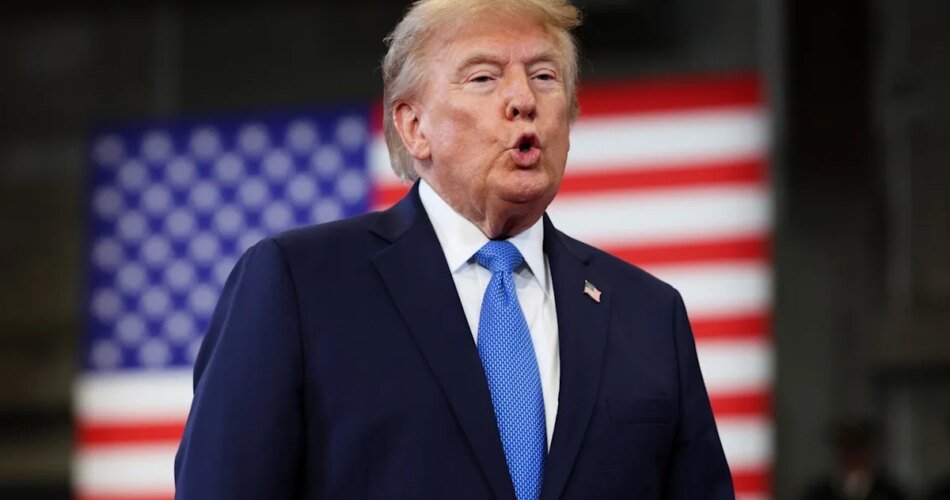

Wall Street has warned Donald Trump that he risks losing credibility with investors after his intervention in the bond market failed to calm traders and raised fears about the US’s spiralling debt.
Analysts at JP Morgan said borrowing costs would keep rising unless the US president takes concrete steps to reduce the US’s $40tn (£29.3tn) debt pile.
Yields on 30-year US treasuries rose back above 5.2pc as increasing oil prices renewed inflation fears. Yields on benchmark 10-year treasuries also rose, pushing global borrowing costs higher.
UK borrowing costs also surged, with yields on 30-year debt climbing to 5.82pc, approaching levels not seen since 1998. Economists warned that the only way Mr Trump could sustain lower borrowing costs was to cut government spending or accept a weaker dollar.
Thursday’s increase almost reverses the drop in borrowing costs after the Trump administration launched a major intervention to calm investors.
However, a string of analysts warned that the intervention would backfire because investors were losing faith in Mr Trump’s ability to reduce debt.
Jay Barry, a managing director at JP Morgan, said: “Absent real fiscal consolidation, we fear the markets will view this action as lacking credibility.”
He added that this could also shake investor confidence in what is still deemed the world’s safest asset.
“This could contribute to higher term premiums and yields over time should treasury become more opportunistic in its approach to debt management and move further away from its ‘regular and predictable’ tenet.”
At a press conference on Wednesday night, Mr Trump insisted the public should not worry about increasingly volatile bond markets.
Asked whether Americans should be worried, Mr Trump said: “No, I don’t think so. Our country is doing so well despite interest rates.”
He reiterated his belief that US interest rates had remained “artificially high” after policymakers at the Federal Reserve voted to hold rates last month.
However, analysts warned that a weaker dollar was all but inevitable if the administration were unwilling to bring down the US’s $40tn deficit, which could fuel a fresh wave of inflation before the midterm elections.
Kit Juckes at Société Générale noted that the US debt pile was already much larger than annual output.
“This will be a growing issue, which will either force the US to tighten fiscal policy, accept higher borrowing costs, or let the dollar weaken,” he said.
Analysts at Jefferies said families would be hit by higher long-term borrowing costs in a move that could cost the Republican Party votes.
Source link