


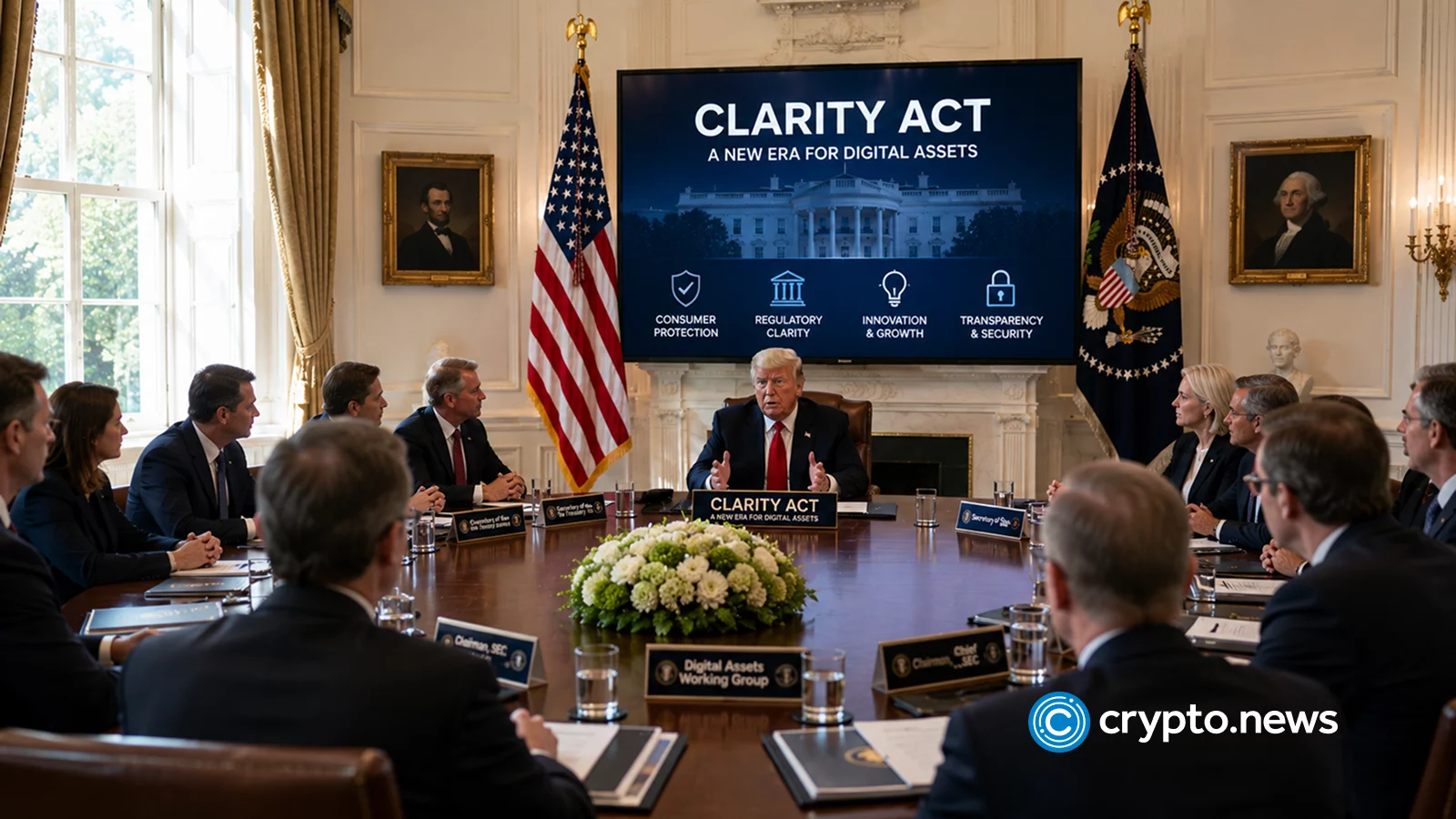
President Donald Trump has called on Congress to approve a “fair” version of the CLARITY Act as the crypto market structure bill approaches a 60-vote test in the Senate.
Summary
- Trump urged Congress to make the administration’s crypto policies permanent through legislation.
- The CLARITY Act would divide digital asset oversight between the SEC and CFTC.
- Senate negotiations remain divided over ethics rules, DeFi treatment, and stablecoin rewards.
- The CFTC will discuss crypto, AI, and prediction markets at its first advisory committee meeting.
President Donald Trump said during an Aug. 19 White House event that Congress needed to “take the next step” by passing legislation that sets federal rules for the U.S. digital asset market.
Joined by executives from Coinbase, Gemini, Ripple, Chainlink Labs, and other technology companies, Trump called for a “fair version” of the Digital Asset Market Clarity Act. The request pointed to negotiations over provisions that have kept the bill from reaching a final Senate vote.
“It’s a very, very powerful structured legislation which will keep us ahead of China, keep us ahead of everyone else,” Trump said. “We’ll open the door to the next wave of innovations and innovators.”
The president described the proposal as “very bipartisan,” although Senate negotiators have not resolved several disagreements over its final language. Among the disputed areas are rules for decentralized finance, rewards paid on stablecoin balances, and ethics restrictions covering senior government officials with digital asset interests.
Trump wants the CLARITY Act to make crypto policy permanent
Trump’s appeal placed congressional action alongside the regulatory work already underway at the Securities and Exchange Commission, the Commodity Futures Trading Commission, and the Treasury Department.
Unlike agency rules, federal legislation would remain in place unless Congress amended or repealed it. Coinbase CEO Brian Armstrong told attendees that passing the CLARITY Act would protect the administration’s policy changes from being reversed by future regulators.
“This would make all of the progress that this administration has made durable into the future, so it could survive for decades and decades to come,” Armstrong said, describing the pending measure as “a true bipartisan compromise.”
“If we all come together, I think we can get this bill over the finish line.”
The legislation would establish legal categories for digital assets and divide oversight duties between the SEC and CFTC. It would also create registration routes for exchanges, brokers, and custodians while setting requirements for customer asset segregation, disclosures, and other market safeguards.
The House passed its version of the CLARITY Act by a 294–134 vote in July 2025. The bill later cleared the Senate Banking Committee, but lawmakers left Washington for their August recess without holding a floor vote.
Senate Majority Leader John Thune filed a cloture motion before the break, setting up a procedural test after lawmakers return. The measure needs support from at least 60 senators to overcome a filibuster and proceed toward final consideration.
An Aug. 18 crypto.news analysis found that Polymarket’s estimated chance of passage had fallen from 82% in February to below 20% by mid-August. Galaxy Digital lowered its own estimate to 10% on Aug. 14, citing the limited Senate calendar and the unresolved disputes.
Ethics rules remain a point of dispute
Democratic negotiators have pressed for provisions limiting digital asset holdings and business interests among senior officials across the executive, legislative, and judicial branches.
Trump’s involvement in crypto ventures has made the ethics language one of the most contested parts of the Senate talks. Any restrictions covering officials and their families could affect his digital asset interests as well as those of other officeholders with tokens, investments, or connections to crypto companies.
Negotiators have also disagreed over how the bill should treat decentralized protocols and stablecoin rewards. Coinbase earns revenue from USDC-related activity, making restrictions on rewards paid through trading platforms commercially important to the company and other intermediaries.
Republicans hold 53 Senate seats but cannot pass the bill without Democratic support. The 60-vote threshold leaves sponsors dependent on a bipartisan agreement at a time when lawmakers have only a short September window before campaigning for the November elections takes over much of the congressional calendar.
SEC proposal cannot settle the SEC-CFTC boundary
SEC Chairman Paul Atkins used the White House event to connect the agency’s latest crypto proposal with the need for legislation.
“Our proposal, the crypto assets rule, would provide crypto entrepreneurs like those here in this room and job creators the certainty to raise capital in the United States using digital assets,” Atkins told Trump.
The SEC’s Regulation Crypto Assets proposal would create two fundraising exemptions for qualifying crypto investment contracts. One route would cover offerings of up to $5 million over four years, while another would allow eligible issuers to raise as much as $75 million during a 12-month period.
As reported on Aug. 18, the proposal also includes disclosure requirements and a conditional safe harbor addressing when a crypto asset may stop being tied to an investment contract. Interested parties will have 60 days to submit comments once the proposal enters the required publication process.
Agency action has limits because the SEC can only write rules within the authority Congress has already granted it. The regulator cannot independently rewrite the statutory division between securities and commodities oversight or give the CFTC full authority over spot digital commodity markets.
Atkins said the SEC’s work supported congressional action rather than replacing it.
“This action is consonant with our belief that the most important priority is for Congress to send the Clarity Act to your desk for your signature, and the SEC is doing everything we can to support that work,” he said.
Treasury has also moved ahead with the implementation of the GENIUS Act, which Trump signed in July 2025. Its proposed stablecoin rules address which issuers must obtain federal or state authorization, as well as reserve, redemption, compliance, and disclosure requirements.
CFTC meeting puts crypto oversight on the agenda
The White House gathering took place one day before the CFTC’s first Innovation Advisory Committee meeting on Aug. 20.
Committee members include executives and senior figures from Coinbase, Ripple, Kraken, Anchorage Digital, Grayscale, and OKX, along with representatives from prediction market platforms and artificial intelligence companies. The panel advises the CFTC but cannot adopt regulations or take enforcement action on its own.
The scheduled three-hour CFTC meeting will run from 1 p.m. to 4 p.m. Eastern time and cover digital assets, artificial intelligence, and prediction markets. Members will attend in Washington, while the public can watch online.
The CFTC has not listed a proposed crypto rule for a committee vote. According to the agency’s Federal Register notice, written public statements related to the meeting may be submitted through Aug. 27 and will become part of the public record.
Source link


