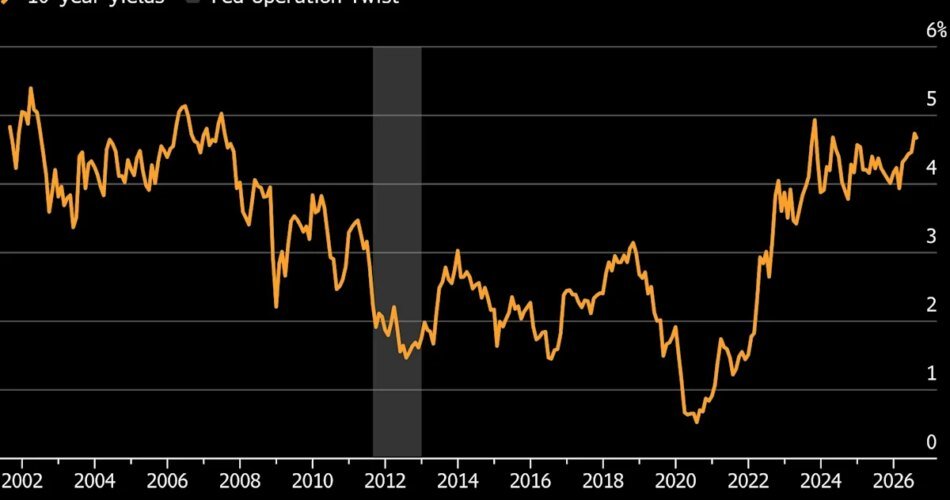
(Bloomberg) — The Trump administration’s surprise move to ramp up buybacks of long-dated Treasuries is drawing parallels with the Federal Reserve’s “Operation Twist,” a strategy that was last deployed in 2011 to pull down bond yields.
Most Read from Bloomberg
Back then, even after the Fed had slashed short-term interest rates to help resuscitate the economy from the Great Recession, longer-term Treasury rates remained stubbornly elevated — offsetting the central bank’s efforts by holding up the cost of all types of loans.
Now, the economy is in far better shape. But the steady bond-market selloff since the start of the US war on Iran has pushed long-term Treasury yields to the highest since 2007, vexing officials by driving up the government’s borrowing costs and squeezing Americans with even higher interest bills just ahead of the November Congressional elections.
US Treasury Secretary Scott Bessent — who has held out the level of 10-year yields as a benchmark of the administration’s success — swooped in on Wednesday to try to nudge the market the other way by announcing that his department would “at least” double buybacks of bonds maturing from 10 to 30 years.
It did the trick, at least temporarily, by pulling down 30-year yields by as much as 10 basis points to 5.18%, before paring the decline. Ten-year yields dropped 5 basis points to 4.66%.
Deutsche Bank’s strategists saw echoes of the Fed’s post-recession playbook in the move.
“Operation Twist is here,” George Saravelos, a strategist at Deutsche Bank, wrote in a note. He described the approach as effectively a “soft form of financial repression.”
Bessent has already shifted to covering more of the nearly $2 trillion annual deficit with sales of shorter-dated Treasury bills, taking some pressure off of longer-term rates.
The department’s recent guidance fueled speculation he could accelerate that by scaling back the size of some bond sales outright. And his decision to help prop up the yen was seen as a way to keep the Japanese authorities from dumping Treasuries to get the dollars they needed, which could have worsened the rout by raising the specter of more sales by the nation’s biggest foreign creditor.
Federal housing officials have also waded into the mortgage-bond market in a bid to lower rates there, only to see them keep moving the other way.
There was no single catalyst behind the steady rise in Treasury yields over the past few months. Angst about the ever-rising national debt, above-target inflation, and the flood of corporate-bond sales for artificial intelligence have all played a role.
So have doubts about Kevin Warsh. He was was elevated to the post of Fed chairman in May by President Donald Trump, who repeatedly attacked Warsh’s predecessor for not cutting rates more deeply, fanning worries about the central bank’s continued independence.
In 2011, the Fed was already trying to stimulate the economy instead of worrying about inflation, the dominant concern now.
But the US recovery was faltering, the European debt crisis was raging, and the central bank’s benchmark rate was already near zero. So the Fed sold bills and used the proceeds to buy longer-dated debt, a move aimed at driving down long-term borrowing costs.
It wasn’t the first time. The tactic had been used in 1961. At the time, the Kennedy administration wanted to support a weak economy by lowering long-term borrowing costs without cutting short-term rates, which risked accelerating outflows of gold, since the dollar’s value was pegged to the metal. Its name was a nod to the dance craze sweeping the country.
The Treasury didn’t say how it would fund the purchases on Wednesday. But most analysts said it would entail issuing more short-term bills, effectively replacing some of the long-dated debt with shorter maturities.
Barclays strategists estimate the buyback increase amounts to roughly $16 billion of additional purchases a quarter, or $64 billion a year — equivalent to about 15% of the current annual supply of 20- and 30-year bonds.
In 2024, Bessent criticized the Biden administration for relying on short-term debt sales, saying it was an effort to artificially stimulate the economy ahead of the election. Once in office, Bessent initially said Trump’s plans would pull down longer-term rates by taming federal spending and inflation. Yet the administration has done neither and the 10-year yield is now higher than it was when Trump returned to the White House.
Evercore economists Krishna Guha and Marco Casiraghi described the Treasury’s move as a “very small-scale Operation Twist” and warned that it could even backfire if its limited firepower fails to produce a sustained impact.
“The operation changes almost nothing in terms of the fundamentals,” they wrote.
Most Read from Bloomberg Businessweek
©2026 Bloomberg L.P.