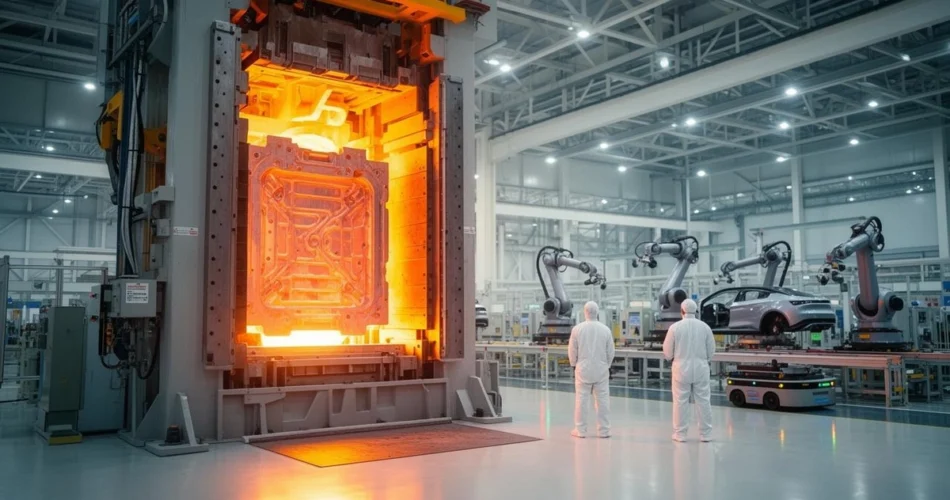
Toyota Motor (7203.T) will begin production of its next-generation electric vehicles (EVs) in China in fall 2027. The vehicles are planned to be sold as sport utility vehicles (SUVs) under the Lexus luxury brand, and will adopt “gigacasting,” a new method that uses aluminum casting to mold the vehicle body in a single piece. As the primary battleground for EV competition shifts to China, Toyota aims to quickly incorporate local advanced technologies and components to strengthen its competitiveness in the global market.
According to a Nikkei report published on the 28th, the company will begin mass production of next-generation EVs in China. Production will start at approximately 1,000 units per month in the first year, with plans to scale up to tens of thousands of units annually from 2028 onward.
China, which will serve as the production base for next-generation EVs, has a dense concentration of suppliers for batteries, electric powertrains, and smart cockpit-related components. Toyota is expected to leverage the local supply chain to simultaneously shorten development timelines and secure cost competitiveness.
The EV market’s center of gravity shifts to China
According to estimates from UK-based research firm GlobalData, China accounted for 8.57 million units—approximately 60%—of global EV sales in 2025. That is roughly three times the volume of Europe and more than 100 times that of Japan. The firm projects China’s EV sales will reach 11.41 million units by 2030.
| Region | 2025 EV Sales (est.) | Global Share |
|---|---|---|
| China | 8.57 million units | ~60% |
| Europe | ~2.86 million units | ~20% |
| Japan | Under 80,000 units | Under 1% |
Note: Europe and Japan figures are approximations based on GlobalData estimates, calculated from the description that China’s volume is “roughly three times Europe’s and more than 100 times Japan’s.”
While EV demand faces headwinds in Japan, Europe, and the U.S., the Chinese market continues to expand, driven by subsidy policies and the price competitiveness of local manufacturers. Toyota’s decision to begin production first in China reflects this structural shift in the market.
Production innovation through gigacasting adoption
The next-generation EVs will introduce a method called “gigacasting,” which uses aluminum casting to mold vehicle body components in a single piece. By using large-scale casting machines to form body structures that were traditionally assembled by welding and joining multiple steel plate components, the number of parts and manufacturing processes can be dramatically reduced.
This method was pioneered by U.S.-based Tesla and is known for achieving both lower production costs and improved body rigidity. Toyota has been validating the production technology primarily at its domestic plants in Japan, but implementing it in China will accelerate the accumulation of mass-production know-how.
The company has already announced plans to begin operations at its first Lexus production plant in China in Shanghai in 2026, and next-generation EV production is highly likely to be centered around this new facility. Lexus EVs produced in China are expected to target not only the local market but also exports, primarily to other Asian markets.
A stepping stone for global strategy
Toyota has announced plans to launch its first next-generation EV in 2026, and the fall 2027 China production represents the mass-production phase of that rollout. The company has set a target of selling 3.5 million EVs annually by 2030, and securing production capacity in China is a prerequisite for achieving that goal.
In China’s EV market, local manufacturers such as BYD and Geely are expanding their market share on the strength of price competitiveness. Toyota’s strategy is to differentiate itself from local players by combining the high-value-added positioning of the Lexus brand with cost reductions enabled by gigacasting.
The technologies and procurement networks cultivated through initial production in China are expected to eventually be deployed to plants in Japan and the U.S. The aim is to feed the insights gained in China—the epicenter of EV competition—back into the global production system, elevating the entire development and production cycle for next-generation vehicles.
Source link
Author

- Ytv Market News
- Share-market news writer and analyst with deep experience covering equities, commodities, forex, and cryptocurrencies for readers in the USA, UK, Canada, and Australia. Ytv Market News delivers timely market updates, practical trading insights, and clear explanations of macro and company-level catalysts that move prices. Combines on-the-ground financial reporting with technical analysis, using concise charts and actionable ideas to help investors and traders make smarter decisions.
Latest entries
 Investing InsightsAugust 28, 2026Nvidia mesmerizes markets: is it too early to doubt the AI bull market?
 Credit Cards USAAugust 28, 2026Chase Cardholders Can Score New Perks at Miami Heat Games
 UsaAugust 28, 2026Prediction: Applied Digital Stock Will Jump 156% in 3 Years. Here’s the Math.
 AustraliaAugust 28, 2026Buy, hold, sell: Ramsay Health Care, PLS Group, Woolworths shares