If you look closely at the last 150 years of stock market history, you’ll see a clear pattern: Periods of extremely high valuations are often followed by disappointing returns, some of which lead to outright crashes.
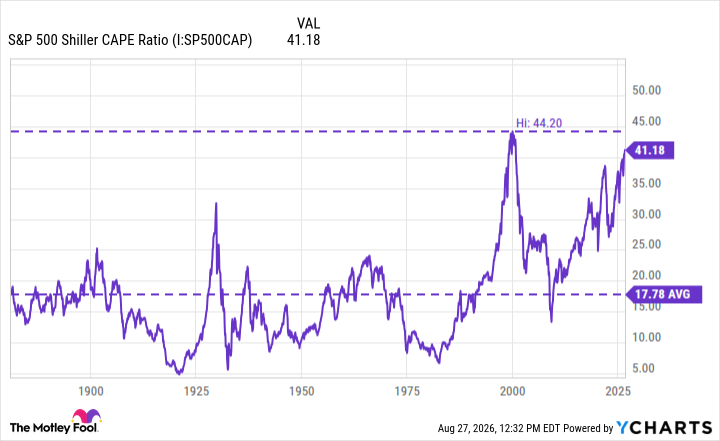
Right now, we’re living through one of the most expensive markets in history — the second most expensive, as measured by the Shiller cyclically adjusted price-to-earnings (P/E) ratio. Since the 1880s, the Shiller CAPE ratio has averaged about 18. At the time of writing, it had exceeded 41. Only once has the market been this expensive, and that was during the dot-com era.
Data by YCharts
What does a high Shiller CAPE ratio actually mean?
The Shiller CAPE ratio is a handy way of evaluating the S&P 500 (^GSPC -0.25%) based on the last decade of inflation-adjusted earnings. “Inflation-adjusted” is just a technical way of saying those earnings are converted into today’s dollars; it makes the comparison more apples-to-apples. Likewise, using a decade of data helps smooth out unusually strong or weak years, which offers a much clearer picture of the market’s underlying value.
Today’s Change
(-0.25%) -19.23
Index Level
7,711.76
Key Data Points
Day’s Range
7,700.91 – 7,771.48
52wk Range
6,316.91 – 7,816.70
Typically, a higher-than-average CAPE ratio is a strong signal that the market is expensive. Over the last 30 years, for instance, the average CAPE ratio has been about 29; today’s reading of about 41 is exceptionally high.

Image source: Getty Images.
What does an expensive market mean to investors?
An expensive market isn’t necessarily bad, nor does it imply that every stock within it is overpriced.
At the same time, high valuations often coincide with overly speculative periods. The speculative nature, which can detach concrete earnings from expectations, is what makes these markets particularly fearsome. Investors expect growth far into the future, leaving little breathing room for disappointment, and any threat to future profits can give the market the jitters, possibly even triggering a crash.
The dot-com crash is an example of this phenomenon. In the mid-to-late 1990s, investors were pouring money into little-known tech companies that had hardly any revenue or profits. At about the same time, the Federal Reserve started raising interest rates — three times in 1999, followed by three more in 2000.
The Nasdaq Composite (^IXIC -0.52%) peaked in March 2000. Then, a combination of higher interest rates and companies selling their own stock triggered panic. By October 2002, the tech-heavy Nasdaq index had fallen 78% from its peak.
Does history indicate a market crash is coming?
History suggests that the market could crash, but it’s impossible to predict when it could occur or how long the damage could last.
On the flip side, the stock market might not crash at all. It might correct itself, which is defined as a 10% drop from recent highs. There’s simply no telling what the market will do in the future. You might think you’re timing the market by selling now, only to miss the market’s best days.
If you’re worried about a stock market crash, it might be worth reviewing your portfolio to see if it’s properly diversified. A market pullback could hurt some industries more than others, and diversification could help limit the overall damage. You might also want to have some cash on hand in case a correction opens up buying opportunities.
Source link
Author

- Ytv Market News
- Share-market news writer and analyst with deep experience covering equities, commodities, forex, and cryptocurrencies for readers in the USA, UK, Canada, and Australia. Ytv Market News delivers timely market updates, practical trading insights, and clear explanations of macro and company-level catalysts that move prices. Combines on-the-ground financial reporting with technical analysis, using concise charts and actionable ideas to help investors and traders make smarter decisions.
Latest entries
 Politics News TodayAugust 30, 2026Dolly Parton laid to rest as niece shares emotional tribute to ‘Granny’
 Crypto NewsAugust 30, 2026Bitcoin Price Analysis: Is BTC Entering a Consolidation Phase After Its Explosive Rally?
 UsaAugust 30, 2026Should Eli Lilly Investors Be Worried About a Threat From Amylyx?
 Politics News TodayAugust 30, 2026Massive AI boom puts one of America’s oldest manufacturers on path to double in size, CEO says