

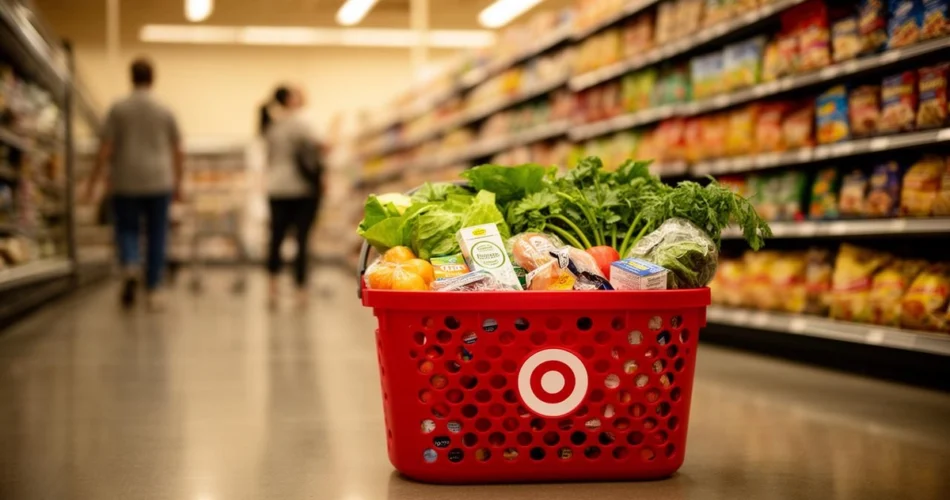
Target is betting that a cookbook can help turn its grocery aisles into a destination.
The retailer has published its first-ever cookbook built around Good & Gather, its flagship owned food and beverage brand, featuring 100 recipes developed in the company’s test kitchen. Every ingredient in the book is available at Target stores, a move executives see as more than a marketing gimmick.
The initiative is part of a broader push under CEO Michael Fiddelke to transform Good & Gather from a sprawling collection of store-brand products into a consumer brand shoppers actively seek out. The line, launched in 2019, spans fresh food, pantry staples, snacks, and beverages, and is on track to become a $4 billion owned brand, according to the company.
“We’re delivering an incredible amount of trend-right newness while also providing outstanding value across the entire portfolio,” Fiddelke said during the company’s second-quarter earnings call.
The cookbook strategy mirrors a playbook that has worked for warehouse retailers. Costco has long used its Kirkland Signature brand to build loyalty, and Walmart has turned its Great Value line into a massive traffic driver. Target is now trying to carve out similar territory.
Grocery gains momentum
The effort comes as Target’s food business shows its strongest performance in years. Food and beverage sales rose 7% in the quarter ended August 1, the category’s fastest growth in three years. Snack sales jumped 15%, driven by demand for protein bars and meat sticks.
Overall, the company reported net sales of $26.5 billion, up 5.3% from a year earlier. Comparable sales increased 3.8%, while digital comparable sales climbed 8.7%. Store traffic rose 3.6%.
Target has reworked the layout of nearly half of its center store grocery assortment, the largest food transition in more than a decade. The company added more fresh produce, expanded snacks and global foods, and introduced functional coffee.
The retailer plans to expand its private-label food lineup by roughly 600 products over the next two years, including 400 under Good & Gather. Executives expect these efforts to generate more than $2 billion in growth over the next few years.
The logic is straightforward: grocery is purchased far more frequently than discretionary merchandise. If customers come in for milk, snacks, or other essentials, they may also buy higher-margin products in beauty, apparel, and home goods.
Beyond the pantry
Signs of improvement extend beyond food. Target’s Fun 101 business, which covers toys, electronics, and entertainment, grew 10.6%. Beauty sales increased about 7%. The company has reallocated space that once went to TVs and bikes toward wearable tech, LEGO sets, and trading cards. LEGO sales climbed more than 30% year over year, while plush toy sales rose more than 20%.
Target’s own $10 headphones under its Heyday electronics line saw sales jump more than 35%. Much of the appeal, executives say, comes down to price points at $5, $10, $15, and $20.
The company has lowered prices on more than 10,000 items over the past 12 months. Fiddelke said 95% of the school supply assortment is priced at or below last year’s levels heading into back-to-school season.
“Over the past year alone, we’ve lowered prices on more than 10,000 items, reinforcing our commitment to ensuring families can find a unique combination of style, quality, and affordability every time they shop with us,” he said.
Inventory reliability has also improved. COO Lisa Roath said the company’s most frequently purchased items now have the strongest availability in recent years. Target is using a new digital tool called Proxima to test inventory flow between warehouses and stores before changes go live. The company fulfilled nearly 30% more same-day and next-day online orders this quarter compared to last year.
CFO Jim Lee noted that gross margin, excluding a one-time tariff refund benefit, was still about one percentage point higher than last year.
The Walmart gap
Despite the progress, Target remains a distant second in U.S. grocery. Food accounts for less than a quarter of Target’s merchandise sales, compared with 59% for Walmart. Target held about 5% of the U.S. grocery market at the end of 2025, versus Walmart’s 27%.
Grocery is also a low-margin business. Strong food sales alone will not transform earnings. The strategy only works if customers who visit for groceries also spend on more profitable merchandise elsewhere in the store.
Apparel and home furnishings, two of Target’s most important discretionary categories, were roughly flat in the quarter. Executives called both a multi-year project. A new Target Beauty Studio format is set to launch in more than 600 stores next month, and larger changes to bedding, bath, and kids’ home are planned for the back half of the year.
Some analysts have cautioned that the recent improvement may be partly a temporary boost from refreshed stores, new products, and better merchandising, effects that can moderate after a few quarters.
Outlook raised
Target raised its full-year forecast again. Net sales growth is now expected around 5%, up from the prior forecast. Adjusted earnings per share guidance moved up to a range of $9.90 to $10.90, which includes a one-time tariff refund benefit.
Target stock has surged more than 70% over the last 12 months, giving the company a market capitalization of about $77 billion. The shares trade at 17.7 times forward earnings, above the 10-year average of 15.9 times.
Among 28 analysts covering the stock, 12 recommend Buy, 14 recommend Hold, and two recommend Sell. The average price target is $166, marginally above current trading levels.
The upcoming back-to-school and holiday periods will provide a clearer test of whether the grocery-led turnaround has staying power. If customers who come in for Good & Gather products also fill their baskets with beauty, apparel, and home goods, the cookbook may prove to be more than a novelty.
Source link
Author

- Ytv Market News
- Share-market news writer and analyst with deep experience covering equities, commodities, forex, and cryptocurrencies for readers in the USA, UK, Canada, and Australia. Ytv Market News delivers timely market updates, practical trading insights, and clear explanations of macro and company-level catalysts that move prices. Combines on-the-ground financial reporting with technical analysis, using concise charts and actionable ideas to help investors and traders make smarter decisions.
Latest entries
 Crypto NewsAugust 28, 2026Strive’s SATA may fund 1,192 BTC purchases this week
 Politics News TodayAugust 28, 2026Raquel Lee Bolleau claims Disney sexual abuse on ‘The Poof Point’ set
 Market Movers TodayAugust 28, 2026Ulta (ULTA) Stock Trades Down, Here Is Why
 Forex NewsAugust 28, 2026South Korean Won: Strong exports support KRW and KOSPI – DBS

