
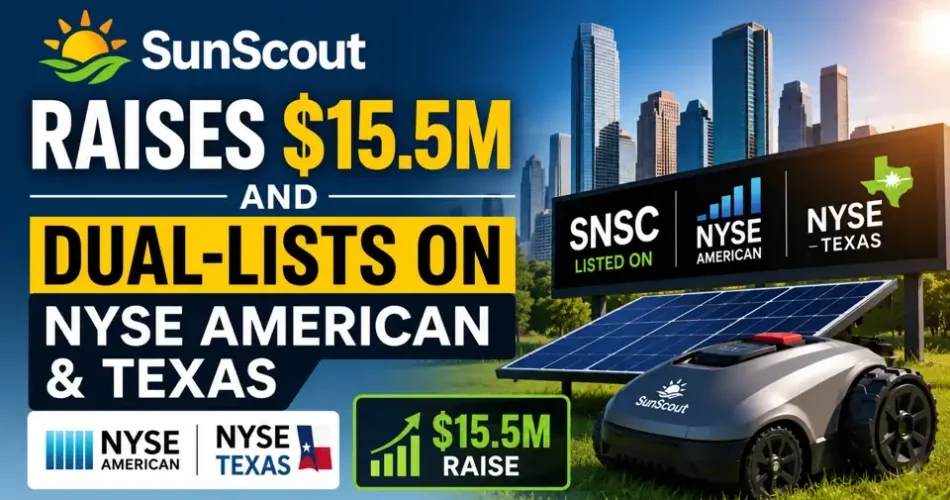
SunScout Dual-Lists on NYSE American & Texas After $15.5M Raise
SunScout Holding Limited has entered the U.S. public markets with a major step in its expansion strategy, raising approximately US$15.5 million through an initial public offering and securing a dual listing on the NYSE American and NYSE Texas. The New Zealand-based clean-technology company began trading under the ticker SNSC on August 12, 2026.
The listing gives SunScout access to U.S. capital markets at a time when interest in robotics, renewable energy and domestic manufacturing remains strong. More importantly, the company intends to use a significant portion of its new capital to establish manufacturing operations in Texas, bringing its technology closer to the large North American market it hopes to serve.
SunScout Raises $15.5 Million in U.S. IPO
SunScout priced its IPO at $5 per Class A ordinary share. The offering consisted of 3.1 million Class A shares, generating approximately $15.5 million in gross proceeds before underwriting discounts and other expenses.
The company’s shares were approved for simultaneous trading on NYSE American and NYSE Texas. SunScout’s market debut represents an important milestone for a company that has built its business around solar-powered robotic mowing technology and other clean-energy solutions.
The company also granted its underwriters an option to purchase as many as 465,000 additional Class A shares within 45 days of the offering’s closing. If fully exercised, that option could provide additional capital, although the extra shares are not part of the base $15.5 million offering.
What the IPO Means for SunScout
For SunScout, becoming publicly traded is about more than raising money. The company is seeking to expand its manufacturing footprint, increase product development, strengthen marketing and establish a larger presence in the United States.
Public-market access could also provide the company with another source of financing as it develops its technology and pursues new commercial opportunities.
Solar-Powered Robotic Mowers Are at the Center of the Business
SunScout focuses on autonomous robotic mowing systems designed to operate using solar power. Its technology combines robotic navigation with solar energy, allowing its machines to reduce reliance on conventional electrical charging infrastructure.
The company markets multiple robotic mower models, including the Eco, Pro and ProMax lines. Its products are aimed at consumers and commercial users looking for automated lawn-care solutions with lower ongoing energy requirements.
SunScout says its technology incorporates artificial intelligence and deployable solar-array technology. The concept is designed to allow robotic equipment to operate independently from the electrical grid in suitable environments.
Why Solar Robotics Could Be an Attractive Market
The combination of robotics and renewable energy gives SunScout exposure to two growing technology themes. Robotic equipment can potentially reduce manual labor requirements, while solar power can lower dependence on traditional energy sources.
However, the company’s future success will depend on factors such as product reliability, manufacturing costs, consumer adoption, competition and its ability to expand distribution.
Texas Becomes a Key Part of the Expansion Plan
One of the most significant elements of SunScout’s IPO strategy is its planned manufacturing operation in Texas. The company has announced plans to establish a facility in the Austin-area market, supporting production and expansion across North America.
Local economic-development information indicates that SunScout plans to establish manufacturing operations in Buda, Texas, in the Austin region. The project is expected to expand the company’s U.S. footprint and create approximately 50 technical, management and production positions.
The Texas operation could become strategically important as SunScout attempts to move closer to its customers and build a more localized supply chain.
Why Texas Matters
Texas has developed a strong reputation as a destination for manufacturing, technology companies and renewable-energy investment. Establishing operations in the Austin area could give SunScout access to transportation infrastructure, a technology-oriented workforce and a growing regional business ecosystem.
For a New Zealand company entering the U.S. market, a physical manufacturing presence could also help demonstrate its long-term commitment to North American expansion.
How SunScout Plans to Use the IPO Proceeds
The company’s newly raised capital is expected to support several areas of its growth strategy. The planned uses include the Texas manufacturing facility, marketing and promotional campaigns, product development and inventory.
SunScout also expects to use part of the proceeds for repayment of a loan, payments associated with the acquisition of Brightway Energy LLC and general working capital.
This allocation gives the company flexibility to invest in both physical expansion and its broader operating platform. The manufacturing investment, in particular, could determine how quickly SunScout can increase production capacity.
Investment in Product Development
Research and development will remain another important area for the company. The robotic-mowing market is competitive, and manufacturers must continually improve navigation, battery and solar technology, automation and user experience.
Additional capital could allow SunScout to refine its existing products while exploring new applications for solar-powered autonomous equipment.
SunScout’s Financial Growth Before the Listing
SunScout entered the public markets after reporting significant revenue growth in its fiscal year ended June 30, 2025. Revenue was approximately $4.8 million, representing a reported increase of 93.6% from the previous year.
The company’s product business also became a larger contributor to overall revenue. According to information released around the IPO, products accounted for approximately 28% of total revenue, compared with 18.5% in the prior period.
Gross profit for the fiscal year was approximately $2.4 million.
These figures suggest that the company was expanding before its public-market debut. Nevertheless, investors will need to watch future filings closely to determine whether revenue growth can continue at scale and whether increased manufacturing and marketing expenses translate into stronger profitability.
What Investors Should Watch After the IPO
SunScout’s debut creates both opportunities and risks for investors. One of the biggest questions will be whether the company can turn its relatively small existing revenue base into a larger commercial operation.
Manufacturing Execution
The Texas facility will be a major test. Construction, equipment installation, staffing and production ramp-up can require substantial capital and time. Delays or cost overruns could affect the company’s financial performance.
U.S. Market Adoption
SunScout is also seeking wider distribution in the United States. The company has distribution relationships involving WWS and MowBot and has indicated that discussions with Walmart are underway.
Securing additional retail and commercial channels could significantly increase product visibility, but negotiations do not guarantee future sales.
Competition in Robotics
The robotic lawn-care market includes established manufacturers as well as newer technology companies. SunScout will therefore need to demonstrate that its solar-powered approach offers meaningful advantages in convenience, operating costs, reliability or environmental performance.
SunScout’s Broader Clean-Tech Ambitions
Although robotic mowers are central to SunScout’s public-market story, the company also operates in other areas of solar energy and engineering. Its activities include solar power development and precision manufacturing through Brunton Engineering.
Brunton Engineering has been described as a certified supplier to the New Zealand Defence Force, giving the group an additional engineering and manufacturing capability beyond consumer robotics.
This diversification could provide opportunities over time, although it also means investors should evaluate the company’s different business segments separately when assessing its growth prospects.
Why the Dual Listing Is Significant
SunScout’s simultaneous listing on NYSE American and NYSE Texas gives the company an unusual profile among newly public businesses. The NYSE American platform is commonly associated with smaller and growing companies, while NYSE Texas is part of the New York Stock Exchange’s newer Texas-focused market initiative.
The dual-market structure is closely aligned with SunScout’s broader U.S. strategy. The company is not only raising money from American investors but also planning to build manufacturing capacity in Texas.
For investors, however, the listing itself should not be viewed as evidence of future performance. The company’s ability to execute its expansion plan, grow revenue and manage cash will ultimately determine its investment case.
What Comes Next for SNSC?
SunScout now faces the challenge of turning its IPO capital into sustainable growth. The next stages will include advancing its Texas manufacturing plans, increasing product availability, expanding its customer base and continuing technology development.
The company will also need to manage the financial demands associated with being publicly traded while building an international business.
If SunScout can successfully combine its solar technology with scalable robotic products, the company could establish a distinctive position in the clean-tech and outdoor-automation markets. If adoption develops more slowly than expected, however, investors could face considerable volatility given the company’s relatively early stage.
Frequently Asked Questions
What is SunScout’s stock ticker?
SunScout Holding Limited trades under the ticker symbol SNSC.
How much did SunScout raise in its IPO?
SunScout raised approximately $15.5 million in gross proceeds by selling 3.1 million Class A ordinary shares at $5 each, before applicable expenses and underwriting discounts.
Where is SunScout listed?
SunScout’s Class A ordinary shares were approved for dual listing on NYSE American and NYSE Texas.
What does SunScout make?
SunScout develops autonomous, solar-powered robotic mowers and related solar-energy solutions. Its mower lineup includes Eco, Pro and ProMax models.
What will SunScout do with the IPO money?
The company plans to allocate the proceeds toward a Texas manufacturing facility, marketing, product development, inventory, loan repayment, an acquisition-related payment and general working capital.
Where will SunScout’s U.S. manufacturing facility be located?
SunScout plans to establish manufacturing operations in the Austin-area community of Buda, Texas.
Does SunScout have an additional share option?
Yes. Underwriters received an option to purchase up to 465,000 additional Class A ordinary shares within 45 days after the offering’s closing, subject to the terms of the option.
Final Takeaway
SunScout’s $15.5 million IPO marks a significant transition for the New Zealand clean-technology company. Its simultaneous NYSE American and NYSE Texas listing gives it a U.S. public-market presence while its planned Texas manufacturing operation provides a foundation for North American expansion.
The company’s solar-powered robotic mowers place it at the intersection of renewable energy and automation, two markets with long-term growth potential. At the same time, investors should remember that SunScout remains a developing business, and execution will be critical.
The company’s ability to successfully establish its Texas operation, expand distribution, increase production and convert technology investments into sustained revenue growth will likely determine whether the IPO becomes a launchpad for a larger clean-tech business.
Source information was cross-checked against recent public reporting and company-related IPO disclosures. This article is independently written and does not reproduce the wording of the source material.